
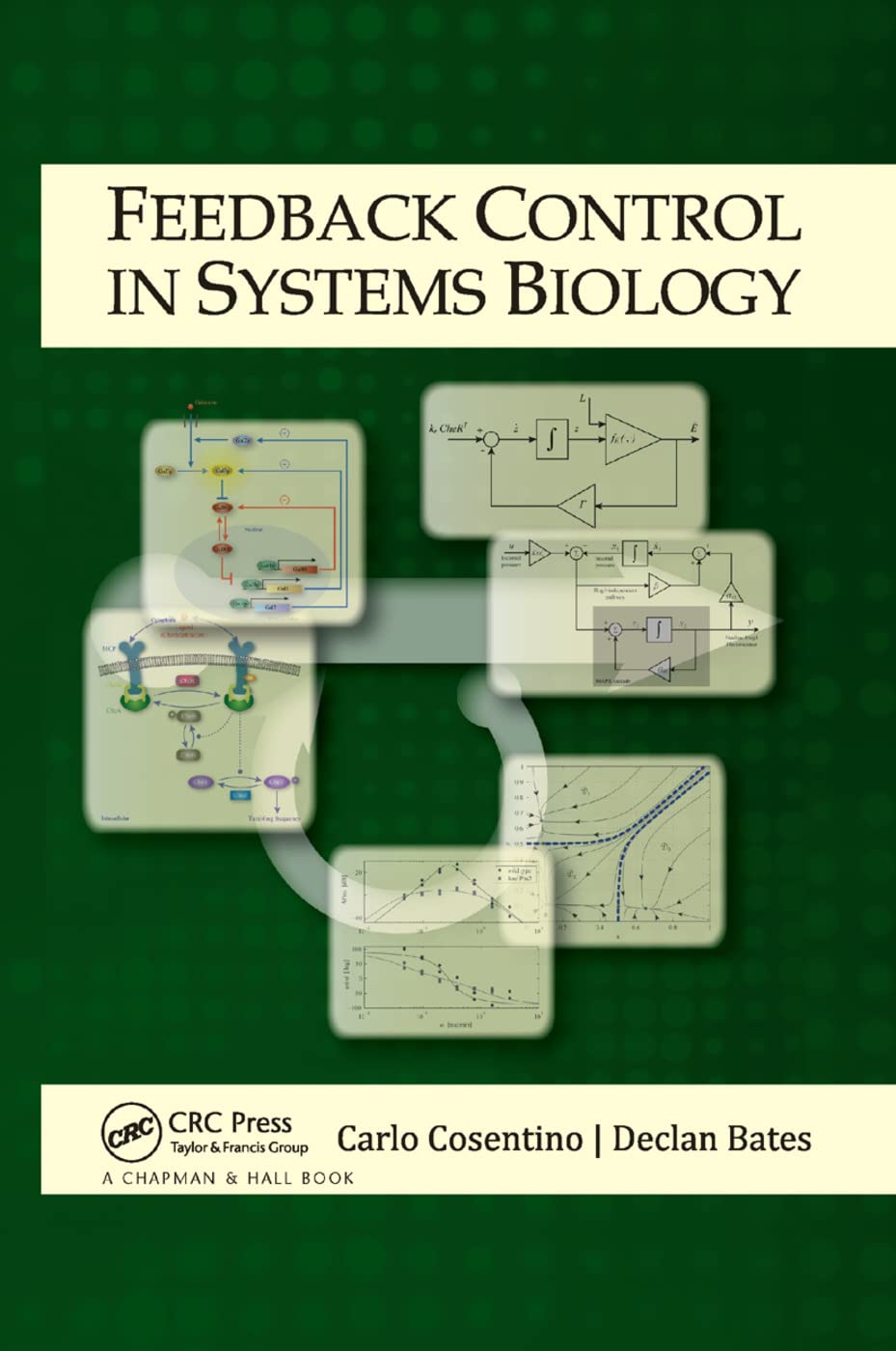
Title
Feedback Control in Systems Biology,New
Sold by Ergodebooks, an authorized reseller.
Returns accepted within 30 days | support@ergodebooks.com
Shipping Information
- Free Standard Shipping — United States only
- Processing Time: 3–5 business days
- Estimated Delivery: 6–10 business days after dispatch
- Double-boxed, fully insured & discreetly packaged
- Tracking number sent via email once dispatched
Returns & Refund
Returns accepted within 30 days of delivery.
Damaged or Defective Item
Free return shipping + replacement or full refund
Wrong Item Received
Free return shipping + replacement or full refund
Change of Mind
Return shipping at customer's expense · 25% restocking fee applies
Payment Option

Like engineering systems, biological systems must also operate effectively in the presence of internal and external uncertaintysuch as genetic mutations or temperature changes, for example. It is not surprising, then, that evolution has resulted in the widespread use of feedback, and research in systems biology over the past decade has shown that feedback control systems are widely found in biology. As an increasing number of researchers in the life sciences become interested in controltheoretic ideas such as feedback, stability, noise and disturbance attenuation, and robustness, there is a need for a text that explains feedback control as it applies to biological systems.Written by established researchers in both control engineering and systems biology, Feedback Control in Systems Biology explains how feedback control concepts can be applied to systems biology. Filling the need for a text on control theory for systems biologists, it provides an overview of relevant ideas and methods from control engineering and illustrates their application to the analysis of biological systems with case studies in cellular and molecular biology.Control Theory for Systems BiologistsThe book focuses on the fundamental concepts used to analyze the effects of feedback in biological control systems, rather than the control system design methods that form the core of most control textbooks. In addition, the authors do not assume that readers are familiar with control theory. They focus on 'control applications' such as metabolic and generegulatory networks rather than aircraft, robots, or engines, and on mathematical models derived from classical reaction kinetics rather than classical mechanics. Another significant feature of the book is that it discusses nonlinear systems, an understanding of which is crucial for systems biologists because of the highly nonlinear nature of
⚠️ WARNING (California Proposition 65):
This product may contain chemicals known to the State of California to cause cancer, birth defects, or other reproductive harm.
For more information, please visit www.P65Warnings.ca.gov.