
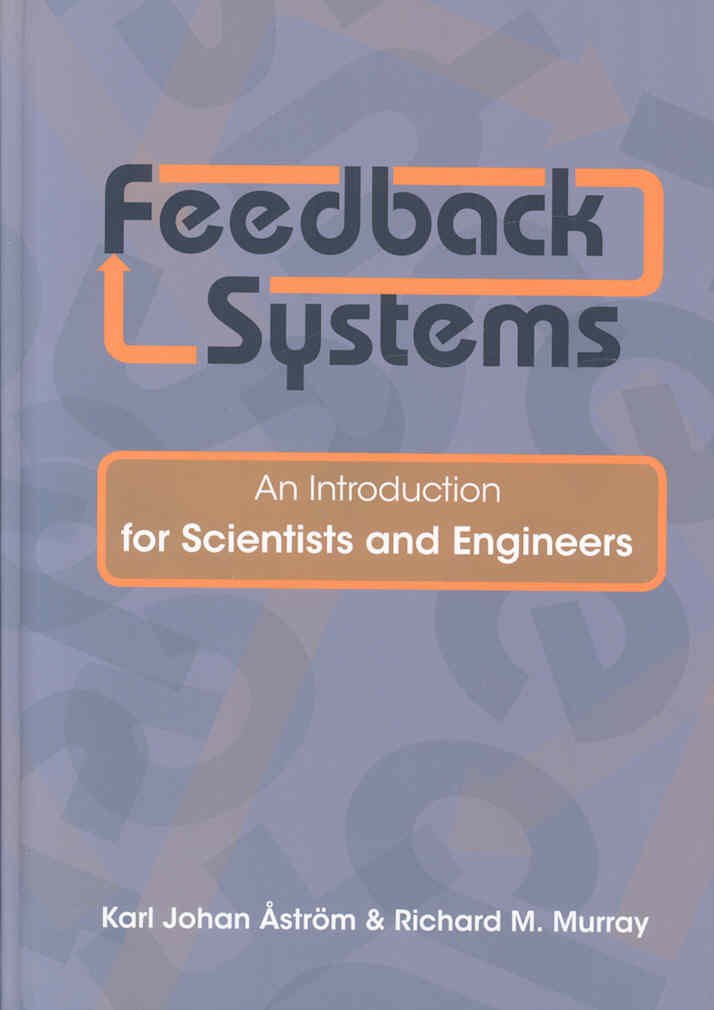
Title
Feedback Systems: An Introduction for Scientists and Engineers,Used
Sold by Ergodebooks, an authorized reseller.
Returns accepted within 30 days | support@ergodebooks.com
Shipping Information
- Free Standard Shipping — United States only
- Processing Time: 3–5 business days
- Estimated Delivery: 6–10 business days after dispatch
- Double-boxed, fully insured & discreetly packaged
- Tracking number sent via email once dispatched
Returns & Refund
Returns accepted within 30 days of delivery.
Damaged or Defective Item
Free return shipping + replacement or full refund
Wrong Item Received
Free return shipping + replacement or full refund
Change of Mind
Return shipping at customer's expense · 25% restocking fee applies
Payment Option

This book provides an introduction to the mathematics needed to model, analyze, and design feedback systems. It is an ideal textbook for undergraduate and graduate students, and is indispensable for researchers seeking a selfcontained reference on control theory. Unlike most books on the subject, Feedback Systems develops transfer functions through the exponential response of a system, and is accessible across a range of disciplines that utilize feedback in physical, biological, information, and economic systems.Karl strm and Richard Murray use techniques from physics, computer science, and operations research to introduce controloriented modeling. They begin with state space tools for analysis and design, including stability of solutions, Lyapunov functions, reachability, state feedback observability, and estimators. The matrix exponential plays a central role in the analysis of linear control systems, allowing a concise development of many of the key concepts for this class of models. strm and Murray then develop and explain tools in the frequency domain, including transfer functions, Nyquist analysis, PID control, frequency domain design, and robustness. They provide exercises at the end of every chapter, and an accompanying electronic solutions manual is available. Feedback Systems is a complete onevolume resource for students and researchers in mathematics, engineering, and the sciences.Covers the mathematics needed to model, analyze, and design feedback systems Serves as an introductory textbook for students and a selfcontained resource for researchers Includes exercises at the end of every chapter Features an electronic solutions manual Offers techniques applicable across a range of disciplines
⚠️ WARNING (California Proposition 65):
This product may contain chemicals known to the State of California to cause cancer, birth defects, or other reproductive harm.
For more information, please visit www.P65Warnings.ca.gov.
- Q: What is the main focus of 'Feedback Systems: An Introduction for Scientists and Engineers'? A: The book primarily focuses on the mathematics required to model, analyze, and design feedback systems, making it suitable for both undergraduate and graduate students as well as researchers.
- Q: Who are the authors of this book? A: The book is authored by Karl Johan Åström and Richard Murray, both of whom are recognized experts in the field of control theory.
- Q: What is the condition of the book being offered? A: The book is listed as a used book in good condition, indicating that it may show some signs of wear but is still functional and readable.
- Q: What are some key topics covered in the book? A: Key topics include state space tools for analysis, stability of solutions, Lyapunov functions, transfer functions, Nyquist analysis, PID control, and frequency domain design.
- Q: Does the book include exercises or problem sets? A: Yes, 'Feedback Systems' includes exercises at the end of every chapter to reinforce learning and understanding of the material.
- Q: Is there a solutions manual available for this book? A: Yes, there is an accompanying electronic solutions manual available to assist students with the exercises provided in the book.
- Q: What disciplines can benefit from the concepts discussed in this book? A: The book's concepts are applicable across a range of disciplines, including physical sciences, biological sciences, information systems, and economics.
- Q: What is the binding type of the book? A: The book is available in hardcover binding, which provides durability and protection for frequent use.
- Q: How many pages does 'Feedback Systems' contain? A: The book contains a total of 408 pages, making it a comprehensive resource on feedback systems.
- Q: When was 'Feedback Systems' published? A: The book was published on April 21, 2008.