
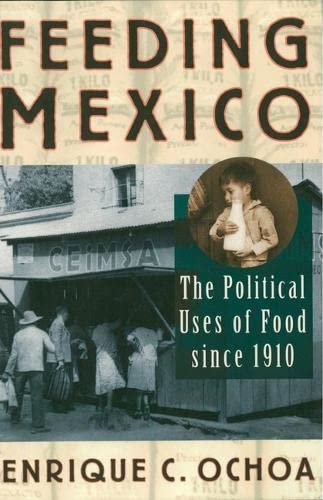
Title

Feeding Mexico: The Political Uses Of Food Since 1910
Sold by Ergodebooks, an authorized reseller.
Returns accepted within 30 days | support@ergodebooks.com
Shipping Information
- Free Standard Shipping — United States only
- Processing Time: 3–5 business days
- Estimated Delivery: 6–10 business days after dispatch
- Double-boxed, fully insured & discreetly packaged
- Tracking number sent via email once dispatched
Returns & Refund
Returns accepted within 30 days of delivery.
Damaged or Defective Item
Free return shipping + replacement or full refund
Wrong Item Received
Free return shipping + replacement or full refund
Change of Mind
Return shipping at customer's expense · 25% restocking fee applies
Payment Option

Winner Of The 1998 Michael C. Meyer Manuscript Prize!Feeding Mexico: The Political Uses Of Food Since 1910 Traces The Mexican Government'S Intervention In The Regulation, Production, And Distribution Of Food From The Days Of Cardenas To The Recent Privatization Inspired By Nafta. Professor Ochoa Argues That The Real Goals Of The Government'S Food Subsidies Were Political, Driven By Presidential Desires To Court Urban Labor. Many Of The Agencies And Policies Were Hastily Set In Place In Response To Shortterm Political Or Economic Crises. Since The Goals Were Not To Alleviate Poverty, But To Provide Modest Subsidies To Urban Consumers, The Policies Did Not Eliminate Destitution Or Malnutrition In The Country. Despite The Minimal Achievements Of These Interventionist Policies, The State Food Agency Provided A Symbol Of The State'S Concern For The Workers. The Elimination Of The Agency In The 1990S Prompted Social Protest And Unrest. Feeding Mexico Is The First Study To Examine The Creation Of Networks To Deliver Food Products, The Relationship Of These Channels Of Distribution To The Food Crisis, And The Role Of The State In Trying To Ameliorate The Problem. Based On Exhaustive Research Of New Archival Material And Richly Documented With Statistical Tables, This Book Exposes The Dynamics And Outcome Of Social Policy In Twentiethcentury Mexico.
⚠️ WARNING (California Proposition 65):
This product may contain chemicals known to the State of California to cause cancer, birth defects, or other reproductive harm.
For more information, please visit www.P65Warnings.ca.gov.
- Q: What is the page count of this book? A: This book has two hundred sixty-seven pages. It provides an in-depth examination of the political uses of food in Mexico.
- Q: What are the dimensions of 'Feeding Mexico'? A: The dimensions of the book are six point twenty-two inches in length, zero point seventy-nine inches in width, and nine point zero two inches in height.
- Q: What type of binding does this book have? A: This book is paperback bound. Paperback binding is flexible and lightweight, making it easy to handle.
- Q: Who is the author of 'Feeding Mexico'? A: The author is Enrique C. Ochoa. He explores the intersection of politics and food in Mexico over the last century.
- Q: What is the main focus of 'Feeding Mexico'? A: The book focuses on the Mexican government's intervention in food regulation and distribution since nineteen ten. It highlights the political motivations behind food subsidies and policies.
- Q: Is this book suitable for academic research? A: Yes, this book is suitable for academic research. It is based on exhaustive research and includes new archival material and statistical tables.
- Q: How does the book address food crisis in Mexico? A: The book examines the creation of distribution networks and the state's role in addressing food crises. It provides insights into the dynamics of social policy.
- Q: What historical context does this book cover? A: The book covers the historical context from the days of Cardenas to the recent privatization influenced by NAFTA. It provides a comprehensive overview of political developments.
- Q: Does the book discuss the impact of food policies on poverty? A: Yes, the book discusses how food policies aimed at urban labor did not effectively alleviate poverty or malnutrition. It critiques the government's approach.
- Q: What accolades has 'Feeding Mexico' received? A: This book won the Michael C. Meyer Manuscript Prize in nineteen ninety-eight. This award recognizes outstanding scholarly work.
- Q: How can I care for this used book? A: To care for this used book, store it in a dry place away from direct sunlight. Avoid bending or damaging the pages to maintain its condition.
- Q: Is 'Feeding Mexico' appropriate for non-specialists? A: Yes, the book can be appreciated by non-specialists interested in Mexican history and food politics. It is written to be accessible to a broader audience.
- Q: What kind of research material is included in the book? A: The book includes new archival material and statistical tables. This comprehensive research supports the author's arguments about food policy.
- Q: What should I do if my book arrives damaged? A: If your book arrives damaged, contact the seller immediately for a return or exchange. Most sellers have policies in place for damaged goods.
- Q: Can this book be used in a college course? A: Yes, this book is suitable for use in college courses. It covers significant themes in political science, history, and sociology.
- Q: What are the notable themes discussed in the book? A: Notable themes include government intervention, social policy, and the political dimensions of food distribution. It critically analyzes the state's role in food crises.