
Title
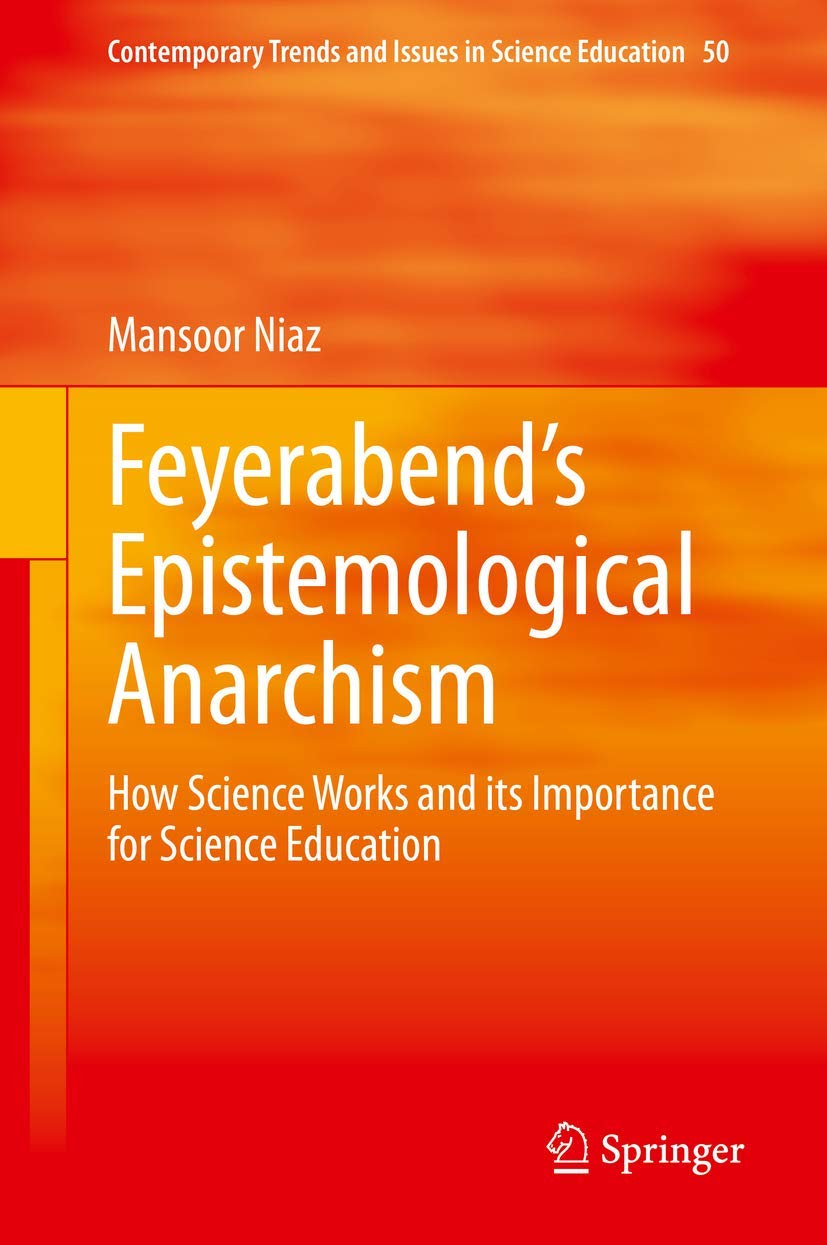
Feyerabends Epistemological Anarchism: How Science Works and its Importance for Science Education (Contemporary Trends and Issue,Used
Sold by Ergodebooks, an authorized reseller.
Returns accepted within 30 days | support@ergodebooks.com
Shipping Information
- Free Standard Shipping — United States only
- Processing Time: 3–5 business days
- Estimated Delivery: 6–10 business days after dispatch
- Double-boxed, fully insured & discreetly packaged
- Tracking number sent via email once dispatched
Returns & Refund
Returns accepted within 30 days of delivery.
Damaged or Defective Item
Free return shipping + replacement or full refund
Wrong Item Received
Free return shipping + replacement or full refund
Change of Mind
Return shipping at customer's expense · 25% restocking fee applies
Payment Option

This book argues that the traditional image of Feyerabend is erroneous and that, contrary to common belief, he was a great admirer of science. It shows how Feyerabend presented a vision of science that represented how science really works. Besides giving a theoretical framework based on Feyerabends philosophy of science, the book offers criteria that can help readers to evaluate and understand research reported in important international science education journals, with respect to Feyerabends epistemological anarchism. The book includes an evaluation of general chemistry and physics textbooks.Most science curricula and textbooks provide the following advice to students: Do not allow theories in contradiction with observations, and all scientific theories must be formulated inductively based on experimental facts. Feyerabend questioned this widely prevalent premise of science education in most parts of the world, and in contrast gave the following advice: Scientistscan accept a hypothesis despite experimental evidence to the contrary and scientific theories are not always consistent with all the experimental data. No wonder Feyerabend became a controversial philosopher and was considered to be against rationalism and antiscience. Recent research in philosophy of science, however, has shown that most of Feyerabends philosophical ideas are in agreement with recent trends in the 21st century. Of the 120 articles from science education journals, evaluated in this book only 9% recognized that Feyerabend was presenting a plurality of perspectives based on how science really works. Furthermore, it has been shown that Feyerabend could even be considered as a perspectival realist. Among other aspects, Feyerabend emphasized that in order to look for breakthroughs in science one does not have to be complacent about the truth of the theories but rather has to look for opportunities to break rules or violate categories.Mansoor Niaz carefully analyses references to Feyerabend in the literature and displays the importance of Feyerabends philosophy in analyzing, historical episodes. Niaz shows through this remarkable book a deep understanding to the essence of science. Calvin Kalman, Concordia University, CanadaIn this book Mansoor Niaz explores the antecedents, context and features of Feyerabends work and offers a morenuanced understanding, then reviews and considers its reception in the science education and philosophy of science literature. This is a valuable contribution to scholarship about Feyerabend, with the potential to inform further research as well as science education practice. David Geelan, Griffith University, Australia
⚠️ WARNING (California Proposition 65):
This product may contain chemicals known to the State of California to cause cancer, birth defects, or other reproductive harm.
For more information, please visit www.P65Warnings.ca.gov.