
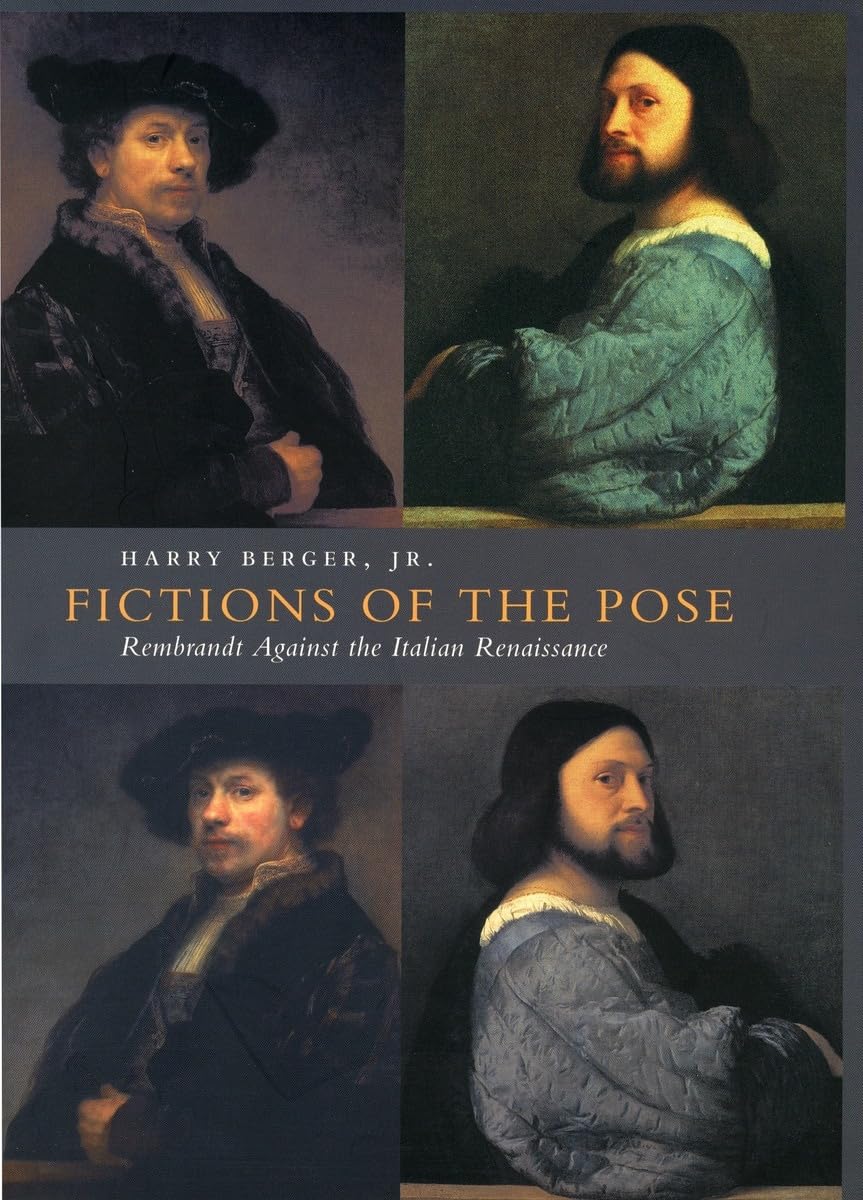
Title
Fictions Of The Pose: Rembrandt Against The Italian Renaissance
Sold by Ergodebooks, an authorized reseller.
Returns accepted within 30 days | support@ergodebooks.com
Shipping Information
- Free Standard Shipping — United States only
- Processing Time: 3–5 business days
- Estimated Delivery: 6–10 business days after dispatch
- Double-boxed, fully insured & discreetly packaged
- Tracking number sent via email once dispatched
Returns & Refund
Returns accepted within 30 days of delivery.
Damaged or Defective Item
Free return shipping + replacement or full refund
Wrong Item Received
Free return shipping + replacement or full refund
Change of Mind
Return shipping at customer's expense · 25% restocking fee applies
Payment Option

The Foundational Question This Book Explores Is: What Happens When Portraits Are Interpreted As Imitations Or Likenesses Not Only Of Individuals But Also Of Their Acts Of Posingwhen The Observer'S Attention Is Redirected So That The Primary Object The Portrait Imitates Becomes The Likeness Not Of A Person But Of An Act, The Act Of Sitting For One'S Portrait? This Shift Of Attention Involves Another: From The Painter'S To The Sitter'S Part In The Act Of (Self)Portrayal. At The Ground Level, Fictions Of The Pose Develops A Hypothesis About The Structure And Meaning Of Portraiture. That Foundation Supports A First Story Devoted To The Practices And Politics Of Early Modern Italian And Dutch Portraiture And A Second Story Devoted To Rembrandt'S Selfportraits, Especially Those In Which He Poses In Fancy Dress As If He Were A Patron. The Author Approaches The Rembrandt/Renaissance Relation Not As An Art Historian But As An Interpreter Trained In Literary Studies, Taunted By The Challenge Of Extending The Practice Of Close Reading From Verbal To Visual Media And Fascinated By The Way This Practice Can Show How Individual Works Talk Back To Their Contexts. The Context For Rembrandt, The Object And Target Of His Lookingglass Theater, Is The Structure Of Patron/Painter Relations That Developed During The Renaissance And Influenced The Very Different Conditions Of Patronage That Emerged In The Dutch Republic Around The Turn Of The Seventeenth Century. The Book Is In Four Parts. Parts One And Two Comprise An Interpretive Study Of The Technical And Sociopolitical Conditions Within Which Portraiture Becomes An Important If Problematic Medium Of Selfrepresentation In Early Modern Europe. The Major Portion Of These Two Sections Considers The Structure And The Consequences Of A System Of Practices And Conventions That Governs Poses In Commissioned Portraits. In Part Three The Scene Shifts From Italian To Dutch Portraiture. Part Four Is Devoted To Selfportraits By Rembrandt That Are Interpreted As Responses To The Conditions Depicted In The First Three Parts. Through A Series Of Close Readings Of Individual Works, The Author Demonstrates The Ironic, Polemical, And Political Force Of Rembrandt'S Selfportraits.
⚠️ WARNING (California Proposition 65):
This product may contain chemicals known to the State of California to cause cancer, birth defects, or other reproductive harm.
For more information, please visit www.P65Warnings.ca.gov.
- Q: How many pages does the book have? A: The book has six hundred twenty-four pages. This length allows for an in-depth exploration of portraiture and its sociopolitical context.
- Q: What is the binding type of the book? A: The book is paperback. This makes it lightweight and flexible, ideal for casual reading.
- Q: What are the dimensions of the book? A: The book measures seven point three eight inches in length, one point five inches in width, and ten inches in height. These dimensions make it a standard size for a paperback.
- Q: Who is the author of the book? A: The author is Harry Berger Jr. He approaches the subject from a literary perspective, bringing a unique interpretation to art.
- Q: What is the main theme of the book? A: The main theme explores the act of posing in portraiture. It examines how portraits serve as representations of both identity and the act of self-representation.
- Q: Is the book suitable for art history students? A: Yes, the book is suitable for art history students. It provides critical insights into early modern portraiture and the dynamics of patronage.
- Q: Can this book be used for academic research? A: Yes, the book can be used for academic research. It contains thorough analyses of portraiture practices in both Italian and Dutch contexts.
- Q: What is the target audience for this book? A: The target audience includes art historians, students, and anyone interested in the intersection of art and literature. It offers a scholarly perspective on portraiture.
- Q: How do I care for this paperback book? A: To care for the paperback book, keep it in a dry place and avoid exposure to direct sunlight. This will help preserve its condition over time.
- Q: Are there any safety concerns regarding this book? A: No, there are no safety concerns regarding this book. It is printed on standard paper and contains no hazardous materials.
- Q: What should I do if the book arrives damaged? A: If the book arrives damaged, contact the seller for a return or exchange. Most sellers have policies in place for such situations.
- Q: Is there a warranty for this book? A: No, there is typically no warranty for books. However, you can check the seller's return policy for specific details.
- Q: Can I find this book in libraries? A: Yes, you may find this book in academic libraries. It is a well-regarded title for studies in art and literature.
- Q: Does this book contain illustrations? A: Yes, the book includes illustrations. These images complement the text and enhance understanding of the discussed artworks.
- Q: Is there an eBook version available? A: Yes, an eBook version may be available. Check with your preferred online retailer for digital formats.
- Q: What makes this book unique compared to others on portraiture? A: This book is unique due to its literary approach to visual art. It combines close reading techniques from literature with visual analysis.