
Title
Fighting for Time: Shifting Boundaries of Work and Social Life,Used
Sold by Ergodebooks, an authorized reseller.
Returns accepted within 30 days | support@ergodebooks.com
Shipping Information
- Free Standard Shipping — United States only
- Processing Time: 3–5 business days
- Estimated Delivery: 6–10 business days after dispatch
- Double-boxed, fully insured & discreetly packaged
- Tracking number sent via email once dispatched
Returns & Refund
Returns accepted within 30 days of delivery.
Damaged or Defective Item
Free return shipping + replacement or full refund
Wrong Item Received
Free return shipping + replacement or full refund
Change of Mind
Return shipping at customer's expense · 25% restocking fee applies
Payment Option

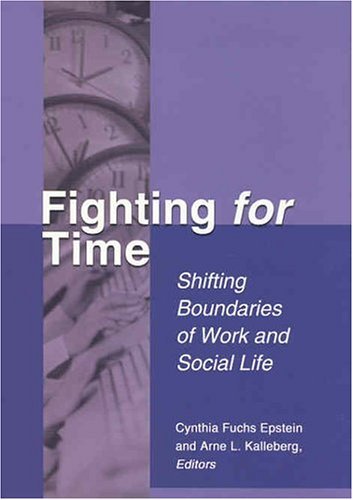
Though there are still just twentyfour hours in a day, society's idea of who should be doing what and when has shifted. Time, the ultimate scarce resource, has become an increasingly contested battle zone in American life, with work, family, and personal obligations pulling individuals in conflicting directions. In Fighting for Time, editors Cynthia Fuchs Epstein and Arne Kalleberg bring together a team of distinguished sociologists and management analysts to examine the social construction of time and its importance in American culture. Fighting for Time opens with an exploration of changes in time spent at workboth when people are on the job and the number of hours they spend thereand the consequences of those changes for individuals and families. Contributors Jerry Jacobs and Kathleen Gerson find that the relative constancy of the average workweek in America over the last thirty years hides the fact that bluecollar workers are putting in fewer hours while more educated whitecollar workers are putting in more. Rudy Fenwick and Mark Tausig look at the effect of nonstandard schedules on workers' health and family life. They find that working unconventional hours can increase family stress, but that control over one's work schedule improves family, social, and health outcomes for workers. The book then turns to an examination of how time influences the organization and control of work. The British insurance company studied by David Collinson and Margaret Collinson is an example of a culture where employees are judged on the number of hours they work rather than on their productivity. There, managers are under intense pressure not to take legally guaranteed parental leave, and clocks are banned from the office walls so that employees will work without regard to the time. In the book's final section, the contributors examine how time can have different meanings for men and women. Cynthia Fuchs Epstein points out that professional women and stayathome fathers face social disapproval for spending too much time on activities that do not conform to socially prescribed gender rolesmen are mocked by coworkers for taking paternity leave, while working mothers are chastised for leaving their children to the care of others. Fighting for Time challenges assumptions about the relationship between time and work, revealing that time is a fluid concept that derives its importance from cultural attitudes, social psychological processes, and the exercise of power. Its insight will be of interest to sociologists, economists, social psychologists, business leaders, and anyone interested in the worklife balance.
⚠️ WARNING (California Proposition 65):
This product may contain chemicals known to the State of California to cause cancer, birth defects, or other reproductive harm.
For more information, please visit www.P65Warnings.ca.gov.