
Title
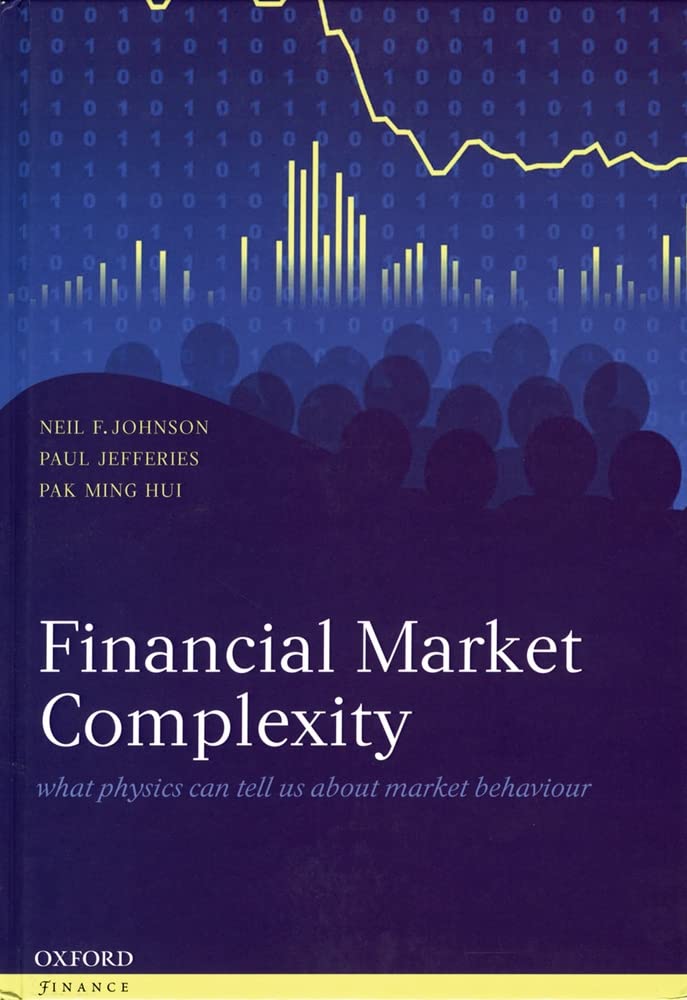
Financial Market Complexity: What Physics Can Tell Us About Market Behaviour (Oxford Finance Series),Used
Sold by Ergodebooks, an authorized reseller.
Returns accepted within 30 days | support@ergodebooks.com
Shipping Information
- Free Standard Shipping — United States only
- Processing Time: 3–5 business days
- Estimated Delivery: 6–10 business days after dispatch
- Double-boxed, fully insured & discreetly packaged
- Tracking number sent via email once dispatched
Returns & Refund
Returns accepted within 30 days of delivery.
Damaged or Defective Item
Free return shipping + replacement or full refund
Wrong Item Received
Free return shipping + replacement or full refund
Change of Mind
Return shipping at customer's expense · 25% restocking fee applies
Payment Option

Financial markets are a fascinating example of 'complexity in action': a realworld complex system whose evolution is dictated by the decisions of crowds of traders who are continually trying to win in a vast global 'game'. This book draws on recent ideas from the highly topical science of complexity and complex systems, to address the following questions: how do financial markets behave? Why do financial markets behave in the way that they do? What can we do to minimize risk, given this behavior? Standard finance theory is built around several seemingly innocuous assumptions about market dynamics. This book shows how these assumptions can give misleading answers to crucially important practical problems such as minimizing financial risk, coping with extreme events such as crashes or drawdowns, and pricing derivatives. After discussing the background to the concept of complexity and the structure of financial markets in Chapter 1, Chapter 2 examines the assumptions upon which standard finance theory is built. Reality sets in which Chapter 3, where data from two seemingly different markets are analyzed and certain universal features uncovered which cannot be explained within standard finance theory. Chapters 4 and 5 mark a significant departure from the philosophy of standard finance theory, being concerned with exploring microscopic models of markets which are faithful to real market microstructure yet, which also reproduce realworld features. Chapter 6 moves to the practical problem of how to quantify and hedge risk in real world markets. Chapter 7 discusses deterministic descriptions of market dynamics, incorporating the topics of chaos and the allimportant phenomenon of market crashes.
⚠️ WARNING (California Proposition 65):
This product may contain chemicals known to the State of California to cause cancer, birth defects, or other reproductive harm.
For more information, please visit www.P65Warnings.ca.gov.