
Title
Financial Models and Tools for Managing Lean Manufacturing (Supply Chain Integration Modeling, Optimization and Application),New
Sold by Ergodebooks, an authorized reseller.
Returns accepted within 30 days | support@ergodebooks.com
Shipping Information
- Free Standard Shipping — United States only
- Processing Time: 3–5 business days
- Estimated Delivery: 6–10 business days after dispatch
- Double-boxed, fully insured & discreetly packaged
- Tracking number sent via email once dispatched
Returns & Refund
Returns accepted within 30 days of delivery.
Damaged or Defective Item
Free return shipping + replacement or full refund
Wrong Item Received
Free return shipping + replacement or full refund
Change of Mind
Return shipping at customer's expense · 25% restocking fee applies
Payment Option

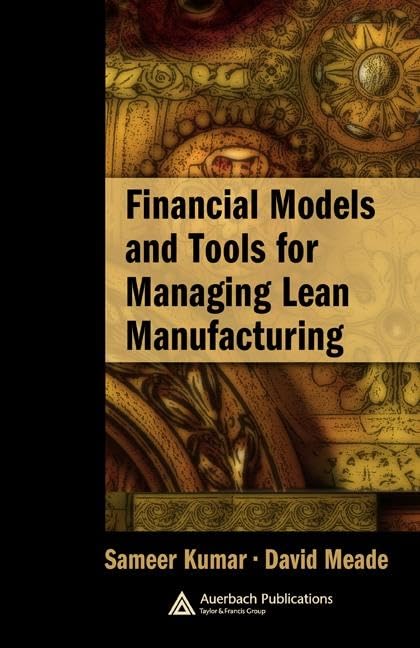
The effect Lean Manufacturing programs have on profit and loss statements during the early months of their implementation often causes them to be viewed as failures. The length of time it will take traditional financial reports to reflect lean manufacturing improvements depends upon how poorly the operation was doing in terms of inventory management prior to the initiation of the lean effort. As yet, no one has put forth a set of methods for dealing with the finances and financial reporting issues dynamically during the implementation of lean practices, until now.Financial Models and Tools for Managing Lean Manufacturing provides an understanding of the impact that traditional accounting practices have on operational improvement programs. The book shows managers of supply chains how to prepare for and present the impact of Lean Manufacturing to top management and stakeholders. To illustrate the impact of lean manufacturing on the income statement, the authors present a multimonth, Excel and ProModel based manufacturing operation environment that incorporates actual sales, sales forecasts, and production results. Their text gives supply chain managers the financial skills they need to successfully manage Lean Manufacturing and its impacts.In short, the book explains how existing accounting practices have a tendency to report the results of operational improvement programs in a negative light. Other books have identified this issue but have not attempted to quantify the impact to a firms profit and loss nor have they shown the impact over a series of reporting periods. As a consequence, although Lean Manufacturing practices are being adopted at an everincreasing rate, they have not been eagerly embraced by manufacturers and supply chain managers. Identifying the effects of past poor manufacturing practices that are being cleaned up by the operational improvements brought by the lean program, the book arms you with the knowledge you need to defend the lean program through the months when income statements indicate a decline in profitability.
⚠️ WARNING (California Proposition 65):
This product may contain chemicals known to the State of California to cause cancer, birth defects, or other reproductive harm.
For more information, please visit www.P65Warnings.ca.gov.