
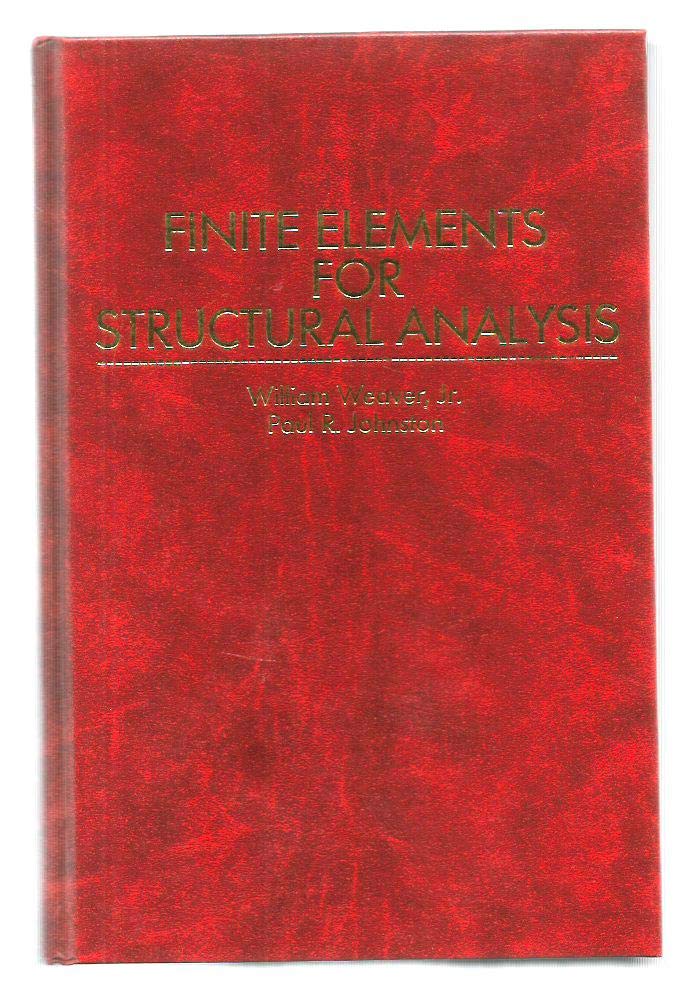
Title
Finite Elements For Structural Analysis (Prenticehall International Series In Civil Engineering And Engineering Mechanics),Used
Sold by Ergodebooks, an authorized reseller.
Returns accepted within 30 days | support@ergodebooks.com
Shipping Information
- Free Standard Shipping — United States only
- Processing Time: 3–5 business days
- Estimated Delivery: 6–10 business days after dispatch
- Double-boxed, fully insured & discreetly packaged
- Tracking number sent via email once dispatched
Returns & Refund
Returns accepted within 30 days of delivery.
Damaged or Defective Item
Free return shipping + replacement or full refund
Wrong Item Received
Free return shipping + replacement or full refund
Change of Mind
Return shipping at customer's expense · 25% restocking fee applies
Payment Option

The Principle Of Virtual Work Is Used As The Basis Of The Finite Element Procedure But While The Potential Energy Basis Is Also Given, No Mention Is Made Of Variational Calculus. After A Brief Discussion On Discretization Of The Solid Continuum, The Principle Of Virtual Work Is Stated And Used To Develop The Finite Element Method For The Onedimensional Elastic Beam Element. This Is Followed By An Introduction To Generalized Stresses And Strains And To Axis Transformations. The First Chapter Is Completed By Brief Comments On The Potential Energy Basis For The Finite Element Method And Elementary Criteria Required For Convergence.Subsequent Chapters Develop The Method For The Basic Structural Systems Beginning With Plane Stress And Strain. All The Details Of The Matrices Are Presented For Linear Strain Elements. The Calculation Of The Righthand Side Vector Is Well Presented. While The Authors Comment Briefly On Their Choice Of A Mesh In An Example, They Do Not Give Adequate Attentionto Mesh Characteristics, Such As Element Aspect Ratios Anddiscontinuous Changes In Element Size, Which Can Adverselyaffect Results.Isoparametric Elements For Twodimensional Elements Areclearly Introduced And The Authors Explanation Of Their Implementation Is Enhanced By Macroflow Charts. Only Passingmention Is Made Of Super And Subparametric Elements. This Development Is Extended To The General Threedimensional Solid.Attention Is Then Given To Those Systems Pertinent To Thestructural Engineer. This Begins With The Details Of Axisymmetric Solids Which Includes A Useful Discussion Ofnonaxisymmetric Loads. (Uncharacteristically, The Details Ofaxisymmetric Elements Which Have Nodes On The Axis Ofrevolution Are Omitted.) Subsequent Development Includesplate And Shell Elements.The Authors Now Turn Their Attention To Two Importantaspects Of The Behavior Of The Structural System,...
⚠️ WARNING (California Proposition 65):
This product may contain chemicals known to the State of California to cause cancer, birth defects, or other reproductive harm.
For more information, please visit www.P65Warnings.ca.gov.
- Q: How many pages does this book have? A: This book has four hundred forty-eight pages. It provides a comprehensive exploration of finite elements in structural analysis.
- Q: What binding does this book have? A: This book is available in hardcover binding. This ensures durability and makes it suitable for frequent use.
- Q: Who is the author of this book? A: The author of this book is William Weaver. He is known for his contributions to the field of civil engineering and engineering mechanics.
- Q: What topics does this book cover? A: This book covers finite element procedures, including the principle of virtual work and generalized stresses. It also discusses two-dimensional and three-dimensional elements.
- Q: What is the target audience for this book? A: This book is intended for students and professionals in civil engineering. It is particularly suitable for those studying structural analysis.
- Q: Is this book suitable for beginners? A: Yes, this book is suitable for beginners in structural analysis. It starts with foundational concepts before advancing to more complex topics.
- Q: How can I use this book effectively? A: You can use this book as a reference for studying finite element methods. It is also useful for practical applications in engineering projects.
- Q: Does this book include examples or problems? A: Yes, this book includes examples and problems related to finite element analysis. These help reinforce learning and application of concepts.
- Q: How should I store this book? A: You should store this book in a cool, dry place. Keeping it upright on a shelf can help prevent damage to the binding.
- Q: Is this book safe for library use? A: Yes, this book is safe for library use. Its hardcover binding is designed to withstand frequent handling.
- Q: What if the book arrives damaged? A: If the book arrives damaged, you should contact the seller for a return or replacement. Most retailers have policies for damaged items.
- Q: Can I return this book if I don’t like it? A: Yes, you can typically return this book if you are unsatisfied with it. Check the retailer’s return policy for specific conditions.
- Q: Does this book discuss mesh characteristics? A: Yes, the book mentions mesh characteristics but does not cover them in detail. It highlights their importance in finite element analysis.
- Q: Are there any references provided in this book? A: Yes, the book includes references for further reading. These are beneficial for readers looking to deepen their understanding of the subject.
- Q: Is this book a part of a series? A: Yes, this book is part of the Prentice-Hall International Series in Civil Engineering and Engineering Mechanics. This series covers various important topics in the field.
- Q: What is the main focus of the book? A: The main focus of the book is on the finite element method for structural analysis. It explores both theoretical and practical aspects of the method.