If you have any questions, you are always welcome to contact us. We'll get back to you as soon as possible, withing 24 hours on weekdays.
Customer service
All questions about your order, return and delivery must be sent to our customer service team by e-mail at yourstore@yourdomain.com
Sale & Press
If you are interested in selling our products, need more information about our brand or wish to make a collaboration, please contact us at press@yourdomain.com
Help
If you have any questions, you are always welcome to contact us. We'll get back to you as soon as possible, withing 24 hours on weekdays.
Customer service
All questions about your order, return and delivery must be sent to our customer service team by e-mail at yourstore@yourdomain.com
Sale & Press
If you are interested in selling our products, need more information about our brand or wish to make a collaboration, please contact us at press@yourdomain.com
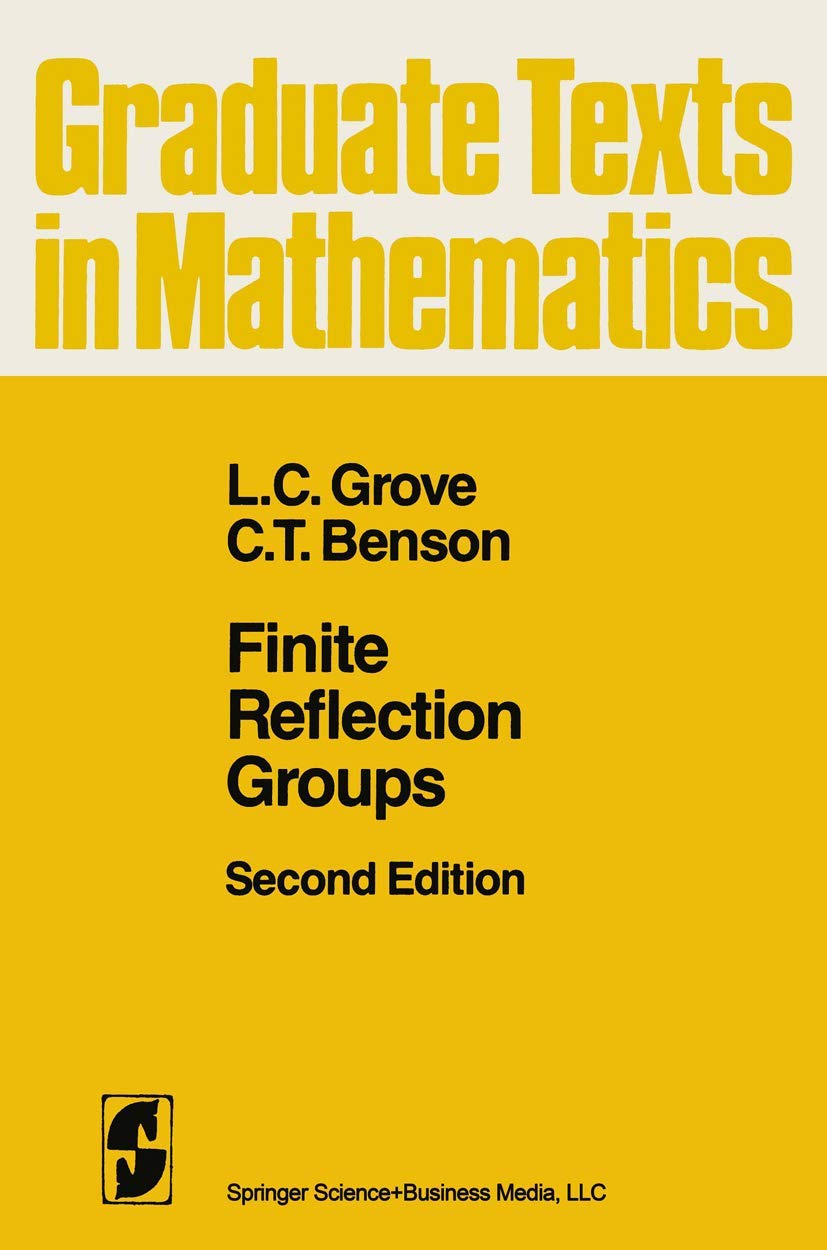
Chapter 1 introduces some of the terminology and notation used later and indicates prerequisites. Chapter 2 gives a reasonably thorough account of all finite subgroups of the orthogonal groups in two and three dimensions. The presentation is somewhat less formal than in succeeding chapters. For instance, the existence of the icosahedron is accepted as an empirical fact, and no formal proof of existence is included. Throughout most of Chapter 2 we do not distinguish between groups that are 'geo metrically indistinguishable,' that is, conjugate in the orthogonal group. Very little of the material in Chapter 2 is actually required for the sub sequent chapters, but it serves two important purposes: It aids in the development of geometrical insight, and it serves as a source of illustrative examples. There is a discussion offundamental regions in Chapter 3. Chapter 4 provides a correspondence between fundamental reflections and funda mental regions via a discussion of root systems. The actual classification and construction of finite reflection groups takes place in Chapter 5. where we have in part followed the methods of E. Witt and B. L. van der Waerden. Generators and relations for finite reflection groups are discussed in Chapter 6. There are historical remarks and suggestions for further reading in a Post lude.
⚠️ WARNING (California Proposition 65):
This product may contain chemicals known to the State of California to cause cancer,
birth defects, or other reproductive harm.
For MAP (Minimum Advertised Price) violations and Intellectual Property (IP) or Trademark concerns, please contact:
support@ergodebooks.com
⚠️ California Proposition 65 Warning: Some products sold on this website may expose you to chemicals known to the State of California to cause cancer, birth defects, or other reproductive harm. For more information, visit www.P65Warnings.ca.gov.