
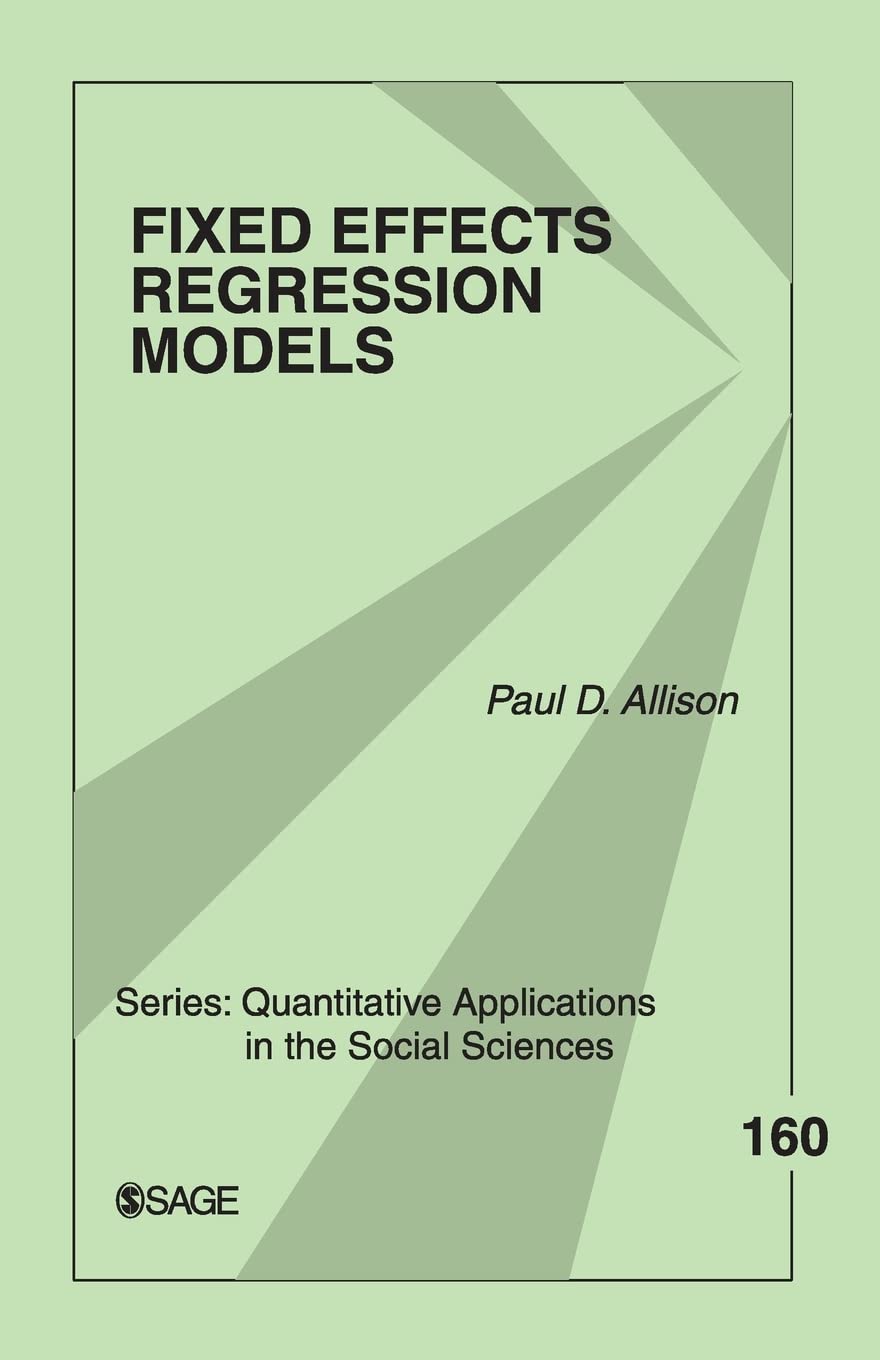
Title
Fixed Effects Regression Models (Quantitative Applications In The Social Sciences)
Sold by Ergodebooks, an authorized reseller.
Returns accepted within 30 days | support@ergodebooks.com
Shipping Information
- Free Standard Shipping — United States only
- Processing Time: 3–5 business days
- Estimated Delivery: 6–10 business days after dispatch
- Double-boxed, fully insured & discreetly packaged
- Tracking number sent via email once dispatched
Returns & Refund
Returns accepted within 30 days of delivery.
Damaged or Defective Item
Free return shipping + replacement or full refund
Wrong Item Received
Free return shipping + replacement or full refund
Change of Mind
Return shipping at customer's expense · 25% restocking fee applies
Payment Option

This Book Demonstrates How To Estimate And Interpret Fixedeffects Models In A Variety Of Different Modeling Contexts: Linear Models, Logistic Models, Poisson Models, Cox Regression Models, And Structural Equation Models. Both Advantages And Disadvantages Of Fixedeffects Models Will Be Considered, Along With Detailed Comparisons With Randomeffects Models. Written At A Level Appropriate For Anyone Who Has Taken A Year Of Statistics, The Book Is Appropriate As A Supplement For Graduate Courses In Regression Or Linear Regression As Well As An Aid To Researchers Who Have Repeated Measures Or Crosssectional Data.Learn More About The Little Green Book Qass Series! Click Here
⚠️ WARNING (California Proposition 65):
This product may contain chemicals known to the State of California to cause cancer, birth defects, or other reproductive harm.
For more information, please visit www.P65Warnings.ca.gov.
- Q: What is the page count of the book? A: The book contains one hundred thirty-six pages. This length makes it a concise resource for understanding fixed effects regression models.
- Q: What is the binding type of this book? A: This book is available in paperback binding. Paperback editions are generally more flexible and lighter than hardcover options.
- Q: Who is the author of this book? A: The author of this book is Paul D. Allison. He is known for his expertise in statistical methods and social sciences.
- Q: What topics does this book cover? A: This book covers fixed effects models, including linear, logistic, Poisson, Cox regression, and structural equation models. It compares fixed-effects and random-effects models thoroughly.
- Q: Is this book suitable for beginners? A: Yes, it is suitable for anyone who has taken a year of statistics. It serves as a supplement for graduate courses and researchers.
- Q: What kind of models are discussed in the book? A: The book discusses multiple types of models, including linear, logistic, and Poisson models. It also addresses Cox regression and structural equation models.
- Q: How should I store this book? A: Store this book in a cool, dry place, away from direct sunlight. Proper storage helps in maintaining its physical condition over time.
- Q: Can this book be used for research purposes? A: Yes, this book is an excellent resource for researchers handling repeated measures or cross-sectional data. It provides valuable insights into fixed effects models.
- Q: What is the book's genre? A: The genre of this book is Probability and Statistics. It focuses on quantitative applications in the social sciences.
- Q: Is there any special care required for this book? A: No special care is required. Just keep it clean and avoid exposure to moisture or extreme temperatures for longevity.
- Q: Who is the publisher of this book? A: The book is published by Sage Publications. They are known for their scholarly publications in various academic fields.
- Q: What are the dimensions of the book? A: The book measures five point five one inches in length, zero point thirty-one inches in width, and eight point five inches in height. These dimensions make it portable and easy to handle.
- Q: Is this book an adult-only resource? A: No, this book is not classified as adult-only. It is appropriate for graduate students and researchers.
- Q: What advantages does this book offer? A: This book offers a comprehensive understanding of fixed effects models and their applications. It discusses both advantages and disadvantages compared to random-effects models.
- Q: How do I access additional resources related to this book? A: You can learn more about this book and its related resources by clicking on links provided by the publisher. They often have supplementary materials available.
- Q: What kind of condition is the used book in? A: The used book is in good condition. It may show minor wear but is still functional for study and reference.