
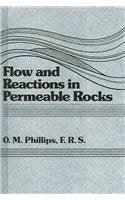
Title
Flow and Reactions in Permeable Rocks,Used
Sold by Ergodebooks, an authorized reseller.
Returns accepted within 30 days | support@ergodebooks.com
Shipping Information
- Free Standard Shipping — United States only
- Processing Time: 3–5 business days
- Estimated Delivery: 6–10 business days after dispatch
- Double-boxed, fully insured & discreetly packaged
- Tracking number sent via email once dispatched
Returns & Refund
Returns accepted within 30 days of delivery.
Damaged or Defective Item
Free return shipping + replacement or full refund
Wrong Item Received
Free return shipping + replacement or full refund
Change of Mind
Return shipping at customer's expense · 25% restocking fee applies
Payment Option

The formation of ore deposits and the patterns of mineral alteration in rocks frequently involves the transport of large amounts of dissolved solids, sometimes transiently, but often over long periods of time. Knowing or suspecting this, we logically seek to resolve several questions: What are the large and smallscale patterns of flow in geological materials? What is the direction and rate of flow in a given structure? What factors control the rates of chemical reaction within the rocks? What governs the dissolution of materials in some regions and their deposition in other areas that, over eons, leads to the distribution of minerals we see today? The search for answers to these issues involves a combination of approaches and subjects that includes geochemistry, structural geology, and fluid mechanics. In Flow and Reactions in Permeable Rocks, Dr. Owen Phillips provides the first booklength work that connects these different fields of study and applies them to the problem of flow and flowcontrolled reaction in rocks. The author begins by specifying the general physical and chemical principles that govern fluid flow and chemical reactions in rocks. He then develops the theoretical underpinnings for a variety of different patterns of flow and for the three basic types of flowcontrolled reaction: fronts, gradient reactions, and reactions in mixing zones. In the next chapter he explores some conditions for stability and instability in fluid flow, for instance the conditions under which one state of flow pattern spontaneously evolves into another. Finally, Dr. Phillips describes in detail the two great driving forces of largescale fluid circulation in rocks: pressure differences and thermal convection. Typical geological examples are given and, wherever possible, compared to numerical results or field observations. The analytical developments require some familiarity with collegelevel mathematics, but derivations are easy to follow or may even be skipped by the trusting reader.
⚠️ WARNING (California Proposition 65):
This product may contain chemicals known to the State of California to cause cancer, birth defects, or other reproductive harm.
For more information, please visit www.P65Warnings.ca.gov.