
Title

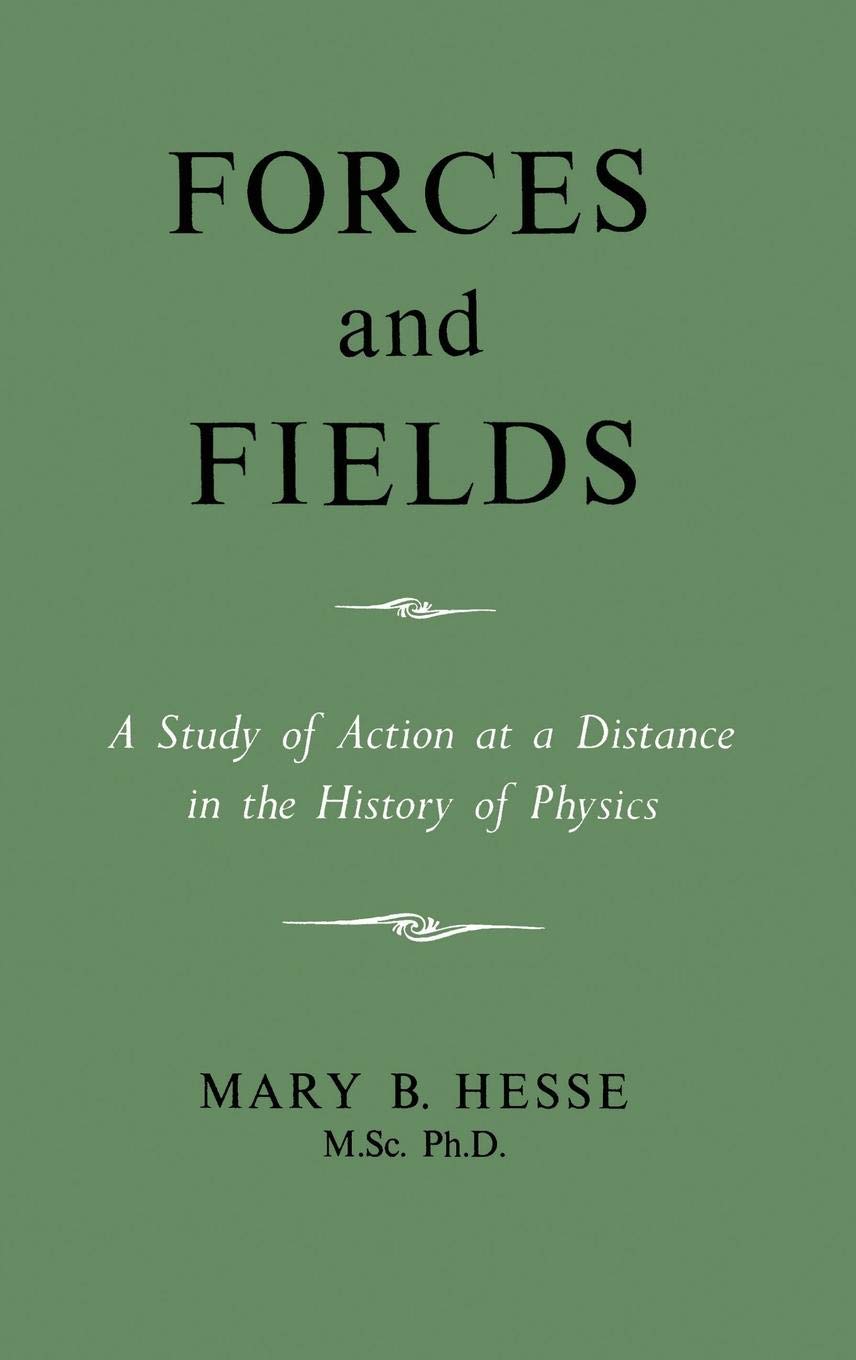
Forces and Fields,Used
Sold by Ergodebooks, an authorized reseller.
Returns accepted within 30 days | support@ergodebooks.com
Shipping Information
- Free Standard Shipping — United States only
- Processing Time: 3–5 business days
- Estimated Delivery: 6–10 business days after dispatch
- Double-boxed, fully insured & discreetly packaged
- Tracking number sent via email once dispatched
Returns & Refund
Returns accepted within 30 days of delivery.
Damaged or Defective Item
Free return shipping + replacement or full refund
Wrong Item Received
Free return shipping + replacement or full refund
Change of Mind
Return shipping at customer's expense · 25% restocking fee applies
Payment Option

Forces and Fields by Mary Hesse is a history of physics surrounding the question: "How do bodies act on one another across space?" Hesse illustrates this through various answers, discussing period of transition in fundamental physics in which new concepts and ideas have been introduced and made scientifically testable, and makes a certain philosophical interpretation of science from the beginning. Some topics include the logical status of theories, primitive analogies, mechanism in Greek science, the Greek inheritance, Corpuscular Philosophy, The Theory of Gravitation and The Theory of Relativity, as well as others. Mary B. Hesse (born 1924) was a contemporary English philosopher of science. She is now professor emerita of the philosophy of science at Cambridge University. Her publication Models and Analogies in Science is a widely cited and accessible introduction to the topic. Hesse argues, contra Duhem, that models and analogies are integral to understanding scientific practice in general and scientific advancement in particular, especially how the domain of a scientific theory is extended and how theories generate genuinely novel predictions. Examples of such models include the famous billiard ball model of the dynamical theory of gases and models of light based on analogies to sound and water waves. Hesse thinks that, in order help us understand a new system or phenomenon, we will often create an analogical model that compares this new system or phenomenon with a more familiar system or phenomenon. In her book, Hesse makes a distinction between three types of analogues in scientific models: positive analogies, negative analogies, and neutral analogies. Positive analogies are those features which are known or thought to be shared by both systems, negative analogies are those features which are known or thought to be present in one system but absent in the other, and neutral analogies are those features whose status as positive or negative analogies is uncertain at present. Neutral analogies are by far the most interesting of the three types of analogies, for they suggest ways to test the limits of our models, guiding the way for scientific advancement. In the late 19th century, for example, the idea that lightwaves have a physical medium called the luminiferous ether would have been best thought of as a neutral analogy with water and sound waves. Eventually, due to a null result in the MichelsonMorley and TroutonNoble experiments, as well as other similar experiments, this analogy came to be accepted as a negative analogy we now accept that light has no physical medium, unlike sound and water waves. The discovery of this negative analogy led to further advancement, including the unification of electromagnetic theory with optics, and the eventual creation of new and more informative models of light.
⚠️ WARNING (California Proposition 65):
This product may contain chemicals known to the State of California to cause cancer, birth defects, or other reproductive harm.
For more information, please visit www.P65Warnings.ca.gov.