
Title
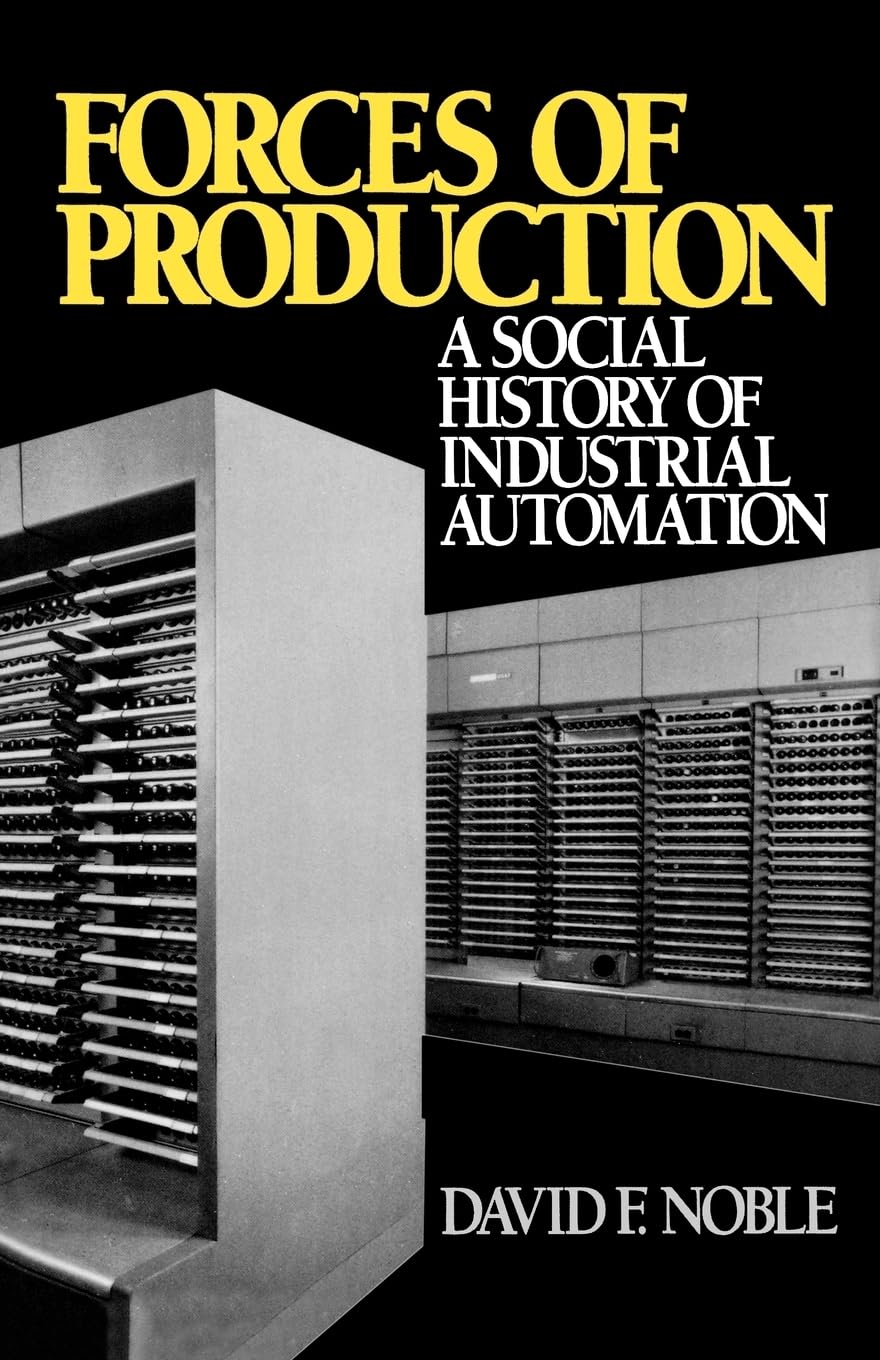
Forces of Production: A Social History of Industrial Automation,New
Sold by Ergodebooks, an authorized reseller.
Returns accepted within 30 days | support@ergodebooks.com
Shipping Information
- Free Standard Shipping — United States only
- Processing Time: 3–5 business days
- Estimated Delivery: 6–10 business days after dispatch
- Double-boxed, fully insured & discreetly packaged
- Tracking number sent via email once dispatched
Returns & Refund
Returns accepted within 30 days of delivery.
Damaged or Defective Item
Free return shipping + replacement or full refund
Wrong Item Received
Free return shipping + replacement or full refund
Change of Mind
Return shipping at customer's expense · 25% restocking fee applies
Payment Option

Focusing on the postwar automation of the American metalworking industrythe heart of the modern industrial economythis is a provocative study of how automation has assumed a critical role in America. David Noble argues that industrial automationmore than merely a technological advanceis a social process that reflects very real divisions and pressures within our society. The book explains how technology is often spurred and shaped by the military, corporations, universities, and other mighty institutions. Using detailed case studies, Noble also demonstrates how engineering design is influenced by political, economic, and sociological considerations, and how the deployment of equipment is frequently entangled with certain managerial concerns.
⚠️ WARNING (California Proposition 65):
This product may contain chemicals known to the State of California to cause cancer, birth defects, or other reproductive harm.
For more information, please visit www.P65Warnings.ca.gov.
- Q: What is the main focus of 'Forces of Production' by David Noble? A: The book focuses on the postwar automation of the American metal-working industry, exploring how automation is a social process that reflects divisions and pressures within society.
- Q: Who is the author of 'Forces of Production'? A: The author of 'Forces of Production: A Social History of Industrial Automation' is David F. Noble.
- Q: When was 'Forces of Production' published? A: The book was published on February 25, 1986.
- Q: What are the key themes discussed in the book? A: Key themes include the influence of military, corporations, and universities on technology, the impact of political and economic considerations on engineering design, and the managerial concerns entangled with equipment deployment.
- Q: How many pages does 'Forces of Production' contain? A: The book contains 427 pages.
- Q: What is the binding type of 'Forces of Production'? A: The book is available in paperback binding.
- Q: Is 'Forces of Production' a new book? A: Yes, the item condition is listed as new.
- Q: What is the edition of 'Forces of Production'? A: This book is the First Edition.
- Q: In which category is 'Forces of Production' classified? A: The book is classified under Historical Study & Educational Resources.
- Q: Does 'Forces of Production' include case studies? A: Yes, the book includes detailed case studies that demonstrate the influence of various factors on engineering design and automation.