
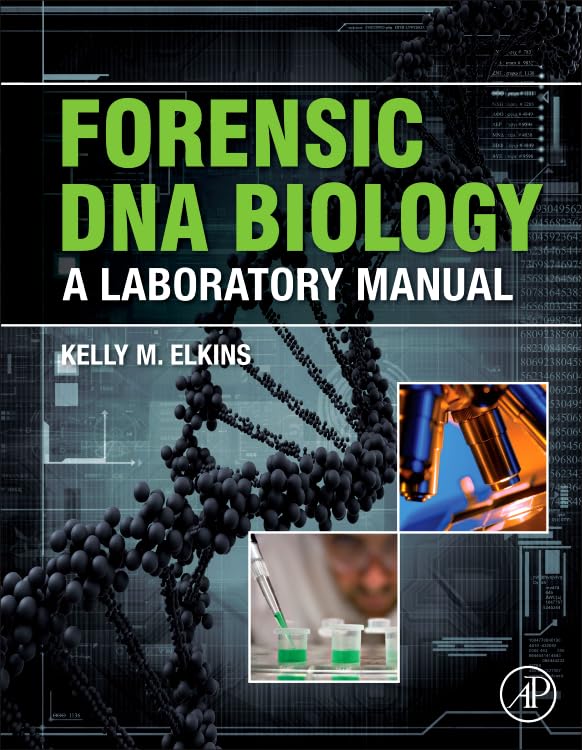
Title
Forensic Dna Biology: A Laboratory Manual
Sold by Ergodebooks, an authorized reseller.
Returns accepted within 30 days | support@ergodebooks.com
Shipping Information
- Free Standard Shipping — United States only
- Processing Time: 3–5 business days
- Estimated Delivery: 6–10 business days after dispatch
- Double-boxed, fully insured & discreetly packaged
- Tracking number sent via email once dispatched
Returns & Refund
Returns accepted within 30 days of delivery.
Damaged or Defective Item
Free return shipping + replacement or full refund
Wrong Item Received
Free return shipping + replacement or full refund
Change of Mind
Return shipping at customer's expense · 25% restocking fee applies
Payment Option

Dna Typing Has Revolutionized Criminal Investigations And Has Become A Powerful Tool In The Identification Of Individuals In Criminal And Paternity Cases. Forensic Dna Biology: A Laboratory Manual Is Comprised Of Uptodate And Practical Experiments And Stepbystep Instructions On How To Perform Dna Analysis, Including Pipetting, Microscopy And Hair Analysis, Presumptive Testing Of Body Fluids And Human Dna Typing. Modern Dna Typing Techniques Are Provided, Reflecting Real Life, Where Not All Institutions And Crime Labs Can Afford The Same Equipment And Software. Real Case Studies Will Be Used Throughout. Provides Practical Stepbystep Instruction On How To Perform Forensic Dna Analysis Includes Analysis Of Hair, Presumptive Testing Of Body Fluids, Human Dna Typing And Statistics Covers Techniques Such As Pipetting, Microscopy And Dna Extraction Pre And Postlab Exercises And Questions Assist The Reader In Learning The Material Report Writing Templates Assure The Reader Learns Real World Crime Lab Procedure
⚠️ WARNING (California Proposition 65):
This product may contain chemicals known to the State of California to cause cancer, birth defects, or other reproductive harm.
For more information, please visit www.P65Warnings.ca.gov.
- Q: How many pages are in the book? A: The book contains two hundred twenty-four pages. It offers a comprehensive guide to forensic DNA biology.
- Q: What is the binding type of this manual? A: The binding type is paperback. This makes it lightweight and portable for easy use in laboratory settings.
- Q: What are the dimensions of the book? A: The dimensions are seven point four inches in length, zero point six inches in width, and nine point zero two inches in height.
- Q: Who is the author of this laboratory manual? A: The author is Kelly M. Elkins. She provides practical insights into forensic DNA analysis.
- Q: What topics does this book cover? A: The book covers DNA typing techniques, hair analysis, and presumptive testing of body fluids. It also includes real case studies.
- Q: What kind of experiments are included in the manual? A: The manual includes practical experiments and step-by-step instructions for performing DNA analysis. This includes techniques such as pipetting and microscopy.
- Q: Is this book suitable for beginners in forensic science? A: Yes, it is suitable for beginners. The manual offers clear instructions and pre- and post-lab exercises to assist in learning.
- Q: Can I use this book for self-study? A: Yes, this book is ideal for self-study. It includes exercises and report writing templates to enhance understanding.
- Q: Does this manual provide real-world applications? A: Yes, it includes real case studies and reflects practical applications in various crime labs. This helps in understanding the relevance of techniques.
- Q: What safety precautions should I follow while using this manual? A: Follow standard laboratory safety protocols. Ensure proper handling of biological samples and use appropriate protective equipment.
- Q: How do I maintain the book in good condition? A: Keep it in a dry, cool place and avoid exposing it to direct sunlight. Handle it carefully to prevent damage.
- Q: What if the book arrives damaged? A: If the book arrives damaged, you should contact customer service for a return or exchange. Make sure to keep the original packaging.
- Q: Is there a warranty with this manual? A: No, there is typically no warranty for books. However, check with the retailer for their return policy.
- Q: How do I report a missing page in the book? A: Report missing pages to the retailer where you purchased the book. They can assist you with a replacement.
- Q: What makes this book different from other forensic science books? A: This book emphasizes practical experiments and real-life applications, making it a unique resource in forensic science education.