If you have any questions, you are always welcome to contact us. We'll get back to you as soon as possible, withing 24 hours on weekdays.
Customer service
All questions about your order, return and delivery must be sent to our customer service team by e-mail at yourstore@yourdomain.com
Sale & Press
If you are interested in selling our products, need more information about our brand or wish to make a collaboration, please contact us at press@yourdomain.com
Help
If you have any questions, you are always welcome to contact us. We'll get back to you as soon as possible, withing 24 hours on weekdays.
Customer service
All questions about your order, return and delivery must be sent to our customer service team by e-mail at yourstore@yourdomain.com
Sale & Press
If you are interested in selling our products, need more information about our brand or wish to make a collaboration, please contact us at press@yourdomain.com
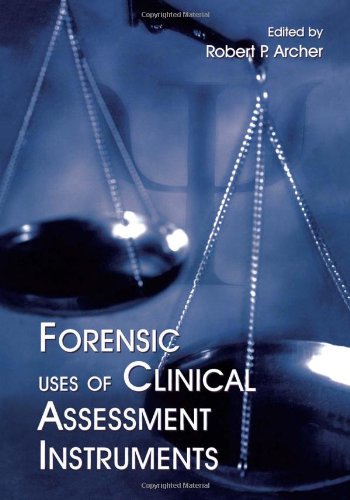
The purpose of this book is to provide a firm basis for psychologists to understand the appropriate uses and limitations of popular clinical assessment measures as they are applied to forensic issues. The instruments were selected because of their wide use and importance in both clinical and forensic settings. The PCLR, the PAI, and MCMIII, for example, are typically used with adults in criminal evaluations; the MMPIA is often used in evaluating adolescents in detention and correctional facilities; while the Child Behavior Checklist (CBCL) (Achenbach, 1991), Personality Inventory for ChildrenSecond Edition (PIC2) (Lachar & Gruber, 2001), and Parenting Stress Index (PSI) (Abidin, 1995) are more commonly used in evaluating families involved in child protection and custody cases. Instruments such as the MMPI2, the Rorschach, and the HalsteadReitan Neuropsychological Battery are widely used across many types of forensic evaluations, although the latter category of testing is particularly related to personal injury evaluations.The end result is a unique and indispensable reference: a comprehensive overview, within a single text, of prominent clinical assessment instruments widely used for forensic purposes and designed to facilitate the optimal use of clinical assessment instruments among psychologists who have undertaken the training necessary to understand and apply psychological principles and test findings to salient legal standards or issues.
⚠️ WARNING (California Proposition 65):
This product may contain chemicals known to the State of California to cause cancer,
birth defects, or other reproductive harm.
For MAP (Minimum Advertised Price) violations and Intellectual Property (IP) or Trademark concerns, please contact:
support@ergodebooks.com
⚠️ California Proposition 65 Warning: Some products sold on this website may expose you to chemicals known to the State of California to cause cancer, birth defects, or other reproductive harm. For more information, visit www.P65Warnings.ca.gov.