
Title
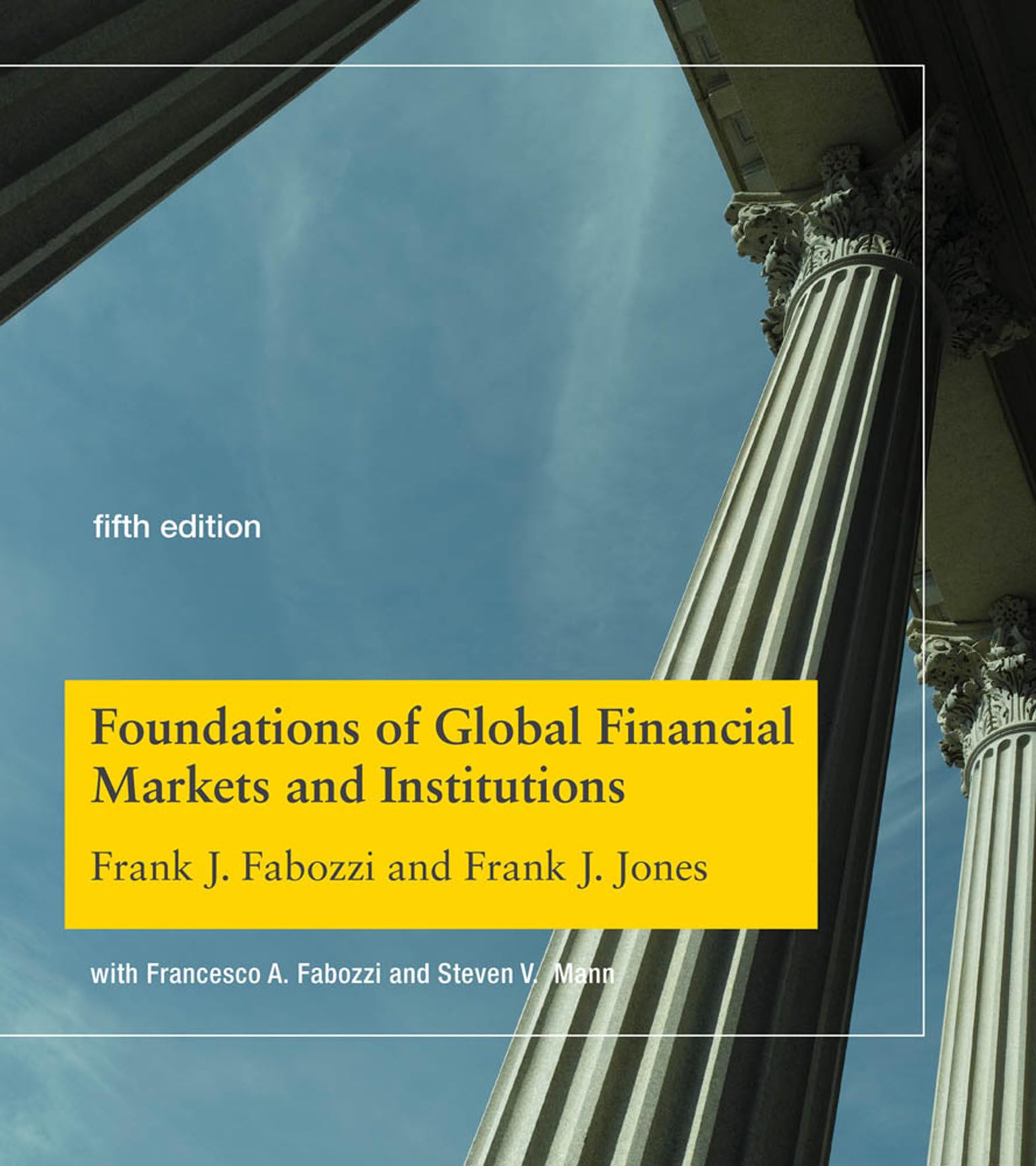
Foundations of Global Financial Markets and Institutions, fifth edition (Mit Press),New
Sold by Ergodebooks, an authorized reseller.
Returns accepted within 30 days | support@ergodebooks.com
Shipping Information
- Free Standard Shipping — United States only
- Processing Time: 3–5 business days
- Estimated Delivery: 6–10 business days after dispatch
- Double-boxed, fully insured & discreetly packaged
- Tracking number sent via email once dispatched
Returns & Refund
Returns accepted within 30 days of delivery.
Damaged or Defective Item
Free return shipping + replacement or full refund
Wrong Item Received
Free return shipping + replacement or full refund
Change of Mind
Return shipping at customer's expense · 25% restocking fee applies
Payment Option

A thoroughly revised and updated edition of a textbook for graduate students in finance, with new coverage of global financial institutions.This thoroughly revised and updated edition of a widely used textbook for graduate students in finance now provides expanded coverage of global financial institutions, with detailed comparisons of U.S. systems with nonU.S. systems. A focus on the actual practices of financial institutions prepares students for realworld problems.After an introduction to financial markets and market participants, including asset management firms, credit rating agencies, and investment banking firms, the book covers risks and asset pricing, with a new overview of risk; the structure of interest rates and interest rate and credit risks; the fundamentals of primary and secondary markets; government debt markets, with new material on nonU.S. sovereign debt markets; corporate funding markets, with new coverage of small and medium enterprises and entrepreneurial ventures; residential and commercial real estate markets; collective investment vehicles, in a chapter new to this edition; and financial derivatives, including financial futures and options, interest rate derivatives, foreign exchange derivatives, and credit risk transfer vehicles such as credit default swaps. Each chapter begins with learning objectives and ends with bullet point takeaways and questions.
⚠️ WARNING (California Proposition 65):
This product may contain chemicals known to the State of California to cause cancer, birth defects, or other reproductive harm.
For more information, please visit www.P65Warnings.ca.gov.
- Q: How many pages does this book have? A: This book contains one thousand eighty-eight pages. It is designed to provide comprehensive coverage of global financial markets and institutions.
- Q: What are the dimensions of the book? A: The book measures eight point thirty-one inches in length, one point sixty-nine inches in width, and nine point thirty-one inches in height. These dimensions make it a substantial textbook for graduate students.
- Q: What type of binding does this book have? A: This book has a hardcover binding. This type of binding enhances its durability and makes it suitable for frequent use.
- Q: Who is the author of the book? A: The author of this book is Frank J. Fabozzi. He is well-known in the field of finance and has authored numerous textbooks.
- Q: What is the primary focus of this textbook? A: The primary focus of this textbook is on global financial markets and institutions. It provides insights into U.S. and non-U.S. financial systems.
- Q: How do I use this textbook effectively? A: To use this textbook effectively, start by reviewing the learning objectives at the beginning of each chapter. This will guide your study and help you focus on key concepts.
- Q: Is this book suitable for beginners in finance? A: No, this book is primarily intended for graduate students in finance. It assumes a foundational understanding of financial concepts and markets.
- Q: Can this book help with real-world financial problems? A: Yes, the book prepares students for real-world financial problems by focusing on actual practices of financial institutions. It covers various financial instruments and markets.
- Q: What are the learning objectives in this textbook? A: Each chapter begins with specific learning objectives. These objectives outline the key concepts that students should grasp after completing the chapter.
- Q: How should I store this textbook? A: Store this textbook in a dry, cool place to maintain its condition. Avoid exposing it to direct sunlight to prevent damage to the cover and pages.
- Q: Is this book suitable for self-study? A: Yes, this book is suitable for self-study. It includes bullet point takeaways and questions at the end of each chapter to reinforce learning.
- Q: How can I keep my textbook in good condition? A: To keep your textbook in good condition, avoid bending the cover and pages. Use a bookmark instead of folding pages to mark your place.
- Q: What if the book arrives damaged? A: If the book arrives damaged, you should contact the seller for a return or replacement. Most sellers have policies in place for such issues.
- Q: Are there any supplementary materials with this textbook? A: No, this textbook does not come with supplementary materials. However, it is comprehensive and self-contained for graduate-level study.
- Q: What topics are covered in this textbook? A: The textbook covers topics such as asset management, credit rating agencies, investment banking, risk assessment, and financial derivatives.
- Q: Is there a glossary of terms in the book? A: Yes, the book includes a glossary of key financial terms. This is helpful for students unfamiliar with specific terminology.