
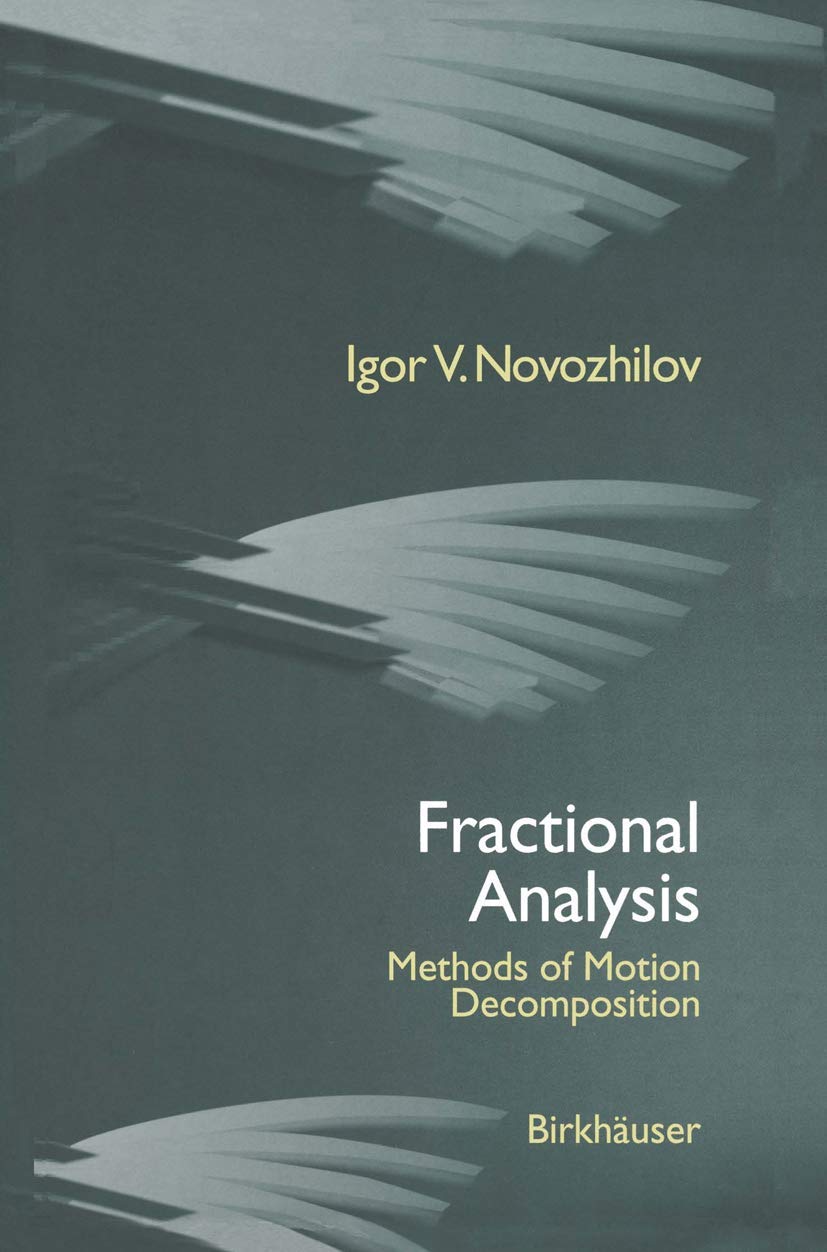
Title
Fractional Analysis: Methods Of Motion Decomposition,Used
Sold by Ergodebooks, an authorized reseller.
Returns accepted within 30 days | support@ergodebooks.com
Shipping Information
- Free Standard Shipping — United States only
- Processing Time: 3–5 business days
- Estimated Delivery: 6–10 business days after dispatch
- Double-boxed, fully insured & discreetly packaged
- Tracking number sent via email once dispatched
Returns & Refund
Returns accepted within 30 days of delivery.
Damaged or Defective Item
Free return shipping + replacement or full refund
Wrong Item Received
Free return shipping + replacement or full refund
Change of Mind
Return shipping at customer's expense · 25% restocking fee applies
Payment Option

This book considers methods of approximate analysis of mechanical, elec tromechanical, and other systems described by ordinary differential equa tions. Modern mathematical modeling of sophisticated mechanical systems consists of several stages: first, construction of a mechanical model, and then writing appropriate equations and their analytical or numerical ex amination. Usually, this procedure is repeated several times. Even if an initial model correctly reflects the main properties of a phenomenon, it de scribes, as a rule, many unnecessary details that make equations of motion too complicated. As experience and experimental data are accumulated, the researcher considers simpler models and simplifies the equations. Thus some terms are discarded, the order of the equations is lowered, and so on. This process requires time, experimentation, and the researcher's intu ition. A good example of such a semiexperimental way of simplifying is a gyroscopic precession equation. Formal mathematical proofs of its admis sibility appeared some several decades after its successful introduction in engineering calculations. Applied mathematics now has at its disposal many methods of approxi mate analysis of differential equations. Application of these methods could shorten and formalize the procedure of simplifying the equations and, thus, of constructing approximate motion models. Wide application of the methods into practice is hindered by the fol lowing. 1. Descriptions of various approximate methods are scattered over the mathematical literature. The researcher, as a rule, does not know what method is most suitable for a specific case. 2.
⚠️ WARNING (California Proposition 65):
This product may contain chemicals known to the State of California to cause cancer, birth defects, or other reproductive harm.
For more information, please visit www.P65Warnings.ca.gov.