
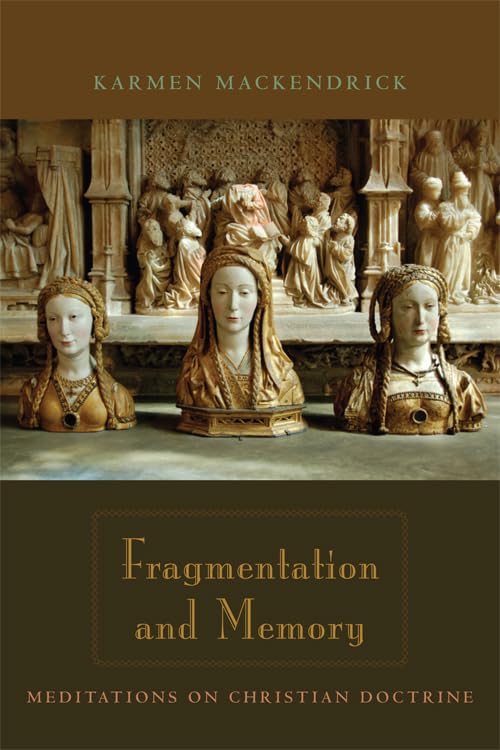
Title
Fragmentation and Memory: Meditations on Christian Doctrine,Used
Sold by Ergodebooks, an authorized reseller.
Returns accepted within 30 days | support@ergodebooks.com
Shipping Information
- Free Standard Shipping — United States only
- Processing Time: 3–5 business days
- Estimated Delivery: 6–10 business days after dispatch
- Double-boxed, fully insured & discreetly packaged
- Tracking number sent via email once dispatched
Returns & Refund
Returns accepted within 30 days of delivery.
Damaged or Defective Item
Free return shipping + replacement or full refund
Wrong Item Received
Free return shipping + replacement or full refund
Change of Mind
Return shipping at customer's expense · 25% restocking fee applies
Payment Option

Philosophers have long and skeptically viewed religion as a source of overeasy answers, with a singular, totalizing God and the comfort of an immortal soul being the greatest among them. But religious thought has always been more interestingindeed, a rich source of endlessly unfolding questions.With questions from the 1885 Baltimore Catechism of the Catholic Church as the starting point for each chapter, Karmen MacKendrick offers postmodern reflections on many of the central doctrines of the Church: the oneness of God, original sin, forgiveness, love and its connection to mortality, reverence for the relics of saints, and the doctrine of bodily resurrection. She maintains that we begin and end in questions and not in answers, in fragments and not in totalitiesmore precisely, in a fragmentation paradoxically integral to wholeness.Taking seriously Augustines idea that we find the divine in memory, MacKendrick argues that memory does not lead us back in time to a tidy answer but opens onto a complicated and fragmented time in which we find that the one and the many, before and after and now, even sacred and profane are complexly entangled. Time becomes something lived, corporeal, and sacred, with fragments of eternity interspersed among the stretches of its duration. Our sense of ourselves is correspondingly complex, because theological considerations lead us not to the security of an everlasting, indivisible soul dwelling comfortably in the presence of a paternal deity but to a more complicated, perpetually peculiar, and paradoxical life in the flesh.Written out of MacKendricks extensive background in both recent and lateancient philosophy, this moving and poetic book can also be an inspiration to anyone, scholar or lay reader, seeking to find contemporary significance in these ancient theological doctrines.
⚠️ WARNING (California Proposition 65):
This product may contain chemicals known to the State of California to cause cancer, birth defects, or other reproductive harm.
For more information, please visit www.P65Warnings.ca.gov.