
Title

Frank Lloyd Wright's S.C. Johnson Research Tower.,Used
Sold by Ergodebooks, an authorized reseller.
Returns accepted within 30 days | support@ergodebooks.com
Shipping Information
- Free Standard Shipping — United States only
- Processing Time: 3–5 business days
- Estimated Delivery: 6–10 business days after dispatch
- Double-boxed, fully insured & discreetly packaged
- Tracking number sent via email once dispatched
Returns & Refund
Returns accepted within 30 days of delivery.
Damaged or Defective Item
Free return shipping + replacement or full refund
Wrong Item Received
Free return shipping + replacement or full refund
Change of Mind
Return shipping at customer's expense · 25% restocking fee applies
Payment Option

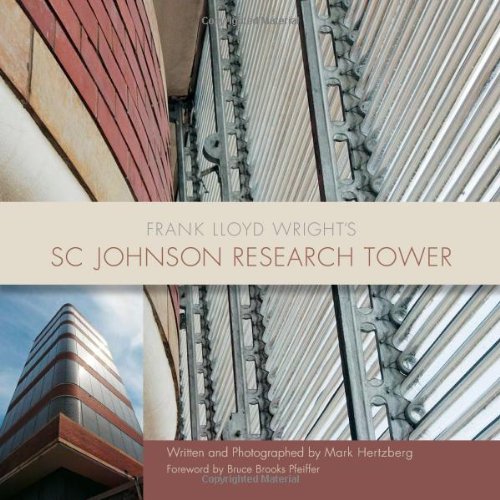
Frank Lloyd Wright's SC Johnson Research Tower in Racine, Wisconsin, is one of modern architecture's most significant landmarks. Completed in 1950, the fifteenstory skyscraper is the only existing example of Wright's ambitious taproot design. Like limbs from a tree trunk, alternating square floors and round mezzanines branch out from the weightbearing central corea truly revolutionary idea at the time and an engineering marvel today.In 1943 H. F. Johnson Jr., president of the SC Johnson & Son Company, commissioned Wright (18671959) to create a new laboratory space that would be as innovative as the research and development team working inside it. The architect eagerly accepted the challenge, envisioning a vertical complement to the firm's streamlined Administration Building, designed by Wright seven years prior. The result was a new kind of skyscraper, one with doubleheight spaces, windows made of Pyrex glass tubing, and stripes of Wright's signature Cherokee red brick, all balanced on a small pedestal basethe Tower's sinewy core. Although the Tower opened to great acclaim in 1950, it closed just thirtyone years later. Despite its ingenious structure, the building ultimately proved to be an impractical model of urbanindustrial architecture.Frank Lloyd Wright's SC Johnson Research Tower investigates the rise and fall of this remarkable building. Bruce Brooks Pfeiffer, director of the Frank Lloyd Wright Foundation Archives, provides an insightful Foreword, while Mark Hertzberg's text explores the design, the construction, andthrough interviews with Johnson employeesthe experience of working within Wright's iconic Tower. Hertzberg's artful photographs document the Towerinside and outas it appears today.
⚠️ WARNING (California Proposition 65):
This product may contain chemicals known to the State of California to cause cancer, birth defects, or other reproductive harm.
For more information, please visit www.P65Warnings.ca.gov.
- Q: What is the significance of Frank Lloyd Wright's SC Johnson Research Tower? A: Frank Lloyd Wright's SC Johnson Research Tower is a significant landmark in modern architecture, recognized for its innovative taproot design that features alternating square floors and round mezzanines.
- Q: When was the SC Johnson Research Tower completed? A: The SC Johnson Research Tower was completed in 1950.
- Q: Who commissioned Frank Lloyd Wright to design the SC Johnson Research Tower? A: H. F. Johnson Jr., the president of SC Johnson & Son Company, commissioned Frank Lloyd Wright to design the tower.
- Q: What are some unique architectural features of the Tower? A: Unique features include double-height spaces, Pyrex glass tubing windows, and stripes of Cherokee red brick, all supported by a central core.
- Q: What condition is the book about the SC Johnson Research Tower in? A: The book is classified as a used book in good condition.
- Q: Who is the author of the book on Frank Lloyd Wright's SC Johnson Research Tower? A: The author of the book is Mark Hertzberg.
- Q: What is the binding type of the book? A: The book is available in hardcover binding.
- Q: How many pages does the book contain? A: The book contains 79 pages.
- Q: When was the book published? A: The book was published on September 15, 2010.
- Q: What can readers expect to learn from the book? A: Readers can expect to learn about the design, construction, and historical significance of the Tower, along with insights from Johnson employees.