
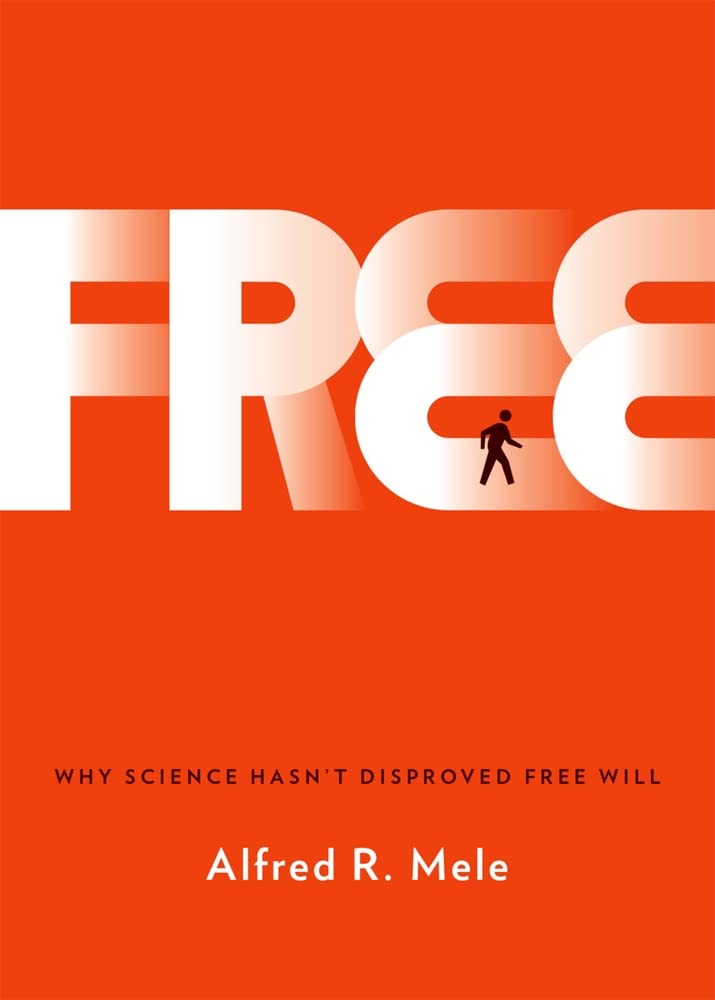
Title
Free: Why Science Hasn't Disproved Free Will,Used
Sold by Ergodebooks, an authorized reseller.
Returns accepted within 30 days | support@ergodebooks.com
Shipping Information
- Free Standard Shipping — United States only
- Processing Time: 3–5 business days
- Estimated Delivery: 6–10 business days after dispatch
- Double-boxed, fully insured & discreetly packaged
- Tracking number sent via email once dispatched
Returns & Refund
Returns accepted within 30 days of delivery.
Damaged or Defective Item
Free return shipping + replacement or full refund
Wrong Item Received
Free return shipping + replacement or full refund
Change of Mind
Return shipping at customer's expense · 25% restocking fee applies
Payment Option

Does free will exist? The question has fueled heated debates spanning from philosophy to psychology and religion. The answer has major implications, and the stakes are high. To put it in the simple terms that have come to dominate these debates, if we are free to make our own decisions, we are accountable for what we do, and if we aren't free, we're off the hook.There are neuroscientists who claim that our decisions are made unconsciously and are therefore outside of our control and social psychologists who argue that myriad imperceptible factors influence even our minor decisions to the extent that there is no room for free will. According to philosopher Alfred R. Mele, what they point to as hard and fast evidence that free will cannot exist actually leaves much room for doubt. If we look more closely at the major experiments that free will deniers cite, we can see large gaps where the light of possibility shines through.In Free: Why Science Hasn't Disproved Free Will, Mele lays out his opponents' experiments simply and clearly, and proceeds to debunk their supposed findings, one by one, explaining how the experiments don't provide the solid evidence for which they have been touted. There is powerful evidence that conscious decisions play an important role in our lives, and knowledge about situational influences can allow people to respond to those influences rationally rather than with blind obedience.Mele also explores the meaning and ramifications of free will. What, exactly, does it mean to have free will is it a state of our soul, or an undefinable openness to alternative decisions? Is it something natural and practical that is closely tied to moral responsibility? Since evidence suggests that denying the existence of free will actually encourages bad behavior, we have a duty to give it a fair chance.
⚠️ WARNING (California Proposition 65):
This product may contain chemicals known to the State of California to cause cancer, birth defects, or other reproductive harm.
For more information, please visit www.P65Warnings.ca.gov.
- Q: What is the main argument of 'Free: Why Science Hasn't Disproved Free Will'? A: 'Free: Why Science Hasn't Disproved Free Will' argues that despite claims from neuroscientists and psychologists that our decisions are predetermined, there is substantial evidence supporting the existence of free will. The author, Alfred R. Mele, critically analyzes experiments used to deny free will and highlights gaps in their findings.
- Q: Who is the author of this book? A: The author of 'Free: Why Science Hasn't Disproved Free Will' is Alfred R. Mele, a philosopher known for his work on free will and moral responsibility.
- Q: What are the implications of believing in free will according to the book? A: The book discusses that believing in free will is crucial for moral accountability. It suggests that if individuals feel they have control over their decisions, they are more likely to take responsibility for their actions.
- Q: Is this book suitable for someone new to the topic of free will? A: Yes, 'Free: Why Science Hasn't Disproved Free Will' is written in an accessible manner, making it suitable for readers new to the concepts of free will, philosophy, and psychology.
- Q: How long is the book? A: 'Free: Why Science Hasn't Disproved Free Will' has a total of 112 pages, providing a concise yet thorough exploration of the topic.
- Q: What is the binding type of this book? A: The book is available in hardcover binding, which provides durability and a premium feel.
- Q: When was 'Free: Why Science Hasn't Disproved Free Will' published? A: 'Free: Why Science Hasn't Disproved Free Will' was published on October 1, 2014.
- Q: What category does this book fall under? A: 'Free: Why Science Hasn't Disproved Free Will' falls under the category of Consciousness & Thought, making it relevant for readers interested in philosophical and psychological discussions.
- Q: Does the book provide evidence supporting free will? A: Yes, the book outlines various experiments and studies that, while often used to argue against free will, actually leave room for the possibility that conscious decisions play a significant role in our lives.
- Q: What is the edition of this book? A: This book is published as the first edition.