If you have any questions, you are always welcome to contact us. We'll get back to you as soon as possible, withing 24 hours on weekdays.
Customer service
All questions about your order, return and delivery must be sent to our customer service team by e-mail at yourstore@yourdomain.com
Sale & Press
If you are interested in selling our products, need more information about our brand or wish to make a collaboration, please contact us at press@yourdomain.com
Help
If you have any questions, you are always welcome to contact us. We'll get back to you as soon as possible, withing 24 hours on weekdays.
Customer service
All questions about your order, return and delivery must be sent to our customer service team by e-mail at yourstore@yourdomain.com
Sale & Press
If you are interested in selling our products, need more information about our brand or wish to make a collaboration, please contact us at press@yourdomain.com
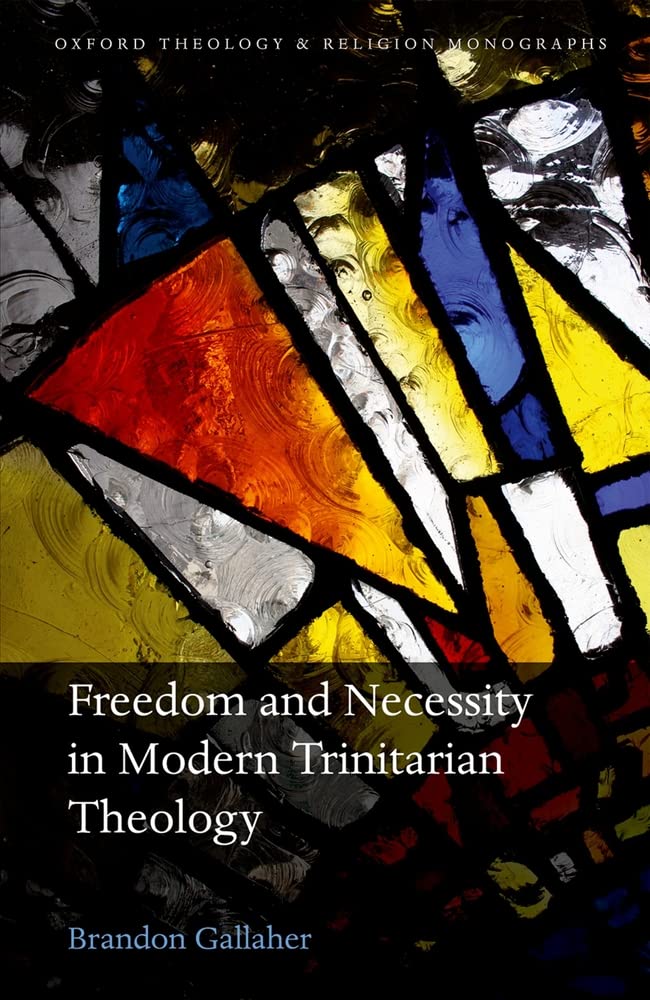
Freedom and Necessity in Modern Trinitarian Theology examines the tension between God and the world through a constructive reading of the Trinitarian theologies and Christologies of Sergii Bulgakov (18711944), Karl Barth (18861968), and Hans Urs von Balthasar (19051988). It focuses on what is called 'the problematic of divine freedom and necessity' and the response of the writers. 'Problematic' refers to God being simultaneously radically free and utterly bound to creation. God did not need to create and redeem the world in Christ. It is a contingent free gift. Yet, on the other side of a dialectic, he also has eternally determined himself to be God as Jesus Christ. He must create and redeem the world to be God as he has so determined. In this way the world is given a certain 'free necessity' by him because if there were no world then there would be no Christ. A spectrum of different concepts of freedom and necessity and a theological ideal of a balance between the same are outlined and then used to illumine the writers and to articulate a constructive response to the problematic. Brandon Gallaher shows that the classical Christian understanding of God having a nonnecessary relationship to the world and divine freedom being a sheer assertion of God's will must be completely rethought. Gallaher proposes a Trinitarian, Christocentric, and cruciform vision of divine freedom. God is free as eternally selfgiving, selfemptying and selfreceiving love. The work concludes with a contemporary theology of divine freedom founded on divine election.
⚠️ WARNING (California Proposition 65):
This product may contain chemicals known to the State of California to cause cancer,
birth defects, or other reproductive harm.
For MAP (Minimum Advertised Price) violations and Intellectual Property (IP) or Trademark concerns, please contact:
support@ergodebooks.com
⚠️ California Proposition 65 Warning: Some products sold on this website may expose you to chemicals known to the State of California to cause cancer, birth defects, or other reproductive harm. For more information, visit www.P65Warnings.ca.gov.