
Title
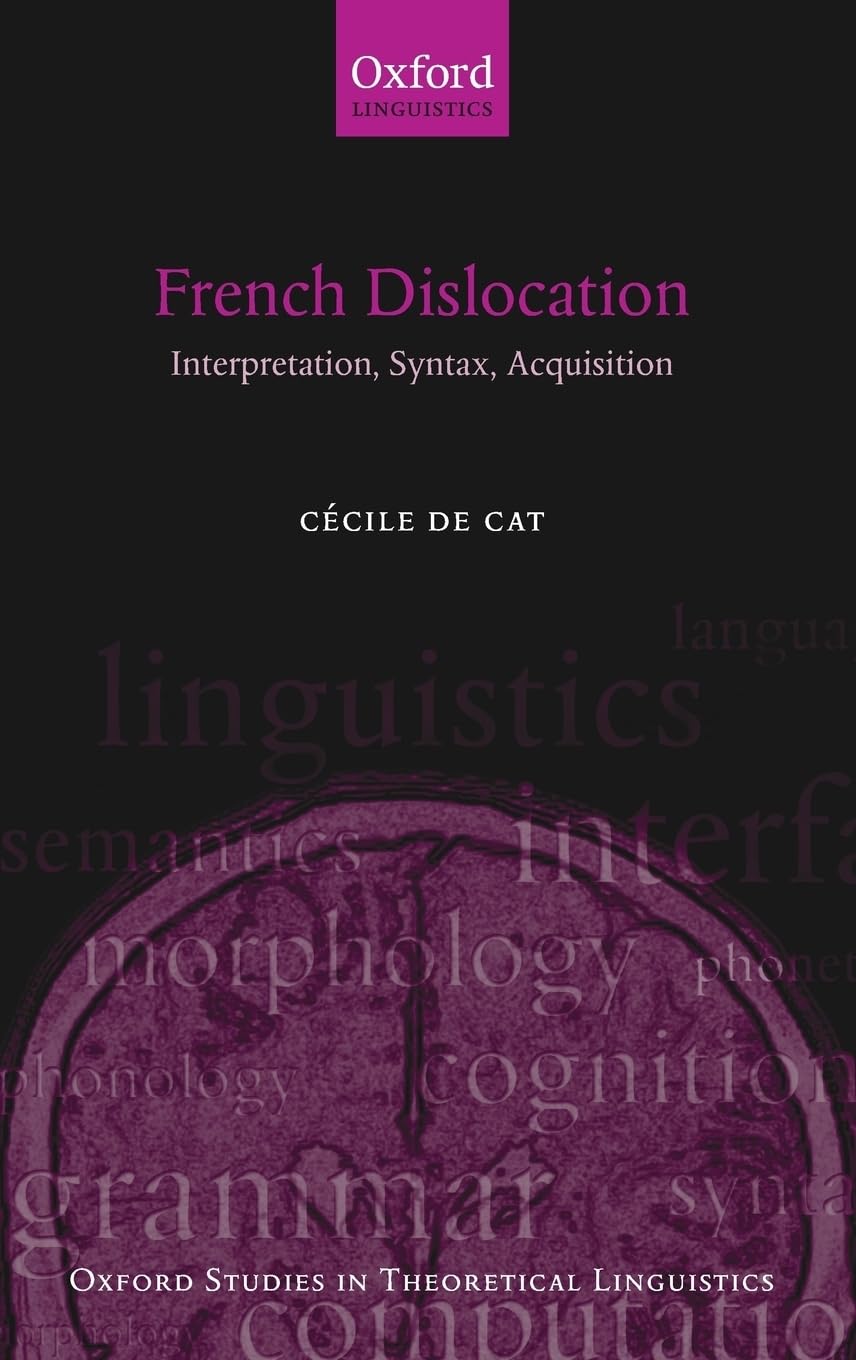
French Dislocation: Interpretation, Syntax, Acquisition (Oxford Studies In Theoretical Linguistics)
Sold by Ergodebooks, an authorized reseller.
Returns accepted within 30 days | support@ergodebooks.com
Shipping Information
- Free Standard Shipping — United States only
- Processing Time: 3–5 business days
- Estimated Delivery: 6–10 business days after dispatch
- Double-boxed, fully insured & discreetly packaged
- Tracking number sent via email once dispatched
Returns & Refund
Returns accepted within 30 days of delivery.
Damaged or Defective Item
Free return shipping + replacement or full refund
Wrong Item Received
Free return shipping + replacement or full refund
Change of Mind
Return shipping at customer's expense · 25% restocking fee applies
Payment Option

The pervasive use of dislocations (as in Le chocolat, c'est bon) is a key characteristic of spoken French. This book offers various new and wellmotivated insights, based on tests conducted by the author, on the syntactic analysis, prosody, and the interpretation of dislocation in spoken French. It also considers important aspects of the acquisition of dislocation by monolingual children learning different French dialects.The author argues that spoken French is a discourseconfigurational language, in which topics are obligatorily dislocated. She develops a syntactically parsimonious account, which maximizes the import of interfaces involved with discourse and prosody. She proposes clear diagnostics, following a reexamination of the status of subject clitics and a reevaluation of the characteristic prosody of dislocated constituents. The theoretical arguments throughout the book rest on data that comes from corpora of spontaneous production and from various elitication experiments.This book throws new light on French syntax and prosody and makes an important and original contribution to the study of linguistic interfaces. Clearly expressed and tightly argued it will interest scholars and advanced students of French and of its acquisition as a first language as well as linguistic theorists interested in the interfaces between syntax, discourse, and phonology.
⚠️ WARNING (California Proposition 65):
This product may contain chemicals known to the State of California to cause cancer, birth defects, or other reproductive harm.
For more information, please visit www.P65Warnings.ca.gov.
- Q: What is the page count of this book? A: The book has three hundred fourteen pages. This length allows for a thorough exploration of dislocation in spoken French.
- Q: What are the dimensions of the book? A: The dimensions are nine point twenty-nine inches in length, six point fourteen inches in width, and six point ten inches in height. These measurements make it a manageable size for reading and reference.
- Q: What type of binding does the book have? A: The book is bound in hardcover. This ensures durability and makes it suitable for frequent handling.
- Q: Who is the author of this book? A: The author is Cecile De Cat. She is known for her contributions to the field of theoretical linguistics.
- Q: What is the main subject of this book? A: This book focuses on French syntax and prosody, particularly the concept of dislocation. It presents new insights based on empirical research.
- Q: How can I apply the concepts from this book? A: You can apply the concepts by analyzing spoken French discourse. The book includes insights that can be used for both academic research and language acquisition.
- Q: Is this book suitable for beginners in linguistics? A: Yes, it is suitable for advanced students but may also benefit beginners who are serious about linguistics. The clear presentation makes complex ideas accessible.
- Q: How does the book assist in understanding French acquisition? A: The book discusses the acquisition of dislocation by monolingual children learning different French dialects. This provides valuable insights for educators and linguists.
- Q: How do I care for this hardcover book? A: To care for the book, store it upright and avoid exposure to excessive moisture. Regularly dust it to prevent dirt accumulation.
- Q: Is there any specific way to clean the book? A: Yes, use a dry cloth to gently wipe the cover. Avoid using liquid cleaners as they can damage the binding or pages.
- Q: What should I do if the book arrives damaged? A: If the book arrives damaged, contact the seller immediately for a return or replacement. Ensure you keep the original packaging for the return process.
- Q: What is the return policy for this book? A: The return policy typically allows returns within a specified period. Check with the seller for exact details regarding their return process.
- Q: How can I determine if this book is right for my studies? A: If you are studying French linguistics or syntax, this book is a great fit. It provides a comprehensive exploration of dislocation, valuable for both learners and scholars.
- Q: Are there any prerequisites for understanding this book? A: A basic understanding of linguistics is helpful but not mandatory. The book is written to be accessible while still engaging for advanced students.
- Q: Can this book be used as a reference for research? A: Yes, this book can serve as a valuable reference for research in linguistics. It includes empirical data and theoretical insights that are relevant to ongoing studies.
- Q: Will the book help with practical language skills? A: While the book is theoretical, it offers insights that can improve your understanding of spoken French, which can enhance practical language skills.