If you have any questions, you are always welcome to contact us. We'll get back to you as soon as possible, withing 24 hours on weekdays.
Customer service
All questions about your order, return and delivery must be sent to our customer service team by e-mail at yourstore@yourdomain.com
Sale & Press
If you are interested in selling our products, need more information about our brand or wish to make a collaboration, please contact us at press@yourdomain.com
Help
If you have any questions, you are always welcome to contact us. We'll get back to you as soon as possible, withing 24 hours on weekdays.
Customer service
All questions about your order, return and delivery must be sent to our customer service team by e-mail at yourstore@yourdomain.com
Sale & Press
If you are interested in selling our products, need more information about our brand or wish to make a collaboration, please contact us at press@yourdomain.com
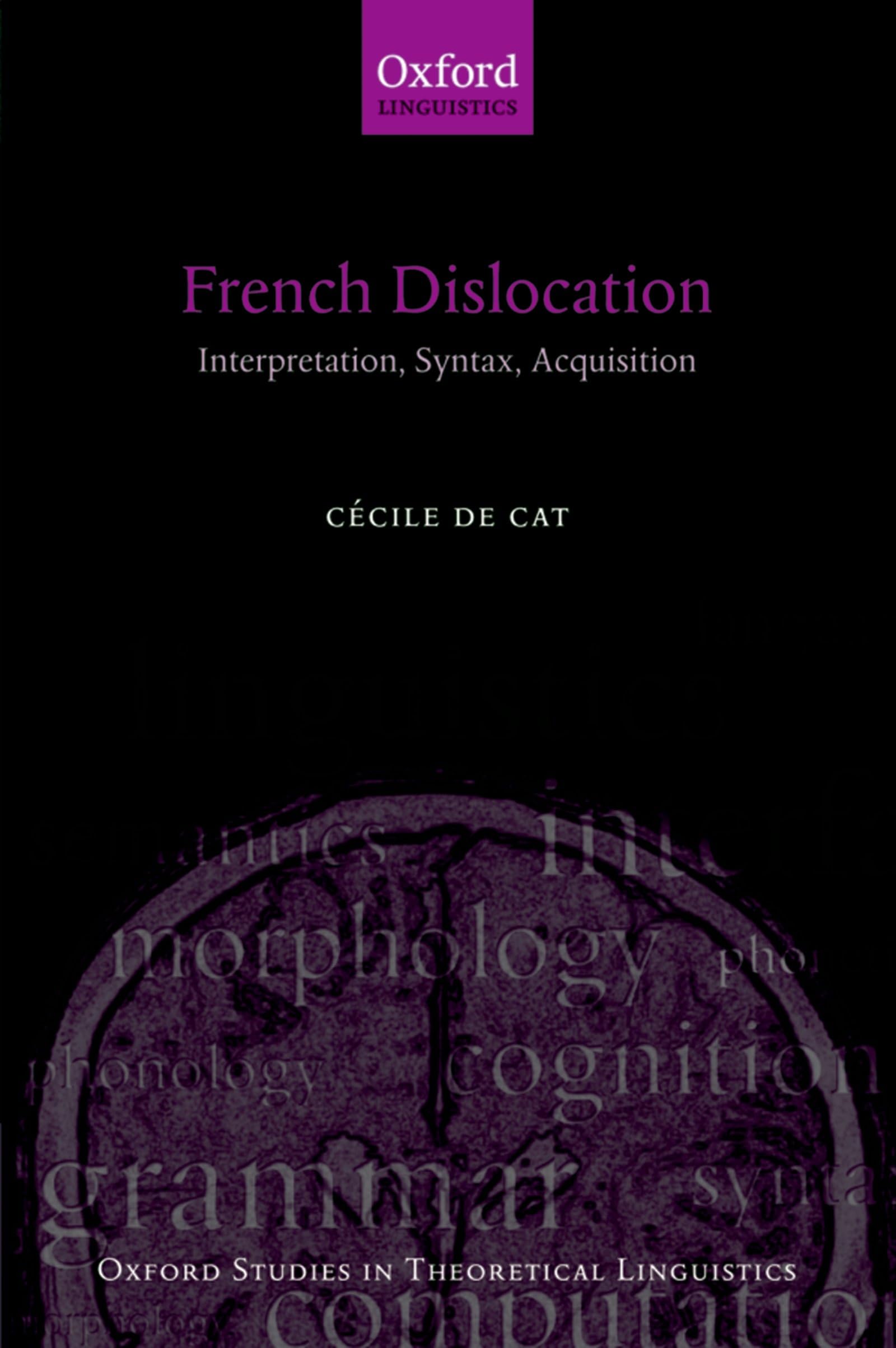
The pervasive use of dislocations (as in Le chocolat, c'est bon) is a key characteristic of spoken French. This book offers various new and wellmotivated insights, based on tests conducted by the author, on the syntactic analysis, prosody, and the interpretation of dislocation in spoken French. It also considers important aspects of the acquisition of dislocation by monolingual children learning different French dialects.The author argues that spoken French is a discourseconfigurational language, in which topics are obligatorily dislocated. She develops a syntactically parsimonious account, which maximizes the import of interfaces involved with discourse and prosody. She proposes clear diagnostics, following a reexamination of the status of subject clitics and a reevaluation of the characteristic prosody of dislocated constituents. The theoretical arguments throughout the book rest on data that comes from corpora of spontaneous production and from various elitication experiments.This book throws new light on French syntax and prosody and makes an important and original contribution to the study of linguistic interfaces. Clearly expressed and tightly argued, it will interest scholars and advanced students of French and of its acquisition as a first language as well as linguistic theorists interested in the interfaces between syntax, discourse, and phonology.
⚠️ WARNING (California Proposition 65):
This product may contain chemicals known to the State of California to cause cancer,
birth defects, or other reproductive harm.
For MAP (Minimum Advertised Price) violations and Intellectual Property (IP) or Trademark concerns, please contact:
support@ergodebooks.com
⚠️ California Proposition 65 Warning: Some products sold on this website may expose you to chemicals known to the State of California to cause cancer, birth defects, or other reproductive harm. For more information, visit www.P65Warnings.ca.gov.