
Title
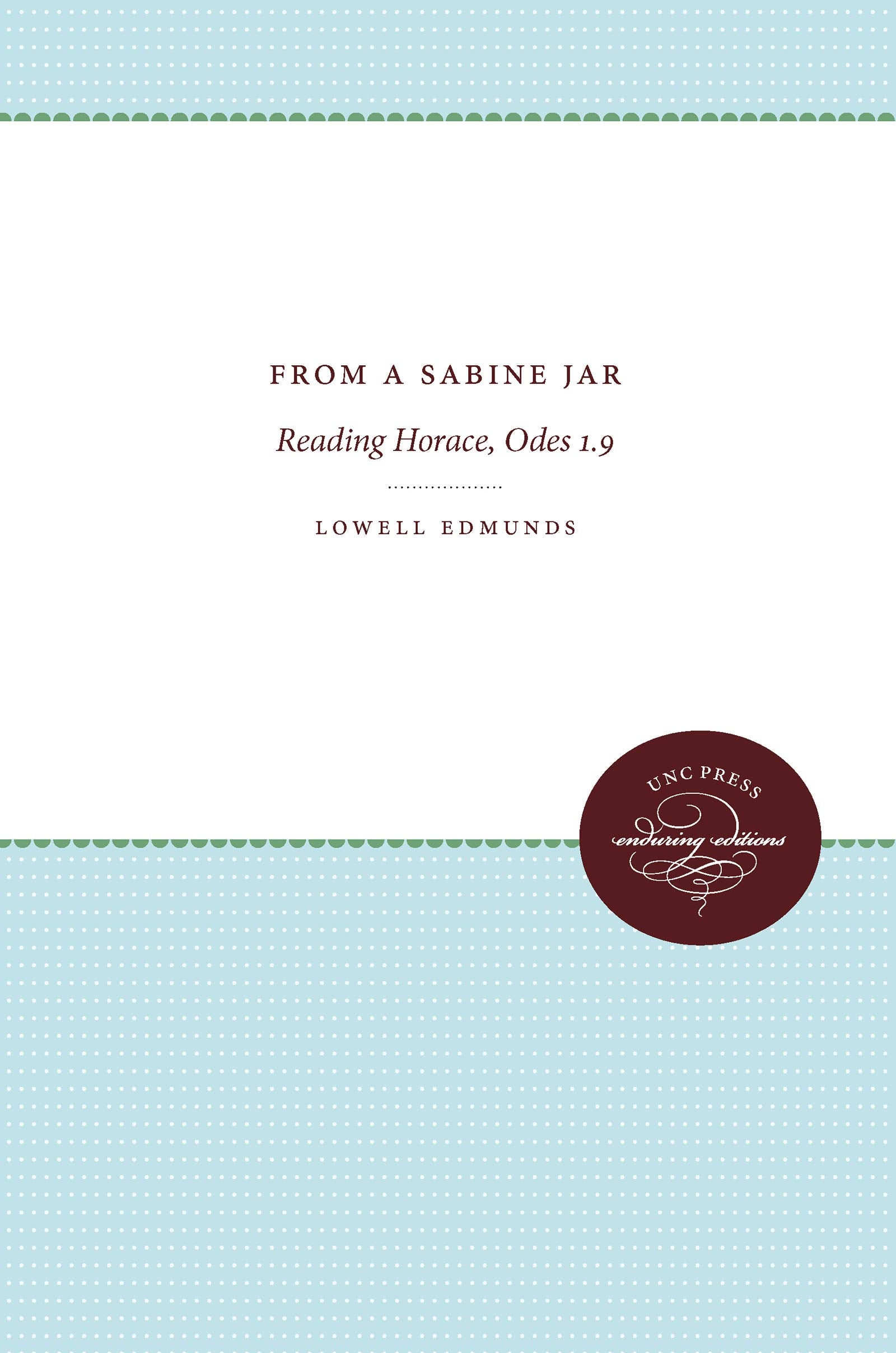
From A Sabine Jar: Reading Horace, Odes 1.9,Used
Sold by Ergodebooks, an authorized reseller.
Returns accepted within 30 days | support@ergodebooks.com
Shipping Information
- Free Standard Shipping — United States only
- Processing Time: 3–5 business days
- Estimated Delivery: 6–10 business days after dispatch
- Double-boxed, fully insured & discreetly packaged
- Tracking number sent via email once dispatched
Returns & Refund
Returns accepted within 30 days of delivery.
Damaged or Defective Item
Free return shipping + replacement or full refund
Wrong Item Received
Free return shipping + replacement or full refund
Change of Mind
Return shipping at customer's expense · 25% restocking fee applies
Payment Option

This book is a detailed study of a single poem Horace, Odes 1.9 often called 'The Soracte Ode' after the mountain named in its second line. Although more than seventy articles and parts of books have been devoted to this twentyfour line poem since the beginning of the last century, Lowell Edmunds is the first scholar to apply developments in literary theory from outside the field of classics to a discussion of the ode. Specifically, he uses Hans Robert Jauss's essay on Baudelaire's 'Spleen (II)' as a model for his study.According to Edmunds, attempts to answer aesthetic questions about ancient lyric poems typically begin with philological or historical facts which scholars present as new evidence, heretofore undiscovered or misunderstood and proceed to an analysis built on those facts. Edmunds argues that contemporary literary theory provides a different way of reconciling the aestheic and historical claims of a lyric poem, ancient or modern. He then takes a fresh look at Horace's poem, employing Jauss's method of performing three successive readings of the text: the first aesthetic or perceptual, the second interpretive, and the third historicist.In this hermeneutic Jaussian approach, Edmunds shows, the unity of the poem appears in the process of reading rather than, as in a philological approach, in the analysis of it. Moreover, he labels an emphasis on the act of reading itself, distinct from analysis, as the main difference between philological and hermeneutical ways of understanding a poem. Focusing on this contrast, he surveys the history of the ode's reception and scholarly interpretation. In the final chapter, he briefly considers deconstruction as an alternative critical method. Assessing the rival claims of hermeneutics, deconstruction, and philology as interpretive tools, Edmunds concludes by favoring hermeneutics.Originally published in 1992.A UNC Press Enduring Edition UNC Press Enduring Editions use the latest in digital technology to make available again books from our distinguished backlist that were previously out of print. These editions are published unaltered from the original, and are presented in affordable paperback formats, bringing readers both historical and cultural value.
⚠️ WARNING (California Proposition 65):
This product may contain chemicals known to the State of California to cause cancer, birth defects, or other reproductive harm.
For more information, please visit www.P65Warnings.ca.gov.