If you have any questions, you are always welcome to contact us. We'll get back to you as soon as possible, withing 24 hours on weekdays.
Customer service
All questions about your order, return and delivery must be sent to our customer service team by e-mail at yourstore@yourdomain.com
Sale & Press
If you are interested in selling our products, need more information about our brand or wish to make a collaboration, please contact us at press@yourdomain.com
Help
If you have any questions, you are always welcome to contact us. We'll get back to you as soon as possible, withing 24 hours on weekdays.
Customer service
All questions about your order, return and delivery must be sent to our customer service team by e-mail at yourstore@yourdomain.com
Sale & Press
If you are interested in selling our products, need more information about our brand or wish to make a collaboration, please contact us at press@yourdomain.com
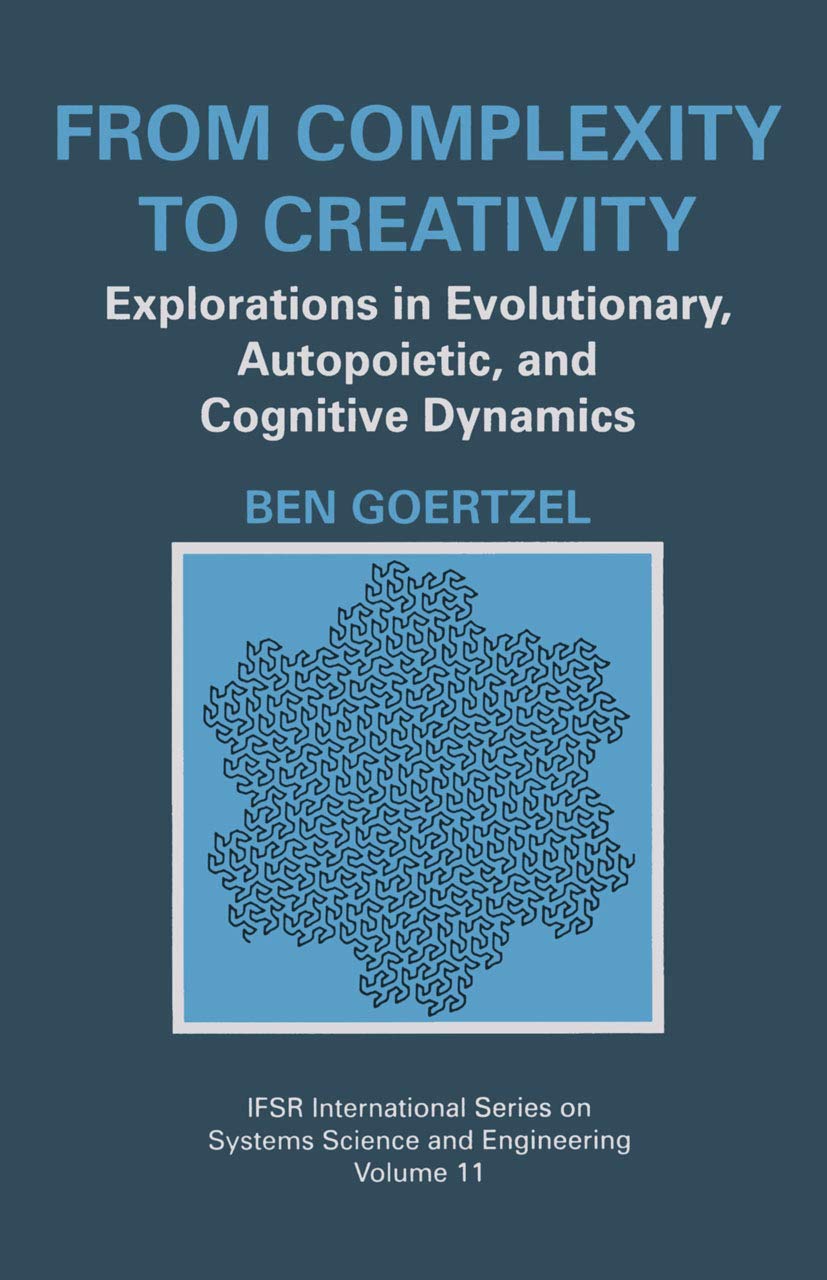
Cybernetic pioneer Warren McCullough asked: 'What is a man, that he may know a number; and what is a number, that a man may know it?' Thinking along much the same lines, my question here is: 'What is a creative mind, that it might emerge from a complex system; and what is a complex system, that it might give rise to a creative mind?' Complexity science is a fashionable topic these days. My perspective on complexity, however, is a somewhat unusual one: I am interested in complex systems science principally as it reflects on abstract mathematical, computational models of mind. In my three previous books, The Structure of Intelligence, Evolving Mind, and Chaotic Logic, I have outlined a comprehensive complexsystemstheoretic theory of mind that I now call the psynet model. This book is a continuation of the research program presented in my previous books (and those books will be frequently referred to here, by the nicknames EM and CL). One might summarize the trajectory of thought spanning these four books as follows. SI formulated a philosophy and mathem ics of mind, based on theoretical computer science and the concept of 'pattern. ' EM analyzed the theory of evolution by natural selection in similar terms, and used this computational theory of evolution to establish the evolutionary nature of thought.
⚠️ WARNING (California Proposition 65):
This product may contain chemicals known to the State of California to cause cancer,
birth defects, or other reproductive harm.
For MAP (Minimum Advertised Price) violations and Intellectual Property (IP) or Trademark concerns, please contact:
support@ergodebooks.com
⚠️ California Proposition 65 Warning: Some products sold on this website may expose you to chemicals known to the State of California to cause cancer, birth defects, or other reproductive harm. For more information, visit www.P65Warnings.ca.gov.