
Title
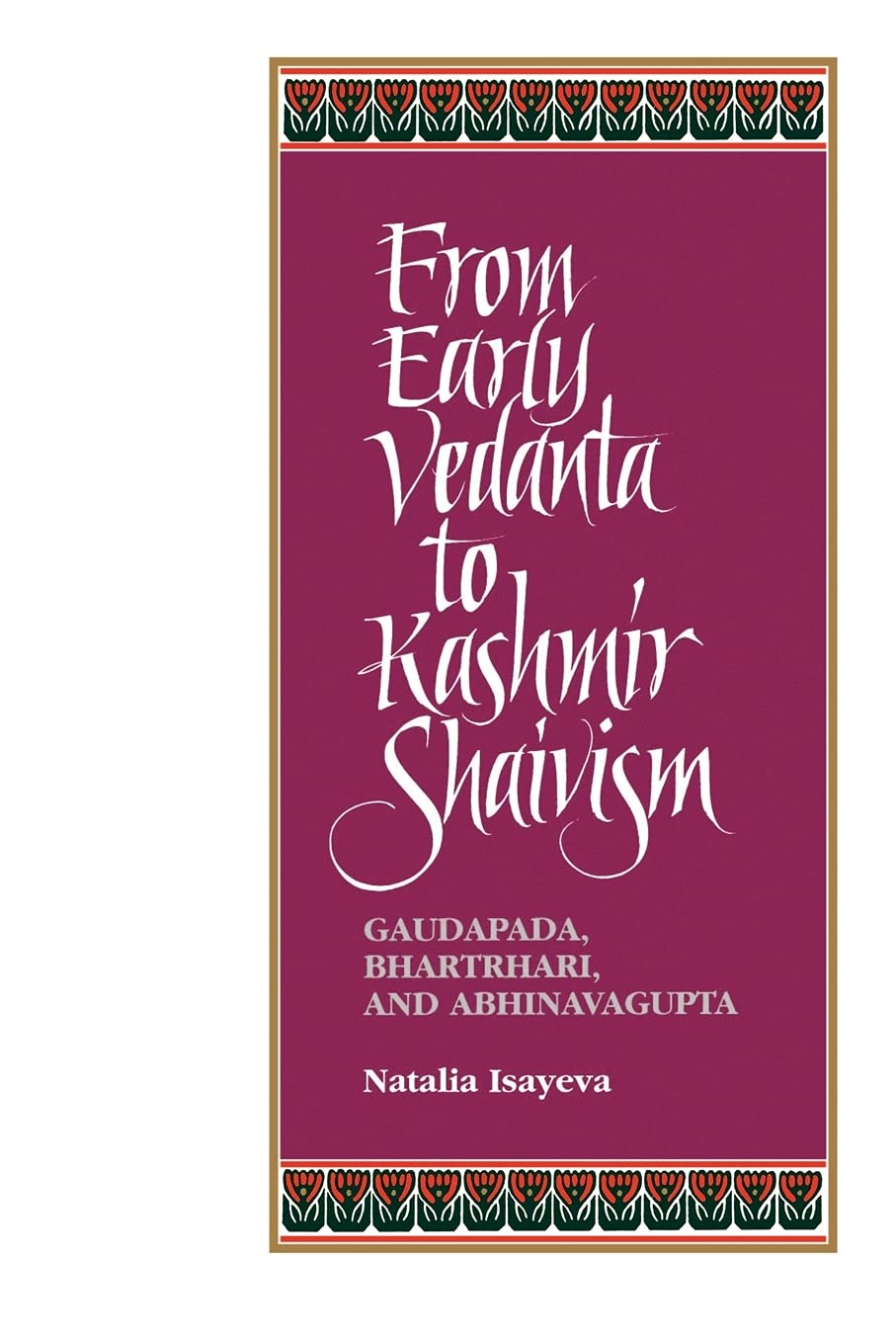
From Early Vedanta to Kashmir Shaivism: Gaudapada, Bhartrhari, and Abhinavagupta (Suny Series, Religious Studies) (Suny Series i,Used
Sold by Ergodebooks, an authorized reseller.
Returns accepted within 30 days | support@ergodebooks.com
Shipping Information
- Free Standard Shipping — United States only
- Processing Time: 3–5 business days
- Estimated Delivery: 6–10 business days after dispatch
- Double-boxed, fully insured & discreetly packaged
- Tracking number sent via email once dispatched
Returns & Refund
Returns accepted within 30 days of delivery.
Damaged or Defective Item
Free return shipping + replacement or full refund
Wrong Item Received
Free return shipping + replacement or full refund
Change of Mind
Return shipping at customer's expense · 25% restocking fee applies
Payment Option

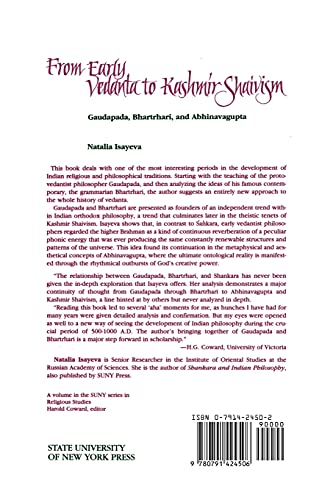
This book clarifies the relationship between God and the creation for Gaudapada, Bhartrhari, and Shankara, and by doing so, demonstrates a major continuity of thought from Gaudapada through Bhartrhari to Abhinavagupta and Kashmir Shaivism.This book deals with one of the most interesting periods in the development of Indian religious and philosophical traditions. Starting with the teaching of the protovedantist philosopher Gaudapada, and then analyzing the ideas of his famous contemporary, the grammarian Bhartrhari, the author suggests an entirely new approach to the whole history of vedanta.Gaudapada and Bhartrhari are presented as founders of an independent trend within Indian orthodox philosophy, a trend that culminates later in the theistic tenets of Kashmir Shaivism. Isayeva shows that, in contrast to SAankara, early vedantist philosophers regarded the higher Brahman as a kind of continuous reverberation of a peculiar phonic energy that was ever producing the same constantly renewable structures and patterns of the universe. This idea found its continuation in the metaphysical and aesthetical concepts of Abhinavagupta, where the ultimate ontological reality is manifested through the rhythmical outbursts of God's creative power.'The relationship between Gaudapada, Bhartrhari, and Shankara has never been given the indepth exploration that Isayeva offers. Her analysis demonstrates a major continuity of thought from Gaudapada through Bhartrhari to Abhinavagupta and Kashmir Shaivism, a line hinted at by others but never analyzed in depth.'Reading this book led to several 'aha' moments for me, as hunches I have had for many years were given detailed analysis and confirmation. But my eyes were opened as well to a new way of seeing the development of Indian philosophy during the crucial period of 5001000 A.D. The author's bringing together of Gaudapada and Bhartrhari is a major step forward in scholarship.' H. G. Coward, University of Victoria
⚠️ WARNING (California Proposition 65):
This product may contain chemicals known to the State of California to cause cancer, birth defects, or other reproductive harm.
For more information, please visit www.P65Warnings.ca.gov.