
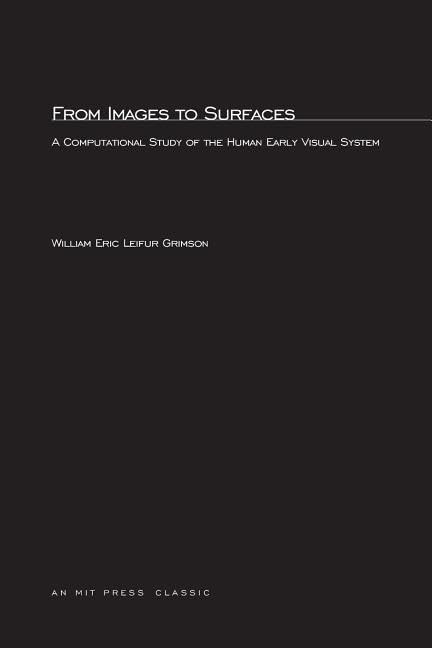
Title
From Images To Surfaces: A Computational Study Of The Human Early Visual System (Artificial Intelligence)
Sold by Ergodebooks, an authorized reseller.
Returns accepted within 30 days | support@ergodebooks.com
Shipping Information
- Free Standard Shipping — United States only
- Processing Time: 3–5 business days
- Estimated Delivery: 6–10 business days after dispatch
- Double-boxed, fully insured & discreetly packaged
- Tracking number sent via email once dispatched
Returns & Refund
Returns accepted within 30 days of delivery.
Damaged or Defective Item
Free return shipping + replacement or full refund
Wrong Item Received
Free return shipping + replacement or full refund
Change of Mind
Return shipping at customer's expense · 25% restocking fee applies
Payment Option

ReviewThe original theory of stereopsis on which Grimson's work is basedhas been substantially improved as an effect of his computer experiments. The second part of the bookgoes well beyond the theory of stereopsis. It considers the difficultquestion of how the sparse information retrieved by stereopsis can beinterpolated into smooth continuous surfacesas we are accustomed tosee around us. This elegant theoretical study of the interpolation problem is rich with several nontrivialmathematical results, which are important for a number of applicationsin computer vision.Tomaso Poggio, EndorsementProduct DescriptionThe projection of light rays onto the retina of the eye forms a twodimensional image, but through combining the stereoscopic aspect of vision with other optical clues by means of some remarkably effective imageprocessing procedures, the viewer is able to perceive threedimensional representations of scenes. From Images to Surfaces proposes and examines a specific imageprocessing procedure to account for this remarkable effecta computational approach that provides a framework for understanding the transformation of a set of images into a representation of the shapes of surfaces visible in a scene. Although much of the analysis is applicable to any visual information processing systembiological or artificialGrimson constrains his final choice of computational algorithms to those that are biologically feasible and consistent with what is known about the human visual system. In order to clarify the analysis, the approach distinguishes three independent levels: the computational theory itself, the algorithms employed, and the underlying implementation of the computation, in this case through the human neural mechanisms. This separation into levels facilitates the generation of specific models from general concepts. This research effort had its origin in a theory of human stereo vision recently developed by David Marr and Tomaso Poggio. Grimson presents a computer implementation of this theory that serves to test its adequacy and provide feedback for the identification of unsuspected problems embedded in it. The author then proceeds to apply and extend the theory in his analysis of surface interpolation through the computational methodology. This methodology allows the activity of the human early visual system to be followed through several stages: the Primal Sketch, in which intensity changes at isolated points on a surface are noted; the Raw 2.5D Sketch, in which surface values at these points are computed; and the Full 2.5D Sketch, in which these valuesncluding stereo and motion perceptionare interpolated over the entire surface. These stages lead to the final 3D Model, in which the threedimensional shapes of objects, in objectcentered coordinates, are made explicit.Review'Eric Grimson's study of the processes of depth perception is a most impressive contribution to the computational approach to the study of vision initiated by David Marr, which has led to much new understanding and opens very exciting possibilities for future research, with farreaching implications in other domains as well.'Noam Chomsky'The original theory of stereopsis on which Grimson's work is based has been substantially improved as an effect of his computer experiments. The second part of the book goes well beyond the theory of stereopsis. It considers the difficult question of how the sparse information retrieved by stereopsis can be interpolated into smooth continuous surfacesas we are accustomed to see around us. This elegant theoretical study of the interpolation problem is rich with several nontrivial mathematical results, which are important for a number of applications in computer vision.'Tomaso Poggio& quot; Eric Grimson's study of the processes of depth perception is a most impressive contribution to the computational approach to the study of vision initiated by David Marr, which has led to much new unders
⚠️ WARNING (California Proposition 65):
This product may contain chemicals known to the State of California to cause cancer, birth defects, or other reproductive harm.
For more information, please visit www.P65Warnings.ca.gov.