
Title

From Signs to Design: Environmental Process and Reform in Renaissance Rome,Used
Sold by Ergodebooks, an authorized reseller.
Returns accepted within 30 days | support@ergodebooks.com
Shipping Information
- Free Standard Shipping — United States only
- Processing Time: 3–5 business days
- Estimated Delivery: 6–10 business days after dispatch
- Double-boxed, fully insured & discreetly packaged
- Tracking number sent via email once dispatched
Returns & Refund
Returns accepted within 30 days of delivery.
Damaged or Defective Item
Free return shipping + replacement or full refund
Wrong Item Received
Free return shipping + replacement or full refund
Change of Mind
Return shipping at customer's expense · 25% restocking fee applies
Payment Option

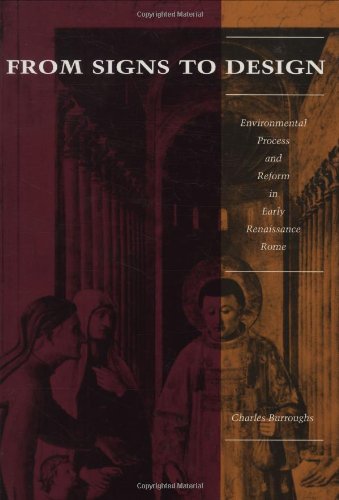
Burroughs brings an especially wide range of explanatory modelsfrom social history, cultural anthropology, iconology and semioticsto bear in his analysis of urban reform and the shifts in architectural design that emerged in early Renaissance Rome.Applying the latest practices from critical theory and discourse to the built environment of early Renaissance Rome, Charles Burroughs sees the city as a field of visual communication and rhetoric. He explores the symbolic dimension of the cultural landscape and the operation of architectural and other visual signs in the urban environment. The result is a profound reconceiving of the implications for the study of Renaissance Rome of the notion of the city as text. Central to Burrough's project is the articulation of a model of cultural mediation and production that is distinct from the standard notion of patronage as a unilateral transaction.On one level From Signs to Design focuses on the production of social meaning in and through environmental process during the pontificate of Nicholas V, celebrated for his intimate links to the new culture of humanism and as an archetypal patron of the arts and literature. On another, it is an elucidation of the origins and the ideological impact of architectural and urbanistic motifs and conceptions of spatial order that were central to the Western tradition of monumental city planning.Burroughs brings an especially wide range of explanatory modelsfrom social history, cultural anthropology, iconology and semioticsto bear in his analysis of urban reform and the shifts in architectural design that emerged in early Renaissance Rome. He focuses in particular on the material basis and context of these shifts, which he studies through the examination of contrasting neighborhoods, social milieus, and institutions, as well as of individuals prominently involved with important building projects or with the general maintenance and improvement of urban facilities and infrastructure. Burroughs provides a concrete and differentiated picture of the intersection of papal/ecclesiastical and local interest and initiatives, placing this within the context of marked political changes. And he devotes extensive discussions to the artistic expression of papal agendas and concerns in Nicholas's private chapel and in Alberti's Tempio Malatestiano.ContentsUrban Pattern and Symbolic Landscapes Interior Architectures: Discordance and Resolution in the Frescoes of Nicholas's Private Chapel Far and Near Perspectives: Urban Ordering and Neighborhood Change in Nicholan Rome Middlemen: Lines of Contact, Mutual Advantage, and Command The Other Rome: Sacrality and Ideology in the Holy Quarter Mirror and Frame: The Surrounding Region and the Long Road Epilogue: The River, the Book, and the Basilica
⚠️ WARNING (California Proposition 65):
This product may contain chemicals known to the State of California to cause cancer, birth defects, or other reproductive harm.
For more information, please visit www.P65Warnings.ca.gov.