
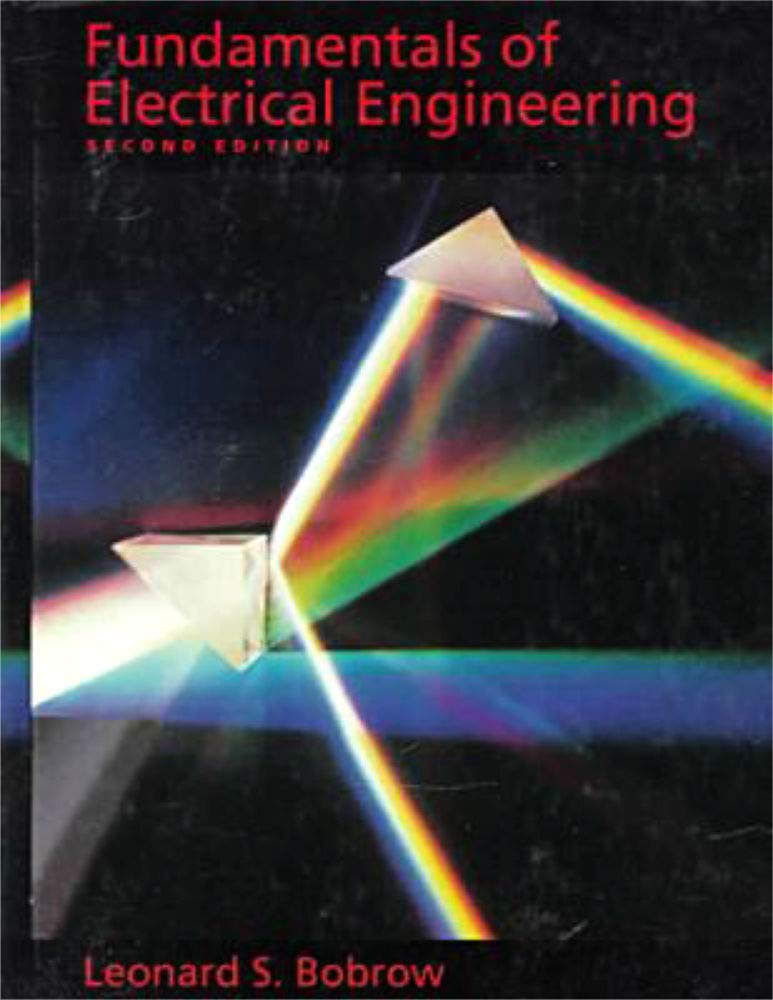
Title
Fundamentals Of Electrical Engineering (The ^Aoxford Series In Electrical And Computer Engineering),New
Sold by Ergodebooks, an authorized reseller.
Returns accepted within 30 days | support@ergodebooks.com
Shipping Information
- Free Standard Shipping — United States only
- Processing Time: 3–5 business days
- Estimated Delivery: 6–10 business days after dispatch
- Double-boxed, fully insured & discreetly packaged
- Tracking number sent via email once dispatched
Returns & Refund
Returns accepted within 30 days of delivery.
Damaged or Defective Item
Free return shipping + replacement or full refund
Wrong Item Received
Free return shipping + replacement or full refund
Change of Mind
Return shipping at customer's expense · 25% restocking fee applies
Payment Option

For The First Course In Electrical Engineering, This Text Is More Than Just A Survey Of The Basics Of Electrical Engineering. Even At This Introductory Level, Bobrow Covers Most Of The Material In Sufficient Detail For Students To Gain A Good Understanding Of The Fundamental Principles On Which Modern Electrical Engineering Is Based. The Text Is Partitioned Into Four Parts: Circuits, Electronics, Digital Systems, And Electromechanics. The Circuits Portion Includes The Traditional Circuits Topics, Such As Ohm'S Law, Kirchhoff'S Laws, Resistive Analysis Techniques, Various Circuit Theorems And Principles, Timedomain And Frequencydomain Analysis Procedures, Power, Threephase Circuits, Resonance, Frequency Response, And Elementary System Concepts. The Electronics Portion Deals With Both Theory And Applications Of The Major Semiconductor Devices: Diodes And Transistors In Both Discrete And Integratedcircuit (Ic) Form. In The Digital Systems Portion, Basic Digital Logic Elements And Logic Design In Both Discrete And Ic Forms Are Covered. Sequential, As Well As Combinational Logic, Is Covered. The Electromechanics Portion Covers Topics Such As Magnetic Circuits, Magnetic Induction, And Transformers On An Elementary Level. Each Chapter Ends With A Problem Set, With Selected Answers Available At The Back Of The Book.
⚠️ WARNING (California Proposition 65):
This product may contain chemicals known to the State of California to cause cancer, birth defects, or other reproductive harm.
For more information, please visit www.P65Warnings.ca.gov.
- Q: How many pages does this book have? A: This book contains nine hundred forty-four pages. It offers a comprehensive overview of electrical engineering principles.
- Q: What are the dimensions of this book? A: The book measures seven point three six inches in length, one point seven five inches in width, and nine point seven five inches in height. These dimensions make it suitable for both reading and storage.
- Q: What type of binding does this book have? A: This book is bound in hardcover. Hardcover binding offers durability and longevity for regular use.
- Q: Is this book suitable for beginners in engineering? A: Yes, this book is designed for beginners in electrical engineering. It covers fundamental principles in a way that is accessible to new students.
- Q: What topics are covered in this book? A: The book covers circuits, electronics, digital systems, and electromechanics. Each section is designed to provide a solid foundation in electrical engineering.
- Q: Are there exercises included in the book? A: Yes, each chapter ends with a problem set. This helps reinforce the concepts learned throughout the text.
- Q: How should I store this book to keep it in good condition? A: Store the book upright in a cool, dry place to prevent damage. Avoid exposure to direct sunlight and moisture.
- Q: Can I clean the book if it gets dirty? A: Yes, you can gently wipe the cover with a soft, dry cloth. Avoid using water or cleaners that may damage the binding.
- Q: What if the book arrives damaged? A: If the book arrives damaged, you should contact the seller for a return or exchange. Most sellers provide a warranty or return policy.
- Q: Is this book appropriate for high school students? A: Yes, high school students interested in engineering can benefit from this book. It introduces foundational concepts in an understandable manner.
- Q: What is the difficulty level of the content in this book? A: The content is suitable for introductory courses in electrical engineering. It is designed to be comprehensible for beginners.
- Q: Does this book include digital system design topics? A: Yes, it includes topics on basic digital logic elements and logic design. These are essential for understanding modern digital systems.
- Q: What is the author’s background? A: The book is authored by Leonard S. Bobrow, who has extensive experience in electrical engineering education. His expertise contributes to the book's clarity and depth.
- Q: Is this book used in college courses? A: Yes, it is commonly used in introductory electrical engineering courses at colleges and universities. Its structured approach helps students grasp complex concepts.
- Q: Are answers to the problem sets provided in the book? A: Yes, selected answers to the problem sets are provided at the back of the book. This allows students to check their work.
- Q: What is the publication date of this book? A: The publication date is not mentioned in the provided details. However, it is part of The Oxford Series in Electrical and Computer Engineering.