
Title
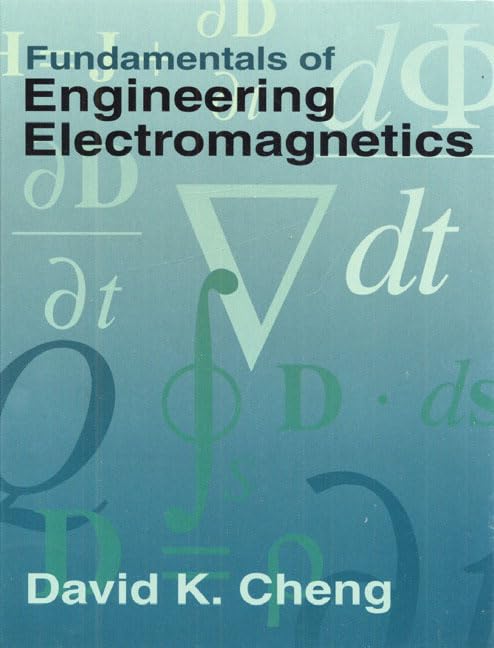
Fundamentals of Engineering Electromagnetics,Used
Sold by Ergodebooks, an authorized reseller.
Returns accepted within 30 days | support@ergodebooks.com
Shipping Information
- Free Standard Shipping — United States only
- Processing Time: 3–5 business days
- Estimated Delivery: 6–10 business days after dispatch
- Double-boxed, fully insured & discreetly packaged
- Tracking number sent via email once dispatched
Returns & Refund
Returns accepted within 30 days of delivery.
Damaged or Defective Item
Free return shipping + replacement or full refund
Wrong Item Received
Free return shipping + replacement or full refund
Change of Mind
Return shipping at customer's expense · 25% restocking fee applies
Payment Option

Product DescriptionThis is a derivative publication of Dr Cheng's Field and Wave Electromagnetics (2nd edition). It has been developed in response to the need for a text that supports the mastery of this difficult subject. Therefore, in addition to presenting electromagnetics in a concise and logical manner, the text includes endofsection review questions, worked examples, boxed remarks that alert students to key ideas and tricky points, margin notes, and pointbypoint chapter summaries. Examples and applications invite students to solve problems and build their knowledge of electromagnetics. Application topics include: electric motors, transmission lines, waveguides, antenna arrays and radar systems.From the Inside FlapThis book is designed for use as an undergraduate text on engineering electromagnetics. Electromagnetics is one of the most fundamental subjects in an electrical engineering curriculum. Knowledge of the laws governing electric and magnetic fields is essential to the understanding of the principle of operation of electric and magnetic instruments and machines, and mastery of the basic theory of electromagnetic waves is indispensable to explaining actionatadistance electromagnetic phenomena and systems.Because most electromagnetic variables are functions of threedimensional space coordinates as well as of time, the subject matter is inherently more involved than electric circuit theory, and an adequate coverage normally requires a sequence of two semestercourses, or three courses in a quarter system. However, some electrical engineering curricula do not schedule that much time for electromagnetics. The purpose of this book is to meet the demand for a textbook that not only presents the fundamentals of electromagnetism in a concise and logical manner, but also includes important engineering application topics such as electric motors, transmission lines, waveguides, antennas, antenna arrays, and radar systems.I feel that one of the basic difficulties that students have in learning electromagenetics is their failure to grasp the concept of an electromagnetic model. The traditional inductive approach of starting with experimental laws and gradually synthesizing them into Maxwell's equations tends to be fragmented and incohesive; and the introduction of gradient, divergence e, and curl operations appears to be ad hoc and arbitrary. On the other hand, the extreme of starting with the entire set of Maxwell's equations, which are of considerable complexity, as fundamental postulates is likely to cause consternation and resistance in students at the outset. The question of the necessity and sufficiency of these general equations is not addressed, and the concept of the electromagnetic model is left vague.This book builds the electromagnetic model using an axiomatic approach in stepsfirst for static electric fields, then for static magnetic fields, and finally for timevarying fields leading to Maxwell's equations. The mathematical basis for each step is Helmholtz's theorem, which states that a vector field is determined to within an additive constant if both its divergence and its curl are specified everywhere. A physical justification of this theorem may be based on the fact that the divergence of a vector field is a measure of the strength of its flow source and the curl of the field is a measure of strength of its vortex source. When the strengths of both the flow source and the vortex source are specified, the vector field is determined.For the development of the electrostatic model in free space, it is only necessary to define a single vector (namely, the electric field intensity E) by specifying its divergence and its curl as postulates. All other relations in electrostatics for free space, including Coulomb's law and Gauss's law, can be derived from the two rather simple postulates. Relations in material media can be developed through the concept of equivalent charge distributions of polarized d
⚠️ WARNING (California Proposition 65):
This product may contain chemicals known to the State of California to cause cancer, birth defects, or other reproductive harm.
For more information, please visit www.P65Warnings.ca.gov.