
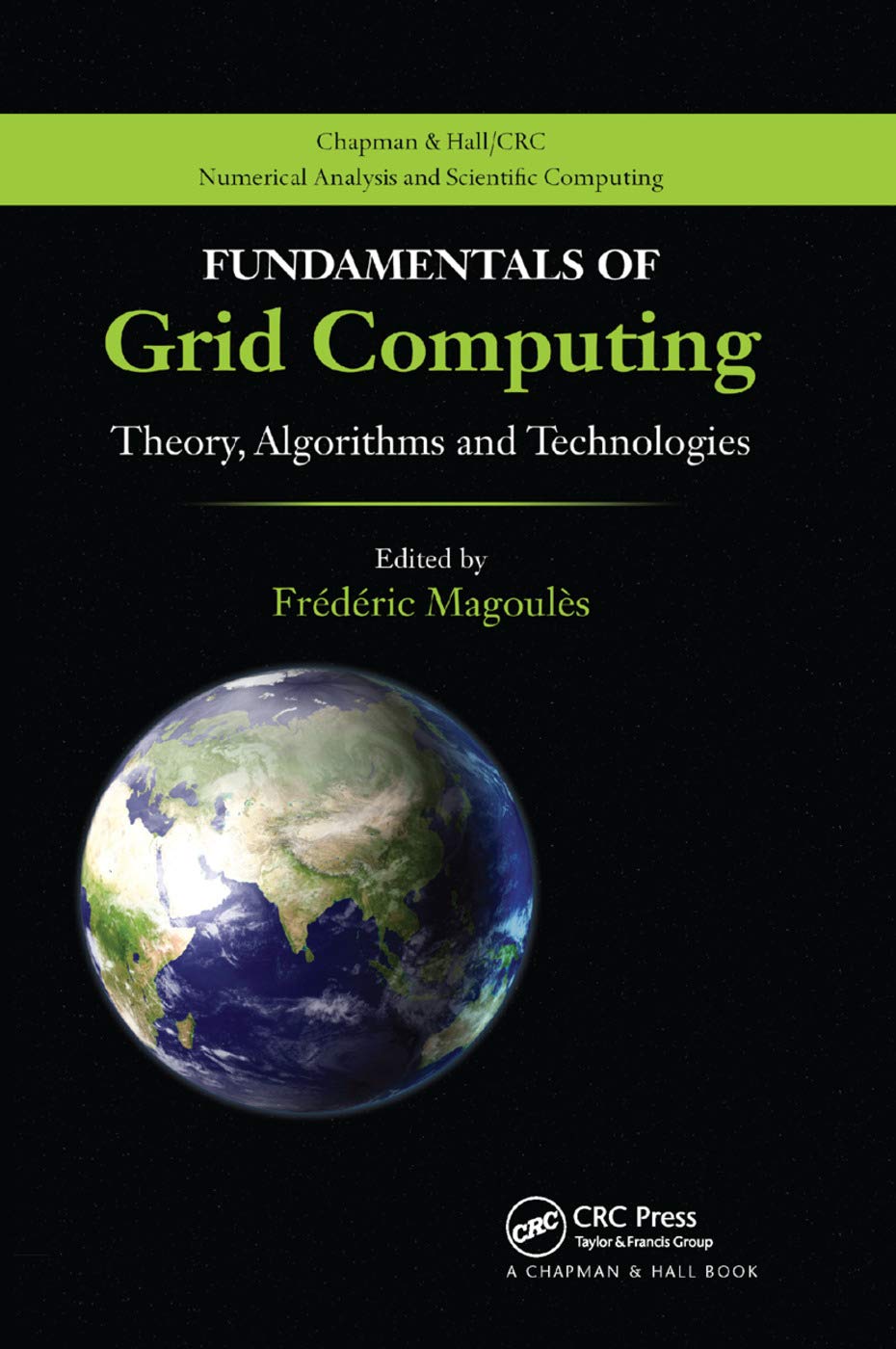
Title
Fundamentals of Grid Computing: Theory, Algorithms and Technologies (Chapman & Hall/Crc Numerical Analysis and Scientific Comput,New
Sold by Ergodebooks, an authorized reseller.
Returns accepted within 30 days | support@ergodebooks.com
Shipping Information
- Free Standard Shipping — United States only
- Processing Time: 3–5 business days
- Estimated Delivery: 6–10 business days after dispatch
- Double-boxed, fully insured & discreetly packaged
- Tracking number sent via email once dispatched
Returns & Refund
Returns accepted within 30 days of delivery.
Damaged or Defective Item
Free return shipping + replacement or full refund
Wrong Item Received
Free return shipping + replacement or full refund
Change of Mind
Return shipping at customer's expense · 25% restocking fee applies
Payment Option

The integration and convergence of stateoftheart technologies in the grid have enabled more flexible, automatic, and complex grid services to fulfill industrial and commercial needs, from the LHC at CERN to meteorological forecasting systems. Fundamentals of Grid Computing: Theory, Algorithms and Technologies discusses how the novel technologies of semantic web and workflow have been integrated into the grid and grid services.The book explains how distributed mutual exclusion algorithms offer solutions to transmission and control processes. It also addresses the replication problem in data grids with limited replica storage and the problem of data management in grids. After comparing utility, grid, autonomic, and cloud computing, the book presents efficient solutions for the reliable execution of applications in computational grid platforms. It then describes a fault tolerant distributed scheduling algorithm for largescale distributed applications, along with broadcasting algorithms for institutional grids. The final chapter shows how load balancing is integrated into a realworld scientific application.Helping readers develop practical skills in grid technology, the appendices introduce userfriendly open source software written in Java. One of the software packages covers strategies for data replication in the grid. The other deals with the implementation of a simulator for distributed scheduling in grid environments.The various technology presented in this book demonstrates the wide aspects of interest in grid computing as well as the many possibilities and venues that exist in this research area. This interest will only further evolve as numerous exciting developments still await us.
⚠️ WARNING (California Proposition 65):
This product may contain chemicals known to the State of California to cause cancer, birth defects, or other reproductive harm.
For more information, please visit www.P65Warnings.ca.gov.