
Title
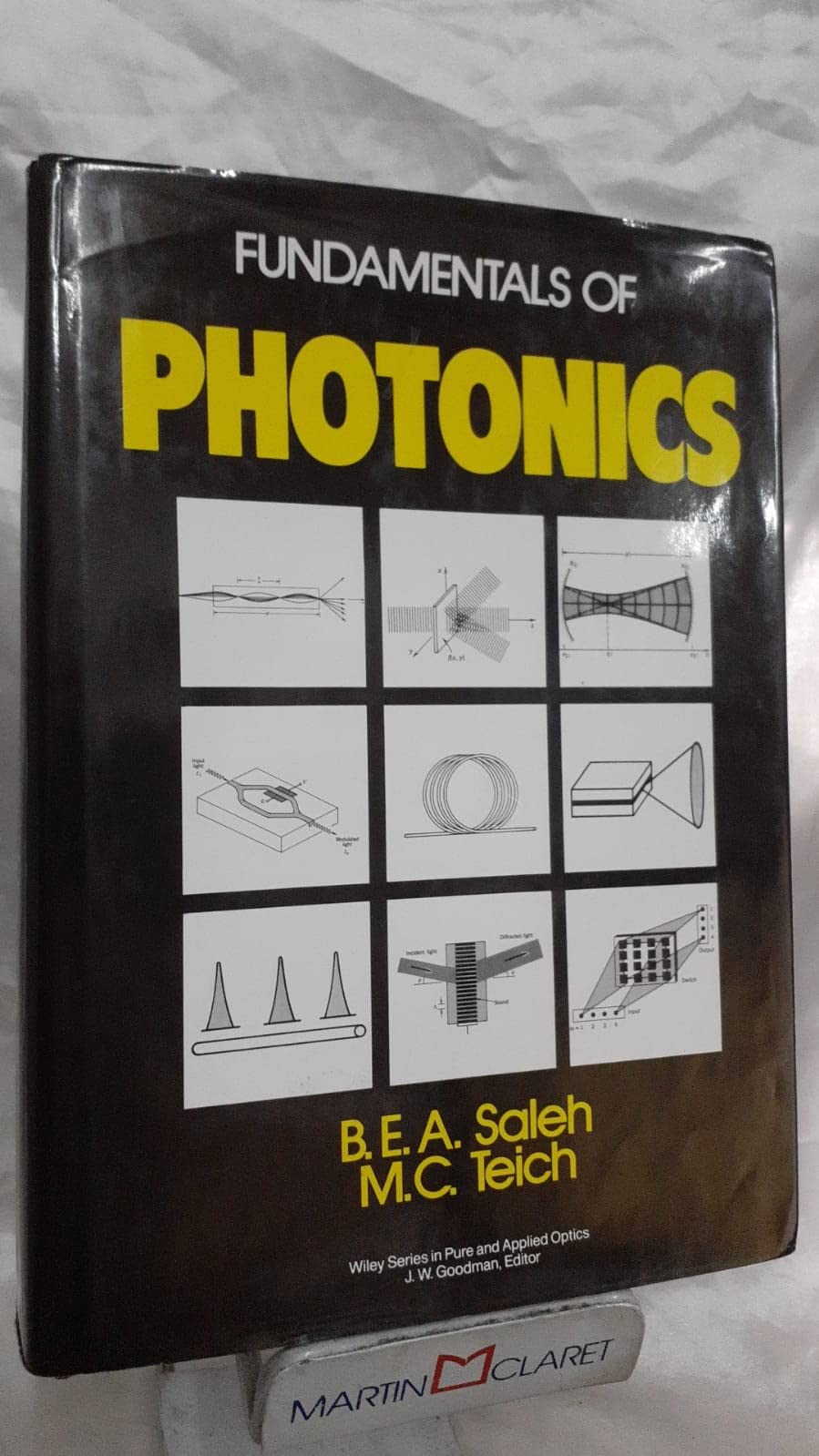
Fundamentals Of Photonics (Wiley Series In Pure And Applied Optics)
Sold by Ergodebooks, an authorized reseller.
Returns accepted within 30 days | support@ergodebooks.com
Shipping Information
- Free Standard Shipping — United States only
- Processing Time: 3–5 business days
- Estimated Delivery: 6–10 business days after dispatch
- Double-boxed, fully insured & discreetly packaged
- Tracking number sent via email once dispatched
Returns & Refund
Returns accepted within 30 days of delivery.
Damaged or Defective Item
Free return shipping + replacement or full refund
Wrong Item Received
Free return shipping + replacement or full refund
Change of Mind
Return shipping at customer's expense · 25% restocking fee applies
Payment Option

In Recent Years, Photonics Has Found Increasing Applications In Such Areas As Communications, Signal Processing, Computing, Sensing, Display, Printing, And Energy Transport. Now, Fundamentals Of Photonics Is The First Selfcontained Introductorylevel Textbook To Offer A Thorough Survey Of This Rapidly Expanding Area Of Engineering And Applied Physics. Featuring A Logical Blend Of Theory And Applications, Coverage Includes Detailed Accounts Of The Primary Theories Of Light, Including Ray Optics, Wave Optics, Electromagnetic Optics, And Photon Optics, As Well As The Interaction Of Light With Matter, And The Theory Of Semiconductor Materials And Their Optical Properties.Presented At Increasing Levels Of Complexity, These Sections Serve As Building Blocks For The Treatment Of More Advanced Topics, Such As Fourier Optics And Holography, Guidedwave And Fiber Optics, Photon Sources And Detectors, Electrooptic And Acoustooptic Devices, Nonlinear Optical Devices, Fiberoptic Communications, And Photonic Switching And Computing. Included Are Such Vital Topics As: Generation Of Coherent Light By Lasers, And Incoherent Light By Luminescence Sources Such As Lightemitting Diodes Transmission Of Light Through Optical Components (Lenses, Apertures, And Imaging Systems), Waveguides, And Fibers Modulation, Switching, And Scanning Of Light Through The Use Of Electrically, Acoustically, And Optically Controlled Devices Amplification And Frequency Conversion Of Light By The Use Of Wave Interactions In Nonlinear Materials Detection Of Light By Means Of Semiconductor Photodetectorseach Chapter Contains Summaries, Highlighted Equations, Problem Sets And Exercises, And Selected Reading Lists. Examples Of Real Systems Are Included To Emphasize The Concepts Governing Applications Of Current Interest, And Appendices Summarize The Properties Of One And Twodimensional Fourier Transforms, Linearsystems Theory, And Modes Of Linear Systems.An Instructor'S Manual Presenting Detailed Solutions To All The Problems In The Book Is Available From The Wiley Editorial Department.
⚠️ WARNING (California Proposition 65):
This product may contain chemicals known to the State of California to cause cancer, birth defects, or other reproductive harm.
For more information, please visit www.P65Warnings.ca.gov.
- Q: What is the page count of Fundamentals of Photonics? A: This book contains nine hundred ninety-two pages. It provides an extensive overview of photonics, making it suitable for readers seeking in-depth knowledge.
- Q: What are the dimensions of the book? A: The book measures seven point four inches in length, one point ninety-seven inches in width, and ten point four inches in height. These dimensions make it a manageable size for reading and reference.
- Q: What type of binding does the book have? A: The Fundamentals of Photonics is bound in hardcover. This ensures durability and longevity for frequent use and learning.
- Q: How do I use this book effectively? A: Readers can utilize this book as a comprehensive introduction to photonics. It is structured with summaries and exercises to reinforce understanding of key concepts.
- Q: Is this book suitable for beginners? A: Yes, this book is ideal for beginners. It presents complex theories in a logical progression, making it accessible for those new to photonics.
- Q: What level of education is this book intended for? A: This textbook is designed for undergraduate students and professionals. It serves as an introductory resource for those studying engineering and applied physics.
- Q: How should I care for this book to keep it in good condition? A: To maintain the book's condition, store it upright in a dry location. Avoid exposure to moisture and direct sunlight to preserve its integrity.
- Q: Is the book safe to store with other materials? A: Yes, it is safe to store alongside other books and materials. Just ensure it is in a stable, dry environment to prevent damage.
- Q: Can I return the book if I am not satisfied? A: Yes, you can return the book if you are not satisfied. Review the return policy for details on eligibility and timeframes.
- Q: What should I do if the book arrives damaged? A: If the book arrives damaged, contact customer support immediately. They will guide you through the return or exchange process.
- Q: How does this book compare to other photonics textbooks? A: This textbook offers a unique blend of theory and application, making it a standout choice among photonics literature. Its comprehensive coverage is beneficial for learners.
- Q: Is this book suitable for professionals in the field? A: Yes, this book is suitable for professionals. It covers advanced topics that can enhance the knowledge of those already working in photonics.
- Q: What topics are covered in Fundamentals of Photonics? A: The book covers topics like ray optics, wave optics, and fiber optics, providing a thorough understanding of the principles of photonics.
- Q: Does the book include practical examples? A: Yes, it includes real-world examples to illustrate concepts. This helps readers understand the practical applications of photonics.
- Q: Is there a manual available for instructors? A: Yes, an Instructor's Manual is available. It contains detailed solutions to all problems in the book, aiding teachers in guiding students.