
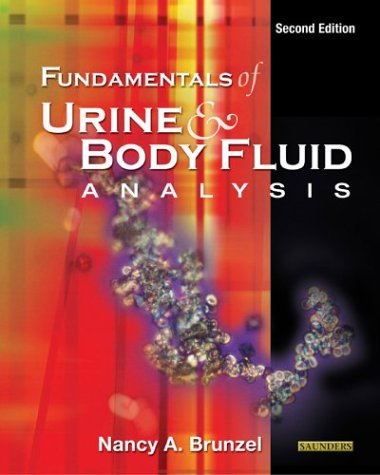
Title
Fundamentals of Urine & Body Fluid Analysis,Used
Sold by Ergodebooks, an authorized reseller.
Returns accepted within 30 days | support@ergodebooks.com
Shipping Information
- Free Standard Shipping — United States only
- Processing Time: 3–5 business days
- Estimated Delivery: 6–10 business days after dispatch
- Double-boxed, fully insured & discreetly packaged
- Tracking number sent via email once dispatched
Returns & Refund
Returns accepted within 30 days of delivery.
Damaged or Defective Item
Free return shipping + replacement or full refund
Wrong Item Received
Free return shipping + replacement or full refund
Change of Mind
Return shipping at customer's expense · 25% restocking fee applies
Payment Option

Renowned for its clear writing style, organization, level and depth of content, and excellent color illustrations, this reference covers the collection and analysis of urine, fecal specimens, vaginal secretions, and other body fluids such as cerebrospinal, synovial, seminal, amniotic, pleural, pericardial, and peritoneal fluids. It covers all aspects of fluid analysis from basic factual information and essential techniques and procedures, to easytograsp explanations of how data is correlated with the basic knowledge of anatomy and physiology to understand pathologic processes. More than 120 photomicrographs are pictured beside their textual explanations to ensure maximum comprehension and understanding. Extensive diagrams and tables throughout the text clarify concepts and reinforce content. Discussion of each body fluid includes the physiology of formation, its composition, diagnostic importance, and the clinical procedures frequently performed. Various pedagogical elements such as chapter outlines, learning objectives, key terms, case studies, and study questions reinforce the most important information in each chapter. The chapter on Quality Assurance and Safety (Chapter 2) focuses on the importance of following established lab protocols and guidelines in the clinical lab. A glossary of scientific terms appears in the back of the book for convenient reference to succinct, accurate definitions. A unique, new chapter on Analysis of Vaginal Secretions covering wet mount preparation, evaluation, and disease correlation. A urine sediment image glossary containing over 90 images that serves as a visual reference for identifying cells, crystals, casts, and other elements at the microscope. In addition, these images are almost exclusively of unstained sediment using Brightfield microscopy the technique most frequently used in clinical laboratories. Case studies at the end of relevant chapters to assist in applying key concepts to reallife scenarios and test reader knowledge.
⚠️ WARNING (California Proposition 65):
This product may contain chemicals known to the State of California to cause cancer, birth defects, or other reproductive harm.
For more information, please visit www.P65Warnings.ca.gov.
- Q: How many pages does this book have? A: This book contains four hundred sixty-four pages. It provides comprehensive coverage of urine and body fluid analysis.
- Q: What are the dimensions of this book? A: The book measures eight point twenty-seven inches in length, zero point seventy-five inches in width, and ten inches in height.
- Q: What type of binding does this book have? A: This book is available in paperback binding. This makes it lightweight and easy to handle.
- Q: Who is the author of this book? A: The author of this book is Nancy A. Brunzel, MS, CLS(NCA). She is recognized for her expertise in medical technology.
- Q: What is the main subject of this book? A: The book focuses on the analysis of urine and various body fluids. It covers collection, techniques, and diagnostic importance.
- Q: Is this book suitable for beginners? A: Yes, this book is suitable for beginners and professionals alike. It offers clear explanations and pedagogical elements to support learning.
- Q: Are there case studies included in this book? A: Yes, the book includes case studies at the end of relevant chapters. These help readers apply key concepts to real-life scenarios.
- Q: How do I use the information in this book? A: You can use the information by reading the chapters, focusing on key terms and case studies for practical application. It’s designed for both study and reference.
- Q: Does this book include diagrams and tables? A: Yes, extensive diagrams and tables are included throughout the text. They clarify concepts and reinforce the content effectively.
- Q: What is the focus of Chapter 2? A: Chapter 2 focuses on Quality Assurance and Safety. It emphasizes the importance of following established lab protocols in clinical settings.
- Q: Is there a glossary in this book? A: Yes, there is a glossary of scientific terms at the back of the book. It provides succinct, accurate definitions for quick reference.
- Q: Can I find images of urine sediment in this book? A: Yes, the book contains a urine sediment image glossary with over ninety images. This serves as a visual reference for identifying key elements.
- Q: What aspects of body fluids are covered? A: The book covers the physiology of formation, composition, diagnostic importance, and clinical procedures for various body fluids.
- Q: Is this book recommended for medical students? A: Yes, this book is highly recommended for medical students. Its clear writing and comprehensive content make it an essential resource.
- Q: What is the overall tone of this book? A: The overall tone of the book is clinical and informative. It aims to provide readers with a thorough understanding of urine and body fluid analysis.