

Title

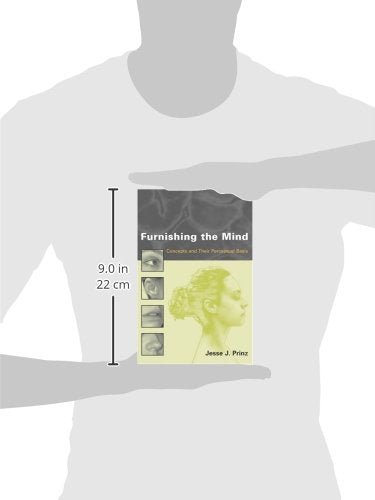
Furnishing the Mind: Concepts and Their Perceptual Basis (Representation and Mind series),New
Sold by Ergodebooks, an authorized reseller.
Returns accepted within 30 days | support@ergodebooks.com
Shipping Information
- Free Standard Shipping — United States only
- Processing Time: 3–5 business days
- Estimated Delivery: 6–10 business days after dispatch
- Double-boxed, fully insured & discreetly packaged
- Tracking number sent via email once dispatched
Returns & Refund
Returns accepted within 30 days of delivery.
Damaged or Defective Item
Free return shipping + replacement or full refund
Wrong Item Received
Free return shipping + replacement or full refund
Change of Mind
Return shipping at customer's expense · 25% restocking fee applies
Payment Option

Western philosophy has long been divided between empiricists, who argue that human understanding has its basis in experience, and rationalists, who argue that reason is the source of knowledge. A central issue in the debate is the nature of concepts, the internal representations we use to think about the world. The traditional empiricist thesis that concepts are built up from sensory input has fallen out of favor. Mainstream cognitive science tends to echo the rationalist tradition, with its emphasis on innateness. In Furnishing the Mind, Jesse Prinz attempts to swing the pendulum back toward empiricism.Prinz provides a critical survey of leading theories of concepts, including imagism, definitionism, prototype theory, exemplar theory, the theory theory, and informational atomism. He sets forth a new defense of concept empiricism that draws on philosophy, neuroscience, and psychology and introduces a new version of concept empiricism called proxytype theory. He also provides accounts of abstract concepts, intentionality, narrow content, and concept combination. In an extended discussion of innateness, he covers Noam Chomsky's arguments for the innateness of grammar, developmental psychologists' arguments for innate cognitive domains, and Jerry Fodor's argument for radical concept nativism.
⚠️ WARNING (California Proposition 65):
This product may contain chemicals known to the State of California to cause cancer, birth defects, or other reproductive harm.
For more information, please visit www.P65Warnings.ca.gov.