If you have any questions, you are always welcome to contact us. We'll get back to you as soon as possible, withing 24 hours on weekdays.
Customer service
All questions about your order, return and delivery must be sent to our customer service team by e-mail at yourstore@yourdomain.com
Sale & Press
If you are interested in selling our products, need more information about our brand or wish to make a collaboration, please contact us at press@yourdomain.com
Help
If you have any questions, you are always welcome to contact us. We'll get back to you as soon as possible, withing 24 hours on weekdays.
Customer service
All questions about your order, return and delivery must be sent to our customer service team by e-mail at yourstore@yourdomain.com
Sale & Press
If you are interested in selling our products, need more information about our brand or wish to make a collaboration, please contact us at press@yourdomain.com
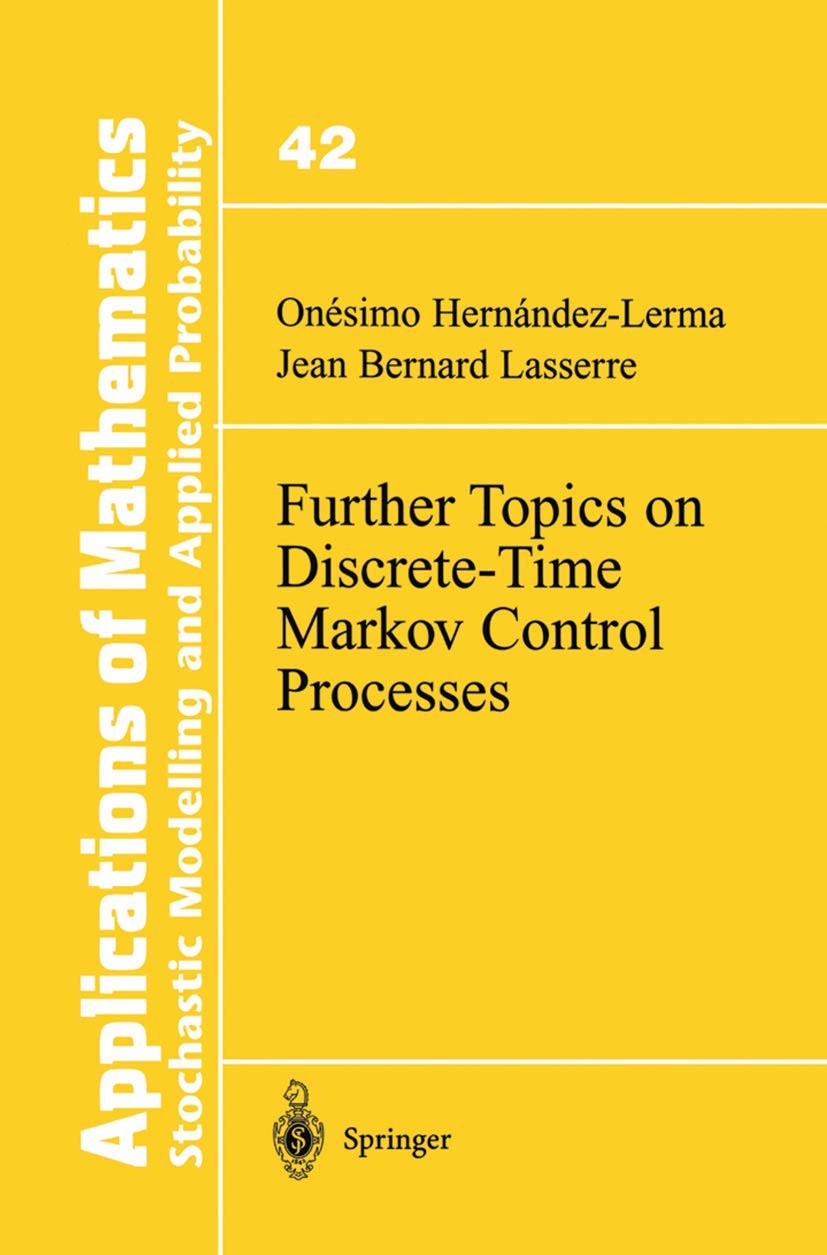
This book presents the second part of a twovolume series devoted to a sys tematic exposition of some recent developments in the theory of discrete time Markov control processes (MCPs). As in the first part, hereafter re ferred to as 'Volume I' (see HernandezLerma and Lasserre [1]), interest is mainly confined to MCPs with Borel state and control spaces, and possibly unbounded costs. However, an important feature of the present volume is that it is essentially selfcontained and can be read independently of Volume I. The reason for this independence is that even though both volumes deal with similar classes of MCPs, the assumptions on the control models are usually different. For instance, Volume I deals only with nonnegative cost perstage functions, whereas in the present volume we allow cost functions to take positive or negative values, as needed in some applications. Thus, many results in Volume Ion, say, discounted or average cost problems are not applicable to the models considered here. On the other hand, we now consider control models that typically re quire more restrictive classes of controlconstraint sets and/or transition laws. This loss of generality is, of course, deliberate because it allows us to obtain more 'precise' results. For example, in a very general context, in 4.
⚠️ WARNING (California Proposition 65):
This product may contain chemicals known to the State of California to cause cancer,
birth defects, or other reproductive harm.
For MAP (Minimum Advertised Price) violations and Intellectual Property (IP) or Trademark concerns, please contact:
support@ergodebooks.com
⚠️ California Proposition 65 Warning: Some products sold on this website may expose you to chemicals known to the State of California to cause cancer, birth defects, or other reproductive harm. For more information, visit www.P65Warnings.ca.gov.