
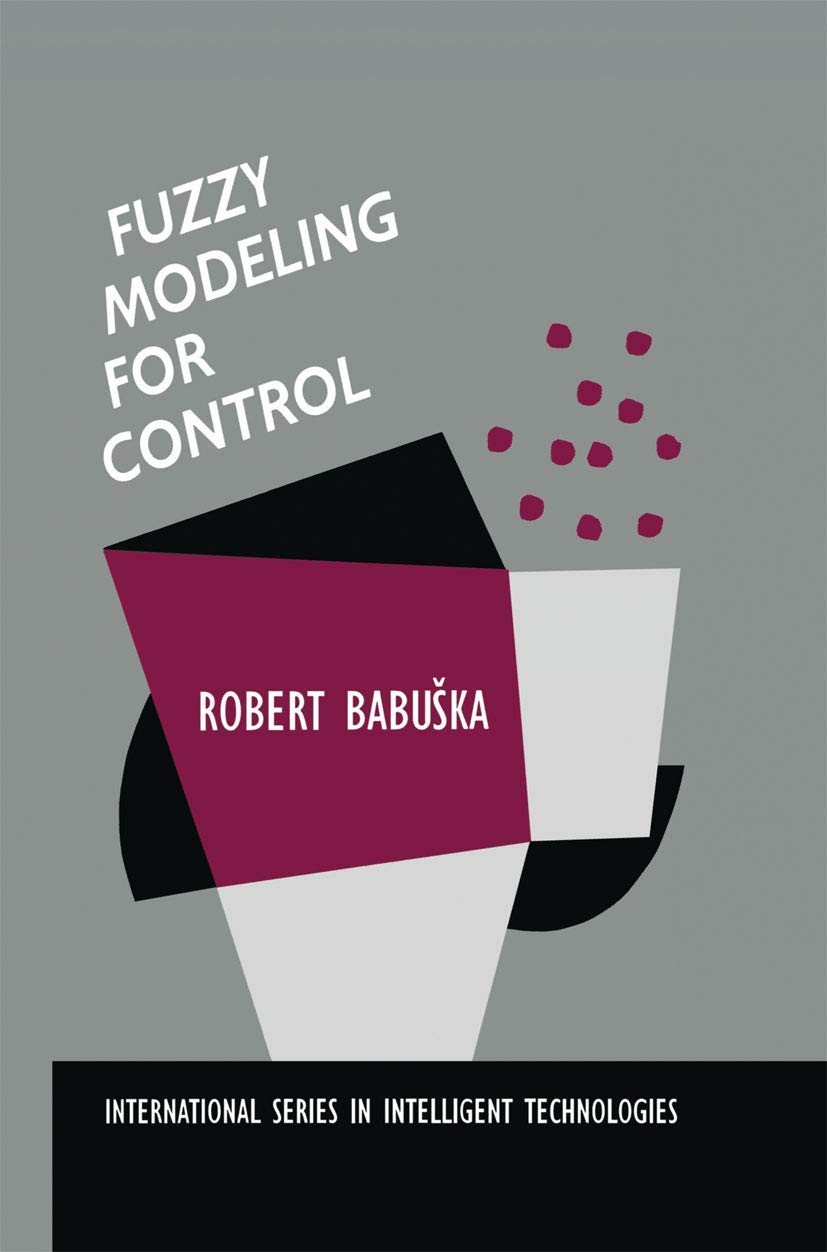
Title
Fuzzy Modeling for Control (International Series in Intelligent Technologies, 12),Used
Sold by Ergodebooks, an authorized reseller.
Returns accepted within 30 days | support@ergodebooks.com
Shipping Information
- Free Standard Shipping — United States only
- Processing Time: 3–5 business days
- Estimated Delivery: 6–10 business days after dispatch
- Double-boxed, fully insured & discreetly packaged
- Tracking number sent via email once dispatched
Returns & Refund
Returns accepted within 30 days of delivery.
Damaged or Defective Item
Free return shipping + replacement or full refund
Wrong Item Received
Free return shipping + replacement or full refund
Change of Mind
Return shipping at customer's expense · 25% restocking fee applies
Payment Option

Rulebased fuzzy modeling has been recognised as a powerful technique for the modeling of partlyknown nonlinear systems. Fuzzy models can effectively integrate information from different sources, such as physical laws, empirical models, measurements and heuristics. Application areas of fuzzy models include prediction, decision support, system analysis, control design, etc. Fuzzy Modeling for Control addresses fuzzy modeling from the systems and control engineering points of view. It focuses on the selection of appropriate model structures, on the acquisition of dynamic fuzzy models from process measurements (fuzzy identification), and on the design of nonlinear controllers based on fuzzy models.To automatically generate fuzzy models from measurements, a comprehensive methodology is developed which employs fuzzy clustering techniques to partition the available data into subsets characterized by locally linear behaviour. The relationships between the presented identification method and linear regression are exploited, allowing for the combination of fuzzy logic techniques with standard system identification tools. Attention is paid to the tradeoff between the accuracy and transparency of the obtained fuzzy models. Control design based on a fuzzy model of a nonlinear dynamic process is addressed, using the concepts of modelbased predictive control and internal model control with an inverted fuzzy model. To this end, methods to exactly invert specific types of fuzzy models are presented. In the context of predictive control, branchandbound optimization is applied.The main features of the presented techniques are illustrated by means of simple examples. In addition, three realworld applications are described. Finally, software tools for building fuzzy models from measurements are available from the author.
⚠️ WARNING (California Proposition 65):
This product may contain chemicals known to the State of California to cause cancer, birth defects, or other reproductive harm.
For more information, please visit www.P65Warnings.ca.gov.