If you have any questions, you are always welcome to contact us. We'll get back to you as soon as possible, withing 24 hours on weekdays.
Customer service
All questions about your order, return and delivery must be sent to our customer service team by e-mail at yourstore@yourdomain.com
Sale & Press
If you are interested in selling our products, need more information about our brand or wish to make a collaboration, please contact us at press@yourdomain.com
Help
If you have any questions, you are always welcome to contact us. We'll get back to you as soon as possible, withing 24 hours on weekdays.
Customer service
All questions about your order, return and delivery must be sent to our customer service team by e-mail at yourstore@yourdomain.com
Sale & Press
If you are interested in selling our products, need more information about our brand or wish to make a collaboration, please contact us at press@yourdomain.com
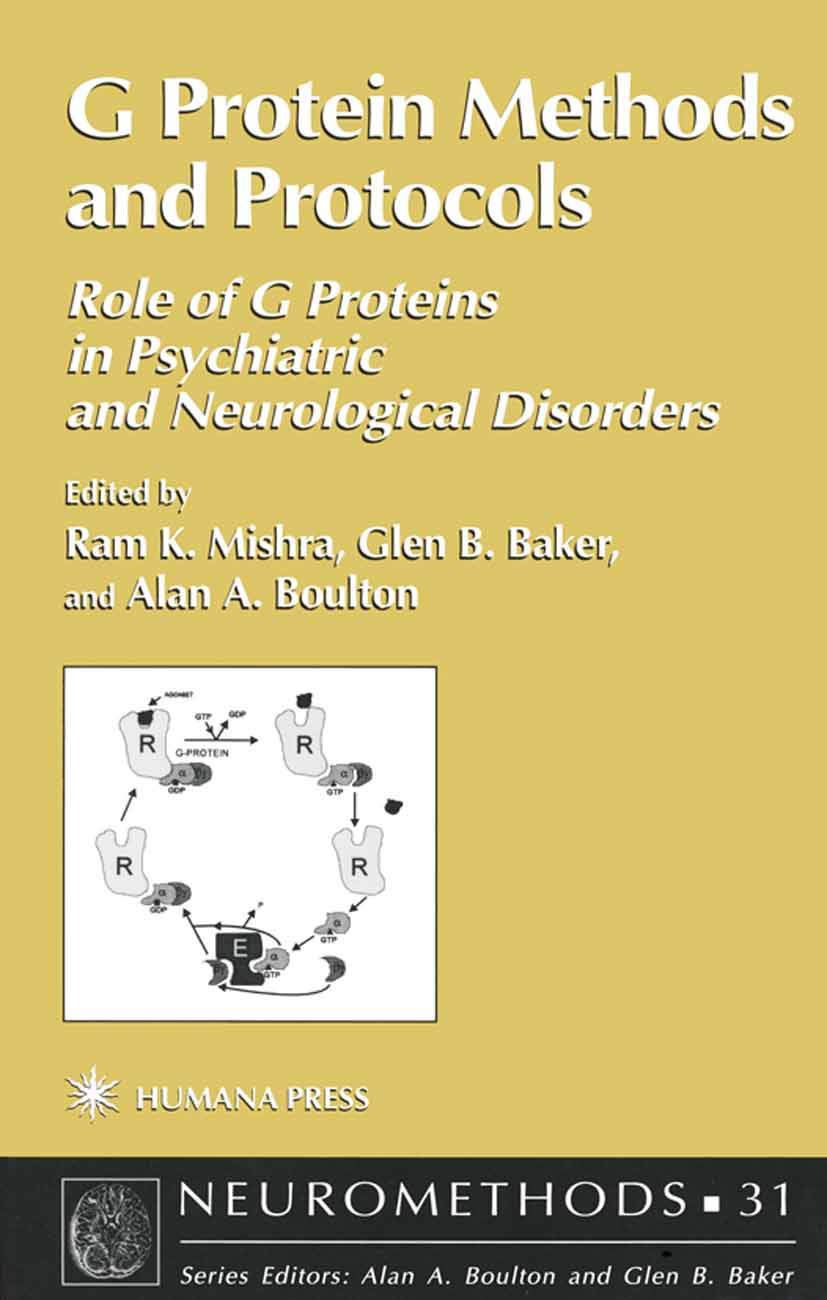
The G proteins are a family of structurally homologous, plasma membraneassociated guaninenucleotidebinding proteins. These proteins play an integral role in the tra duction of extracellular signals through second messenger systems. As such, G proteins affect a wide variety of intra cellular biochemical reactions by regulating the concent tion of second messengers in cells. G proteins are heterotrimeric, consisting of a, p, and y polypeptide chains, with G protein specificity largely det mined by the asubunit, Molecular cloning of G protein s units has revealed 23 distinct asubunits, encoded by 17 different genes. Based on functional measures, G proteins are generally classified into three major categories: the G, family, which is stimulatory for adenylyl cyclase; the G, f ily, which is inhibitory for adenylyl cyclase; and the G, f ily, which stimulates phospholipases (Birnbaumer and Birnbaumer, 1995). Alternatively, on the basis of sequence homology, G proteins can be subdivided into four cate ries: G,, G,, G,, and G12.
⚠️ WARNING (California Proposition 65):
This product may contain chemicals known to the State of California to cause cancer,
birth defects, or other reproductive harm.
For MAP (Minimum Advertised Price) violations and Intellectual Property (IP) or Trademark concerns, please contact:
support@ergodebooks.com
⚠️ California Proposition 65 Warning: Some products sold on this website may expose you to chemicals known to the State of California to cause cancer, birth defects, or other reproductive harm. For more information, visit www.P65Warnings.ca.gov.