
Title
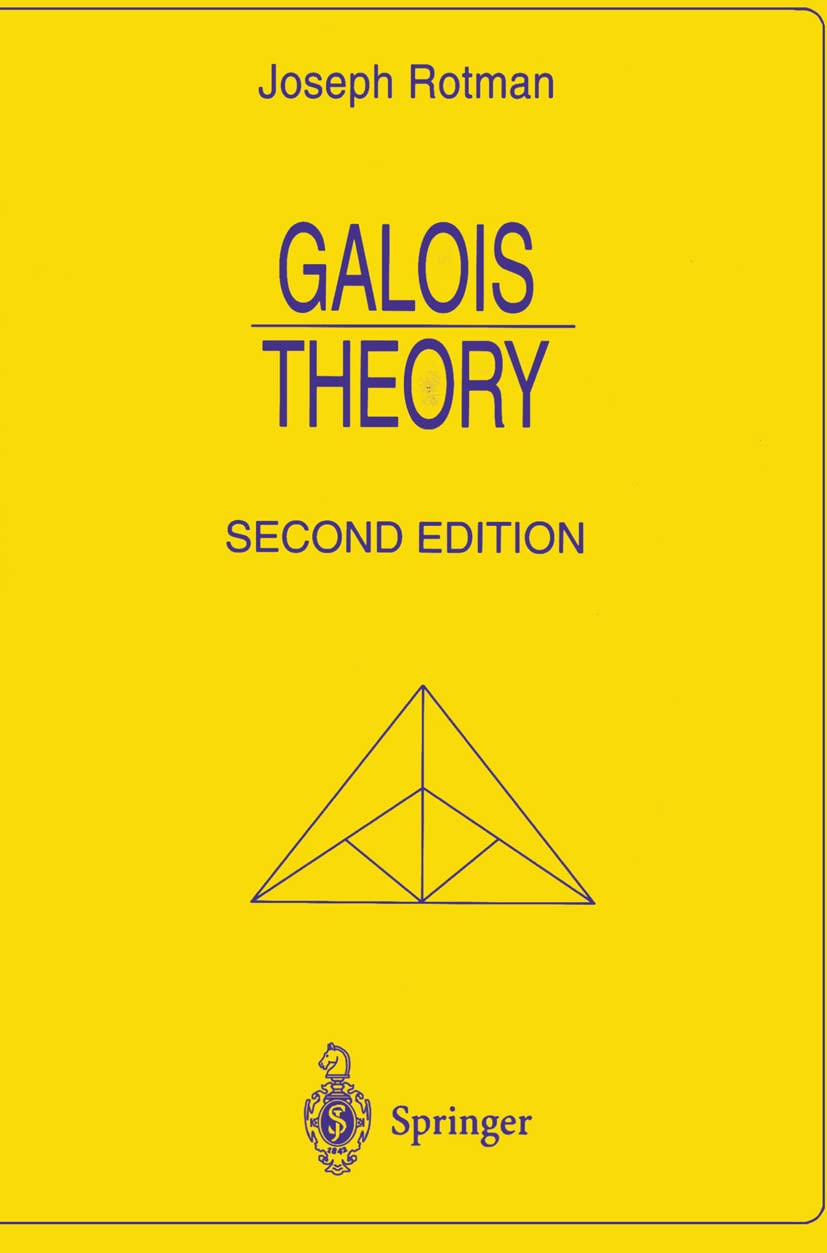
Galois Theory (Universitext),Used
Sold by Ergodebooks, an authorized reseller.
Returns accepted within 30 days | support@ergodebooks.com
Shipping Information
- Free Standard Shipping — United States only
- Processing Time: 3–5 business days
- Estimated Delivery: 6–10 business days after dispatch
- Double-boxed, fully insured & discreetly packaged
- Tracking number sent via email once dispatched
Returns & Refund
Returns accepted within 30 days of delivery.
Damaged or Defective Item
Free return shipping + replacement or full refund
Wrong Item Received
Free return shipping + replacement or full refund
Change of Mind
Return shipping at customer's expense · 25% restocking fee applies
Payment Option

The First Edition Aimed To Give A Geodesic Path To The Fundamental Theorem Of Galois Theory, And I Still Think Its Brevity Is Valuable. Alas, The Book Is Now A Bit Longer, But I Feel That The Changes Are Worthwhile. I Began By Rewriting Almost All The Text, Trying To Make Proofs Clearer, And Often Giving More Details Than Before. Since Many Students Find The Road To The Fundamental Theorem An Intricate One, The Book Now Begins With A Short Section On Symmetry Groups Of Polygons In The Plane; An Analogy Of Polygons And Their Symmetry Groups With Polynomials And Their Galois Groups Can Serve As A Guide By Helping Readers Organize The Various Definitions And Constructions. The Exposition Has Been Reorganized So That The Discussion Of Solvability By Radicals Now Appears Later; This Makes The Proof Of The Abelruffini Theo Rem Easier To Digest. I Have Also Included Several Theorems Not In The First Edition. For Example, The Casus Irreducibilis Is Now Proved, In Keeping With A Historical Interest Lurking In These Pages.
⚠️ WARNING (California Proposition 65):
This product may contain chemicals known to the State of California to cause cancer, birth defects, or other reproductive harm.
For more information, please visit www.P65Warnings.ca.gov.
- Q: What is the page count of Galois Theory? A: The book contains one hundred fifty-seven pages. This length provides a concise yet thorough exploration of Galois Theory.
- Q: What are the dimensions of the Galois Theory paperback? A: The paperback measures six point one inches by nine point two five inches and is zero point four inches thick. These dimensions make it easy to handle and read.
- Q: Who is the author of Galois Theory? A: The author is Joseph Rotman. He is known for his contributions to mathematics, particularly in abstract algebra.
- Q: How do I approach reading Galois Theory? A: Begin with the initial section on symmetry groups of polygons. This analogy helps clarify the relationship between polynomials and their Galois groups.
- Q: Is Galois Theory suitable for beginners? A: Yes, it is suitable for advanced beginners. The book is designed to guide readers through complex concepts in a structured manner.
- Q: What mathematical concepts does Galois Theory cover? A: It covers fundamental concepts like symmetry groups, Galois groups, and solvability by radicals. The book also includes historical theorems.
- Q: How should I care for my Galois Theory book? A: Store it in a cool, dry place to prevent damage. Avoid exposure to direct sunlight to keep the pages from fading.
- Q: Can I clean the Galois Theory book if it gets dirty? A: Yes, gently wipe the cover with a soft cloth. Avoid using water or cleaning solutions that could damage the pages.
- Q: What happens if my Galois Theory book arrives damaged? A: You can return it for a replacement or refund. Check the seller's return policy for specific instructions.
- Q: Does Galois Theory include exercises or problems? A: No, it does not include exercises. It focuses on theoretical concepts and theorems in abstract algebra.
- Q: Is there a glossary or index in Galois Theory? A: Yes, there is an index to help locate specific topics. This makes it easier to reference key concepts quickly.
- Q: What is the binding type of the Galois Theory book? A: The book is paperback bound. This type of binding is lightweight and portable, ideal for study and reference.
- Q: Is Galois Theory written in a clear style? A: Yes, the author has rewritten much of the text for clarity. The organization of topics helps facilitate understanding.
- Q: Does Galois Theory discuss historical theorems? A: Yes, it includes discussions on historical theorems such as the Casus Irreducibilis. This adds depth to the theoretical content.
- Q: Is this book appropriate for graduate studies? A: Yes, it is appropriate for graduate studies. The text provides essential insights into advanced algebraic concepts.