If you have any questions, you are always welcome to contact us. We'll get back to you as soon as possible, withing 24 hours on weekdays.
Customer service
All questions about your order, return and delivery must be sent to our customer service team by e-mail at yourstore@yourdomain.com
Sale & Press
If you are interested in selling our products, need more information about our brand or wish to make a collaboration, please contact us at press@yourdomain.com
Help
If you have any questions, you are always welcome to contact us. We'll get back to you as soon as possible, withing 24 hours on weekdays.
Customer service
All questions about your order, return and delivery must be sent to our customer service team by e-mail at yourstore@yourdomain.com
Sale & Press
If you are interested in selling our products, need more information about our brand or wish to make a collaboration, please contact us at press@yourdomain.com
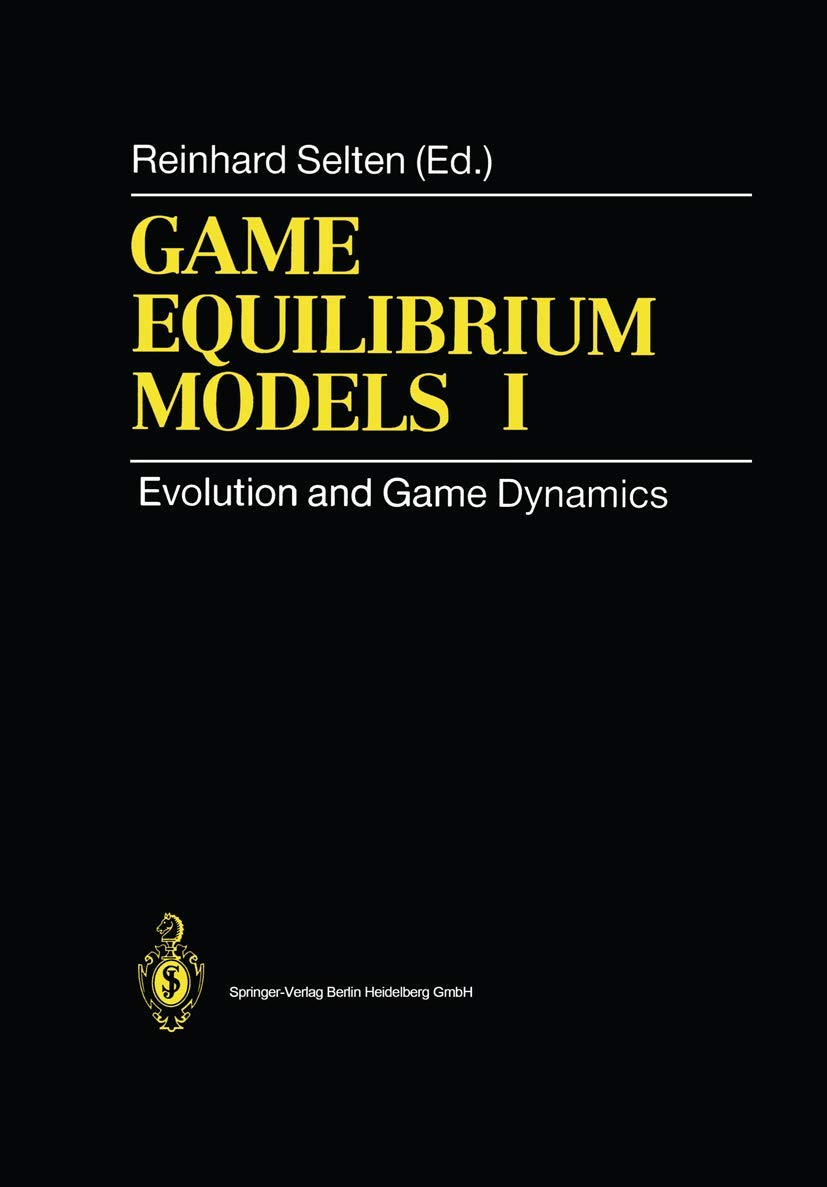
There are two main approaches towards the phenotypic analysis of frequency dependent natural selection. First, there is the approach of evolutionary game theory, which was introduced in 1973 by John Maynard Smith and George R. Price. In this theory, the dynamical process of natural selection is not modeled explicitly. Instead, the selective forces acting within a population are represented by a fitness function, which is then analysed according to the concept of an evolutionarily stable strategy or ESS. Later on, the static approach of evolutionary game theory has been complemented by a dynamic stability analysis of the replicator equations. Introduced by Peter D. Taylor and Leo B. Jonker in 1978, these equations specify a class of dynamical systems, which provide a simple dynamic description of a selection process. Usually, the investigation of the replicator dynamics centers around a stability analysis of their stationary solutions. Although evolutionary stability and dynamic stability both intend to characterize the longterm outcome of frequency dependent selection, these concepts differ considerably in the 'philosophies' on which they are based. It is therefore not too surprising that they often lead to quite different evolutionary predictions (see, e. g. , Weissing 1983). The present paper intends to illustrate the incongruities between the two approaches towards a phenotypic theory of natural selection. A detailed game theoretical and dynamical analysis is given for a generic class of evolutionary normal form games.
⚠️ WARNING (California Proposition 65):
This product may contain chemicals known to the State of California to cause cancer,
birth defects, or other reproductive harm.
For MAP (Minimum Advertised Price) violations and Intellectual Property (IP) or Trademark concerns, please contact:
support@ergodebooks.com
⚠️ California Proposition 65 Warning: Some products sold on this website may expose you to chemicals known to the State of California to cause cancer, birth defects, or other reproductive harm. For more information, visit www.P65Warnings.ca.gov.