If you have any questions, you are always welcome to contact us. We'll get back to you as soon as possible, withing 24 hours on weekdays.
Customer service
All questions about your order, return and delivery must be sent to our customer service team by e-mail at yourstore@yourdomain.com
Sale & Press
If you are interested in selling our products, need more information about our brand or wish to make a collaboration, please contact us at press@yourdomain.com
Help
If you have any questions, you are always welcome to contact us. We'll get back to you as soon as possible, withing 24 hours on weekdays.
Customer service
All questions about your order, return and delivery must be sent to our customer service team by e-mail at yourstore@yourdomain.com
Sale & Press
If you are interested in selling our products, need more information about our brand or wish to make a collaboration, please contact us at press@yourdomain.com
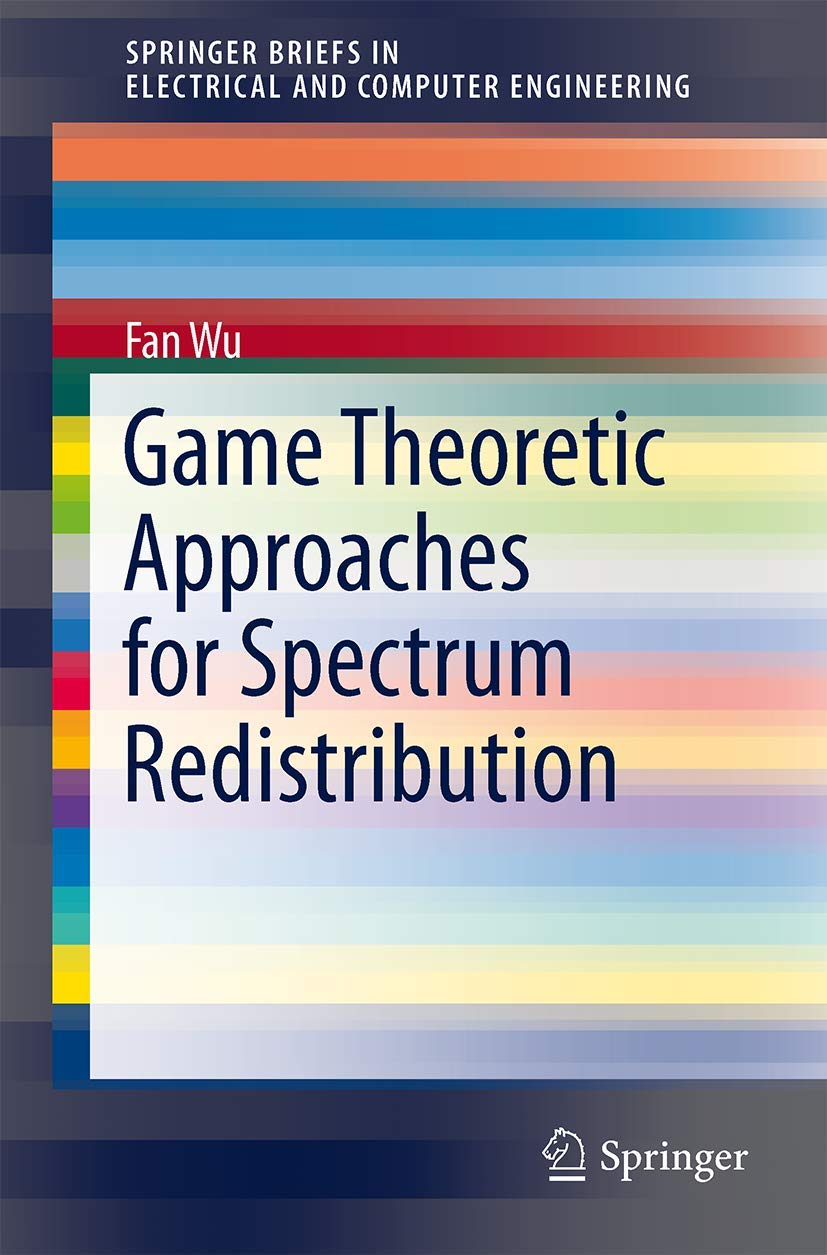
This brief examines issues of spectrum allocation for the limited resources of radio spectrum. It uses a gametheoretic perspective, in which the nodes in the wireless network are rational and always pursue their own objectives. It provides a systematic study of the approaches that can guarantee the systems convergence at an equilibrium state, in which the system performance is optimal or suboptimal. The author provides a short tutorial on game theory, explains gametheoretic channel allocation in clique and in multihop wireless networks and explores challenges in designing gametheoretic mechanisms for dynamic channel redistribution. Since designing a completely secure mechanism is extremely expensive or impossible in most of distributed autonomous systems, it is more beneficial to study misbehavior of the nodes and develop lightweighted gametheoretic channel allocation mechanisms. With a mix of theoretical and handson information, the brief traces the concepts of game theory, the current state of spectrum allocation in wireless networks and future competition for resources. Thorough yet accessible, the content is ideal for researchers and practitioners working on spectrum redistribution. It is also a helpful resource for researchers and advancedlevel students interested in game theory and wireless communications.
⚠️ WARNING (California Proposition 65):
This product may contain chemicals known to the State of California to cause cancer,
birth defects, or other reproductive harm.
For MAP (Minimum Advertised Price) violations and Intellectual Property (IP) or Trademark concerns, please contact:
support@ergodebooks.com
⚠️ California Proposition 65 Warning: Some products sold on this website may expose you to chemicals known to the State of California to cause cancer, birth defects, or other reproductive harm. For more information, visit www.P65Warnings.ca.gov.