
Title
Garbage In, Garbage Out: Solving The Problems With Longdistance Trash Transport,Used
Sold by Ergodebooks, an authorized reseller.
Returns accepted within 30 days | support@ergodebooks.com
Shipping Information
- Free Standard Shipping — United States only
- Processing Time: 3–5 business days
- Estimated Delivery: 6–10 business days after dispatch
- Double-boxed, fully insured & discreetly packaged
- Tracking number sent via email once dispatched
Returns & Refund
Returns accepted within 30 days of delivery.
Damaged or Defective Item
Free return shipping + replacement or full refund
Wrong Item Received
Free return shipping + replacement or full refund
Change of Mind
Return shipping at customer's expense · 25% restocking fee applies
Payment Option

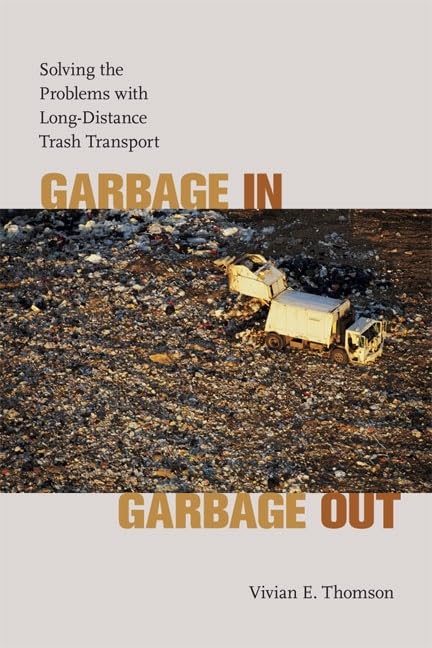
Your garbage is going places youd never imagine. What used to be sent to the local dump now may move hundreds of miles by truck and barge to its final resting place. Virtually all forms of pollution migrate, subjected to natural forces such as wind and water currents. The movement of garbage, however, is under human control. Its patterns of migration reveal much about power sharing among state, local, and national institutions, about the Constitutions protection of trash transport as a commercial activity, and about competing notions of social fairness. In Garbage In, Garbage Out, Vivian Thomson looks at Virginias status as the secondlargest importer of trash in the United States and uses it as a touchstone for exploring the many controversies around trash generation and disposal.Political conflicts over waste management have been felt at all levels of government. Local governments who want to manage their own trash have fought other local governments hosting huge landfills that depend on trash generated hundreds of miles away. State governments have tried to avoid becoming the dumping grounds for cities hundreds of miles away. The constitutional questions raised in these battles have kept interstate trash transport on Congresss agenda since the early 1990s. Whether the resulting legislative proposals actually address our most critical garbagerelated problems, however, remains in question.Thomson sheds muchneeded light on these problems. Within the context of increased interstate trash transport and the trend toward privatization of waste management, she examines the garbage issue from a number of perspectivesincluding the links between environmental justice and trash management, a critical evaluation of the theoretical and empirical relationship between economic growth and environmental improvement, and highlighting the ways in which waste management practices in the US differ from those in the European Union and Japan. Thomson then provides specific, substantive recommendations for our own policymakers.Everything eventually becomes trash. As we explore the long, often surprising, routes our garbage takes, we begin to understand that it is something more than a mere nuisance that regularly 'disappears' from our curbside. Rather, trash generation and management reflect patterns of consumption, political choices over whether garbage is primarily pollution or commerce, the social distribution of environmental risk, and how our daily lives compare with those of our counterparts in other industrialized nations.
⚠️ WARNING (California Proposition 65):
This product may contain chemicals known to the State of California to cause cancer, birth defects, or other reproductive harm.
For more information, please visit www.P65Warnings.ca.gov.