
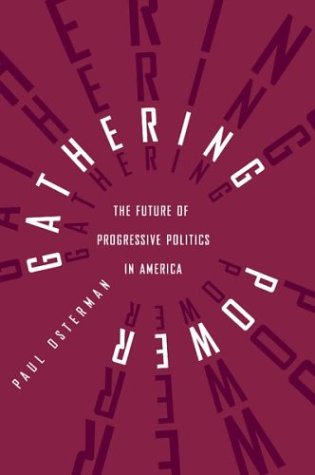
Title
Gathering Power: The Future of Progressive Politics in America,Used
Sold by Ergodebooks, an authorized reseller.
Returns accepted within 30 days | support@ergodebooks.com
Shipping Information
- Free Standard Shipping — United States only
- Processing Time: 3–5 business days
- Estimated Delivery: 6–10 business days after dispatch
- Double-boxed, fully insured & discreetly packaged
- Tracking number sent via email once dispatched
Returns & Refund
Returns accepted within 30 days of delivery.
Damaged or Defective Item
Free return shipping + replacement or full refund
Wrong Item Received
Free return shipping + replacement or full refund
Change of Mind
Return shipping at customer's expense · 25% restocking fee applies
Payment Option

From Booklist Osterman spent seven years getting an upclose look at a multiracial interfaith community organization on the border between Texas and Mexico and using that group as a means of exploring how and why citizen participation has declined so dramatically in our democracy. The Valley Interfaith group is part of the Industrial Areas Foundation, a national organization that is the successor to efforts by Saul Alinsky, the pioneer of community organizing in the U.S. Using Valley Interfaith as a focal point, Osterman explores the current status of the progressive movement and the disconnection between politics and economics. Osterman explores how Valley Interfaith organized around churches, schools, and other local institutions to win school reforms and to improve wages for area workers. He explores the broader lessons to be learned from that experience in creating a more engaged American citizenry and reigniting a progressive political agenda. Readers interested in political activism and progressive politics will appreciate this indepth look at successful political organizing. Vanessa BushCopyright American Library Association. All rights reserved Product Description How an interfaith community organization is revitalizing our democracyDemocrats are looking for the right national message that will attract the most voters, leaving progressive politics to operate from the margins. Paul Osterman argues that political change lies not in crafting a better message tobeam from Washington but rather in effective local action. Gathering Power explores the most successful and promising organization to enable local activism and strengthen our democracy: the Industrial Areas Foundation (IAF).Osterman focuses on the successes of Valley Interfaith, a progressive multiracial coalition founded by the charismatic Ernesto Cortes. It is based in the Rio Grande Valley, which straddles the border between Texas and Mexico and, since the passage of NAFTA, has been one of the fastest growing regions in America, as well as one of the poorest. With the help of the IAF, and working primarily through local churches, Valley Interfaith has brought together Latino residents to improve their communities. They have fought for, and won, reform in their schools and improved wagesbut most important, the members of Valley Interfaith have been transformed into activists, ready to take on future battles as a community. Gathering Power shows how the IAF teaches people to become activists, and argues that religious values have an important place in progressivepolitics. Paul Osterman is professor at the Massachusetts Institute of Technology, with joint appointments in the Sloan School of Management andthe Department of Urban Studies and Planning. He travels extensively throughout the country and abroad to speak to business groups, communityorganizations, and government and public policy organizations. He lives in the Boston area. From Publishers Weekly Osterman, an MIT professor of management and urban studies, offers a template to reenergize the American progressive movement. He believes that progressive politics is the best antidote to the topdown decision making of party politics, which he views as a danger to democracy and responsible for the welldocumented alienation of voters. His progressive politics poster child is the Industrial Areas Foundation, or IAF, a network of community organizations whose mundane name belies the local political power it has built through grassroots campaigns. Readers familiar with Saul Alinsky, whose seminal work in the 1930s defined community organizing, will find the IAF's methods familiar but modernized. In particular, the IAF actively courts women and places an emphasis on involving religious institutions. Osterman makes a strong case that grassroots organizing can create real political power and improve the lives of many. In McAllen, Tex., for example, Valley Interfaith, an IAF member, successf
⚠️ WARNING (California Proposition 65):
This product may contain chemicals known to the State of California to cause cancer, birth defects, or other reproductive harm.
For more information, please visit www.P65Warnings.ca.gov.