
Title
Gender and Fair Assessment,Used
Sold by Ergodebooks, an authorized reseller.
Returns accepted within 30 days | support@ergodebooks.com
Shipping Information
- Free Standard Shipping — United States only
- Processing Time: 3–5 business days
- Estimated Delivery: 6–10 business days after dispatch
- Double-boxed, fully insured & discreetly packaged
- Tracking number sent via email once dispatched
Returns & Refund
Returns accepted within 30 days of delivery.
Damaged or Defective Item
Free return shipping + replacement or full refund
Wrong Item Received
Free return shipping + replacement or full refund
Change of Mind
Return shipping at customer's expense · 25% restocking fee applies
Payment Option

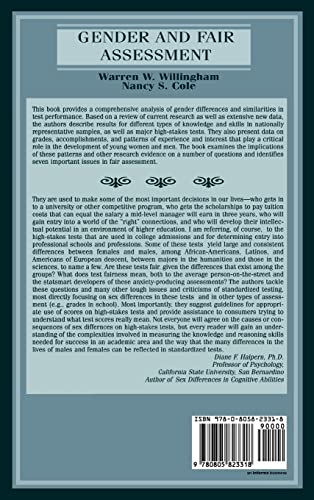
There have been many important changes in the participation of women and men in American society over the past quartercentury. Tests play a role in those changes by providing evidence of the diverse achievement and proficiency of women and men. They aid the learning process and reflect inequalities in opportunity to learn and participate. In addition, they provide useful information in considering what alternatives in education and work make most sense for individuals and influence views about groups of students, educational programs, and a wide range of issues. For all of these reasons, it is important that tests assess fairly and reflect accurately the ways young people are and are not achieving as well as desired.The test performance of women and men is a research topic of historical interest and has received much attention in recent years. Because of this increased interest, there is a great deal of new research and data available. The purpose of the study presented in this volume was to review this new information with two objectives in mind:*to clarify patterns of gender difference and similarity in test performance and related achievements, and*to see what implications those findings might have for fair assessment and, as a corollary, examine the assessment process as a possible source of gender differences.This study is interested in tests used in education to assess developed knowledge and skill. In order to gain a broader view of gender similarity and difference, the contributors looked at other types of measures and other characteristics of young women and men. Their hope is to contribute to a firmer basis for insuring fairness in testsan objective which is particularly important as the field moves increasingly to new forms of assessment in which there is less experience.
⚠️ WARNING (California Proposition 65):
This product may contain chemicals known to the State of California to cause cancer, birth defects, or other reproductive harm.
For more information, please visit www.P65Warnings.ca.gov.