If you have any questions, you are always welcome to contact us. We'll get back to you as soon as possible, withing 24 hours on weekdays.
Customer service
All questions about your order, return and delivery must be sent to our customer service team by e-mail at yourstore@yourdomain.com
Sale & Press
If you are interested in selling our products, need more information about our brand or wish to make a collaboration, please contact us at press@yourdomain.com
Help
If you have any questions, you are always welcome to contact us. We'll get back to you as soon as possible, withing 24 hours on weekdays.
Customer service
All questions about your order, return and delivery must be sent to our customer service team by e-mail at yourstore@yourdomain.com
Sale & Press
If you are interested in selling our products, need more information about our brand or wish to make a collaboration, please contact us at press@yourdomain.com
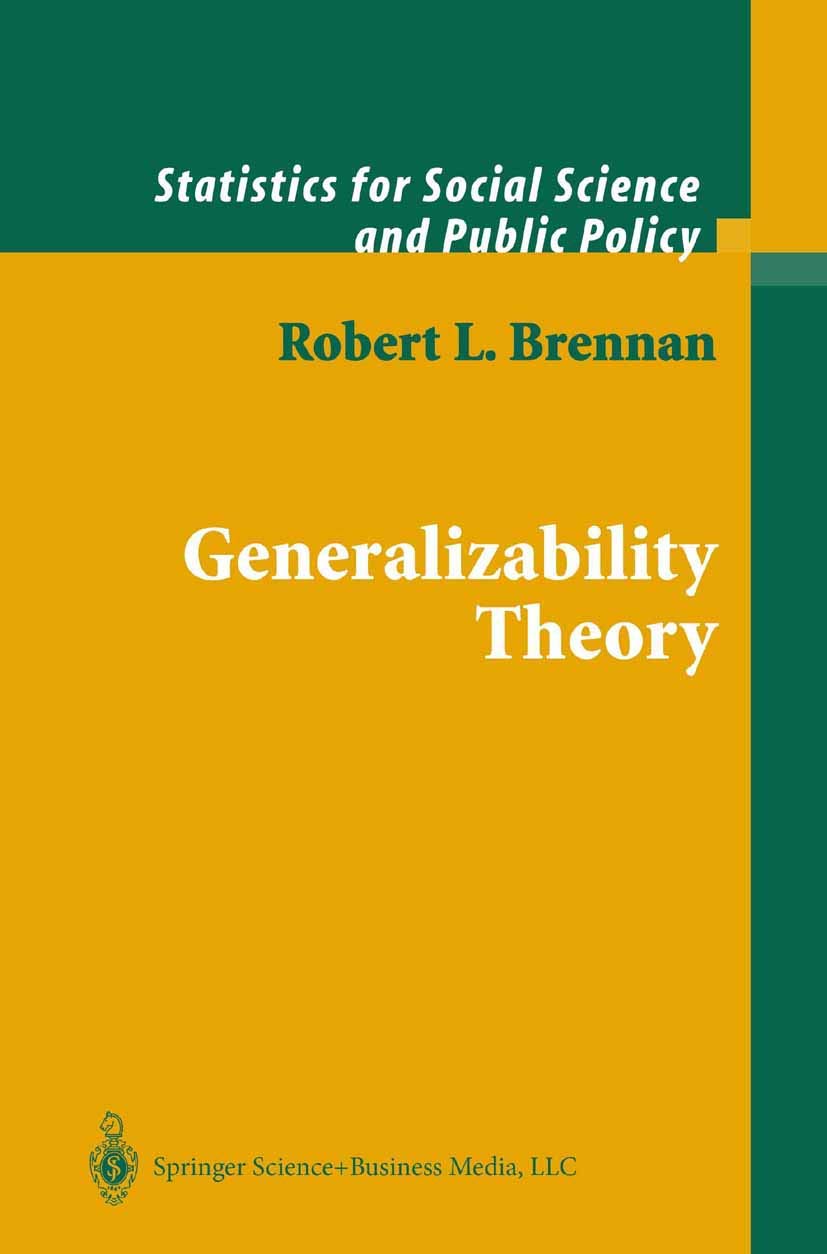
In 1972 a monograph by Cronbach, Gleser, Nanda, and Rajaratnam was published entitled The Dependability of Behavioral Measurements. That book incorporated, systematized, and extended their previous research into what came to be called generalizability theory, which liberalizes classical test theory, in part through the application of analysis of variance proce dures that focus on variance components. Generalizability theory is perhaps the most broadly defined measurement model currently in existence, and the Cronbach et al. (1972) treatment of the theory represents a major con tribution to psychometrics. However, as Cronbach et al. (1972, p. 3) state, their book is 'complexly organized and by no means simple to follow' and, of course, it is nearly 30 years old. In 1983, ACT, Inc. published my monograph entitled Elements of Gen eralizability Theory, with a slightly revised version appearing in 1992. That treatment is considerably less comprehensive than Cronbach et al. (1972) but still detailed enough to convey much ofthe richness of the theory and to facilitate its application. However, the 1983/1992 monograph is essen tially two decades old, it does not cover multivariate generalizability theory in depth, and it does not incorporate recent developments in statistics that bear upon the estimation of variance components. Also, of course, there have been numerous developments in generalizability theory in the last 20 years.
⚠️ WARNING (California Proposition 65):
This product may contain chemicals known to the State of California to cause cancer,
birth defects, or other reproductive harm.
For MAP (Minimum Advertised Price) violations and Intellectual Property (IP) or Trademark concerns, please contact:
support@ergodebooks.com
⚠️ California Proposition 65 Warning: Some products sold on this website may expose you to chemicals known to the State of California to cause cancer, birth defects, or other reproductive harm. For more information, visit www.P65Warnings.ca.gov.