
Title

Generalized Estimating Equations,Used
Sold by Ergodebooks, an authorized reseller.
Returns accepted within 30 days | support@ergodebooks.com
Shipping Information
- Free Standard Shipping — United States only
- Processing Time: 3–5 business days
- Estimated Delivery: 6–10 business days after dispatch
- Double-boxed, fully insured & discreetly packaged
- Tracking number sent via email once dispatched
Returns & Refund
Returns accepted within 30 days of delivery.
Damaged or Defective Item
Free return shipping + replacement or full refund
Wrong Item Received
Free return shipping + replacement or full refund
Change of Mind
Return shipping at customer's expense · 25% restocking fee applies
Payment Option

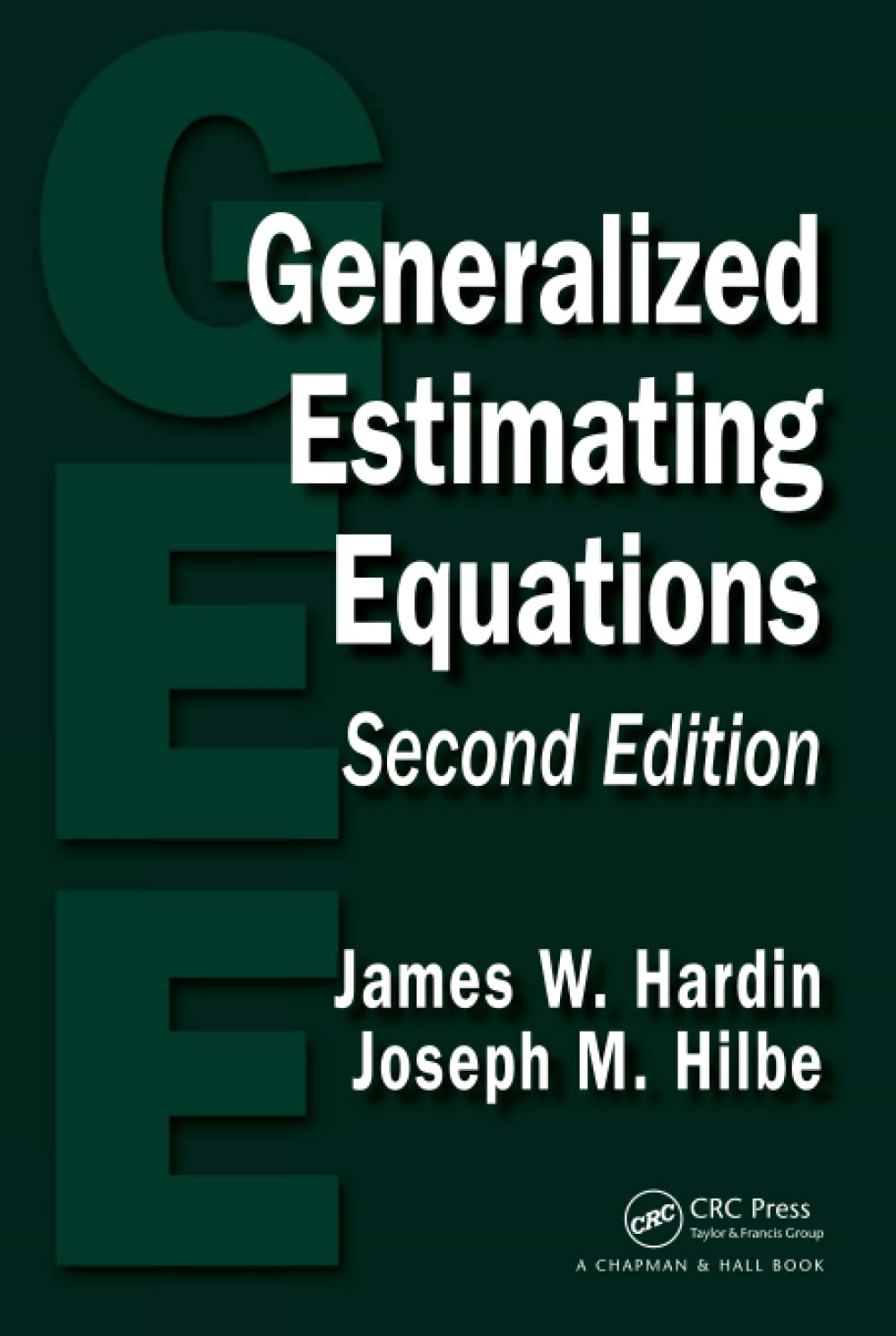
Generalized Estimating Equations, Second Edition updates the bestselling previous edition, which has been the standard text on the subject since it was published a decade ago. Combining theory and application, the text provides readers with a comprehensive discussion of GEE and related models. Numerous examples are employed throughout the text, along with the software code used to create, run, and evaluate the models being examined. Stata is used as the primary software for running and displaying modeling output; associated R code is also given to allow R users to replicate Stata examples. Specific examples of SAS usage are provided in the final chapter as well as on the books website.This second edition incorporates comments and suggestions from a variety of sources, including the Statistics.com course on longitudinal and panel models taught by the authors. Other enhancements include an examination of GEE marginal effects; a more thorough presentation of hypothesis testing and diagnostics, covering competing hierarchical models; and a more detailed examination of previously discussed subjects.Along with doubling the number of endofchapter exercises, this edition expands discussion of various models associated with GEE, such as penalized GEE, cumulative and multinomial GEE, survey GEE, and quasileast squares regression. It also offers a thoroughly new presentation of model selection procedures, including the introduction of an extension to the QIC measure that is applicable for choosing among working correlation structures.See Professor Hilbe discuss the book.
⚠️ WARNING (California Proposition 65):
This product may contain chemicals known to the State of California to cause cancer, birth defects, or other reproductive harm.
For more information, please visit www.P65Warnings.ca.gov.