If you have any questions, you are always welcome to contact us. We'll get back to you as soon as possible, withing 24 hours on weekdays.
Customer service
All questions about your order, return and delivery must be sent to our customer service team by e-mail at yourstore@yourdomain.com
Sale & Press
If you are interested in selling our products, need more information about our brand or wish to make a collaboration, please contact us at press@yourdomain.com
Help
If you have any questions, you are always welcome to contact us. We'll get back to you as soon as possible, withing 24 hours on weekdays.
Customer service
All questions about your order, return and delivery must be sent to our customer service team by e-mail at yourstore@yourdomain.com
Sale & Press
If you are interested in selling our products, need more information about our brand or wish to make a collaboration, please contact us at press@yourdomain.com
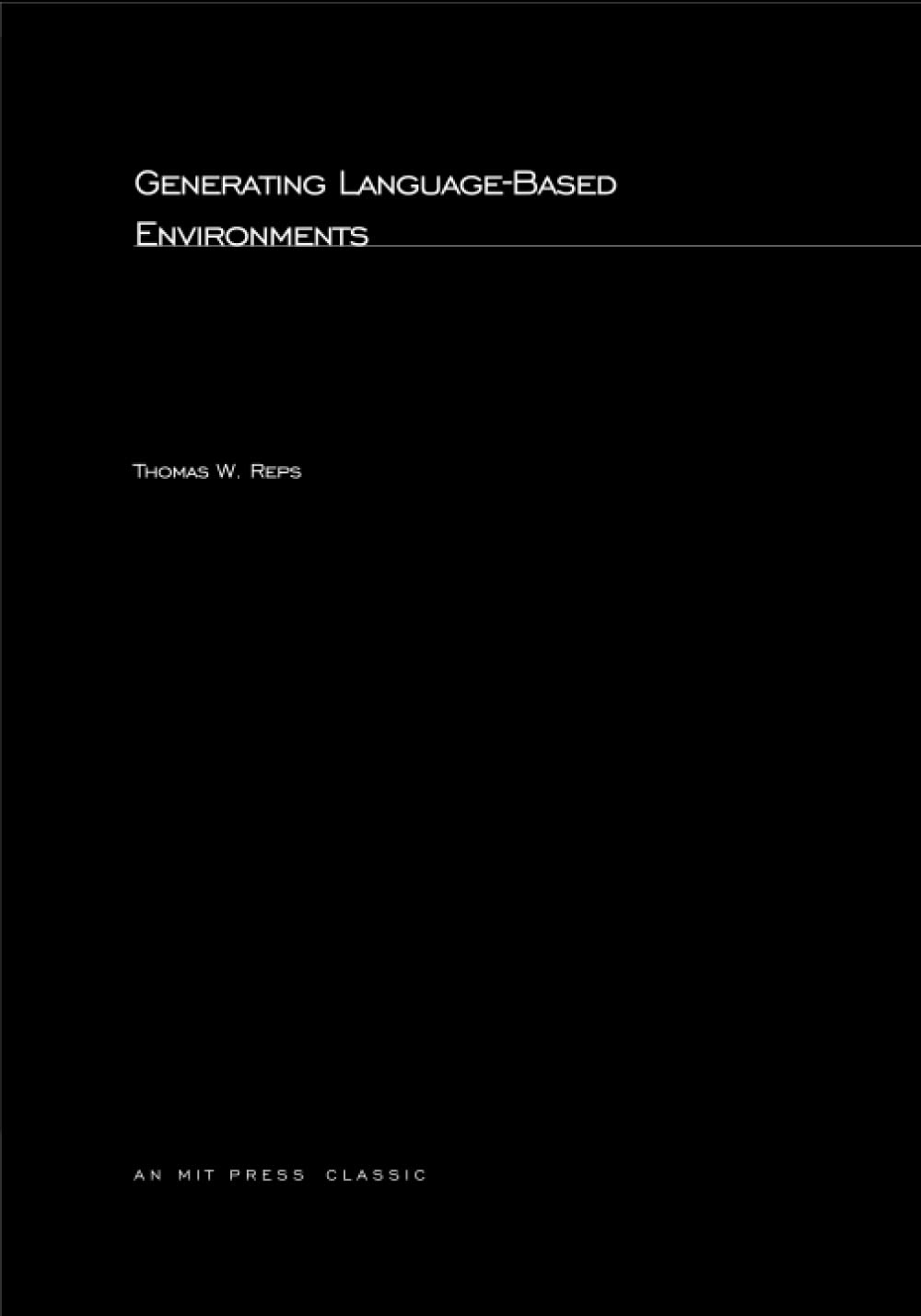
This book addresses a fundamental software engineering issue, applying formal techniques and rigorous analysis to a practical problem of great current interest: the incorporation of languagespecific knowledge in interactive programming environments. It makes a basic contribution in this area by proposing an attributegrammar framework for incremental semantic analysis and establishing its algorithmic foundations. The results are theoretically important while having immediate practical utility for implementing environmentgenerating systems. The book's principal technical results include: an optimaltime algorithm to incrementally maintain a consistent attributedtree of attribute grammar subclasses, allowing an optimizing environmentgenerator to select the most efficient applicable algorithm; a general method for sharing storage among attributes whose values are complex data structures; and two algorithms that carry out attribute evaluation while reducing the number of intermediate attribute values retained. While others have worked on this last problem, Reps's algorithms are the first to achieve sublinear worstcase behavior. One algorithm is optimal, achieving the log n lower space bound in nonlinear time, while the second algorithm uses as much as root n. space but runs in linear time.
⚠️ WARNING (California Proposition 65):
This product may contain chemicals known to the State of California to cause cancer,
birth defects, or other reproductive harm.
For MAP (Minimum Advertised Price) violations and Intellectual Property (IP) or Trademark concerns, please contact:
support@ergodebooks.com
⚠️ California Proposition 65 Warning: Some products sold on this website may expose you to chemicals known to the State of California to cause cancer, birth defects, or other reproductive harm. For more information, visit www.P65Warnings.ca.gov.