If you have any questions, you are always welcome to contact us. We'll get back to you as soon as possible, withing 24 hours on weekdays.
Customer service
All questions about your order, return and delivery must be sent to our customer service team by e-mail at yourstore@yourdomain.com
Sale & Press
If you are interested in selling our products, need more information about our brand or wish to make a collaboration, please contact us at press@yourdomain.com
Help
If you have any questions, you are always welcome to contact us. We'll get back to you as soon as possible, withing 24 hours on weekdays.
Customer service
All questions about your order, return and delivery must be sent to our customer service team by e-mail at yourstore@yourdomain.com
Sale & Press
If you are interested in selling our products, need more information about our brand or wish to make a collaboration, please contact us at press@yourdomain.com
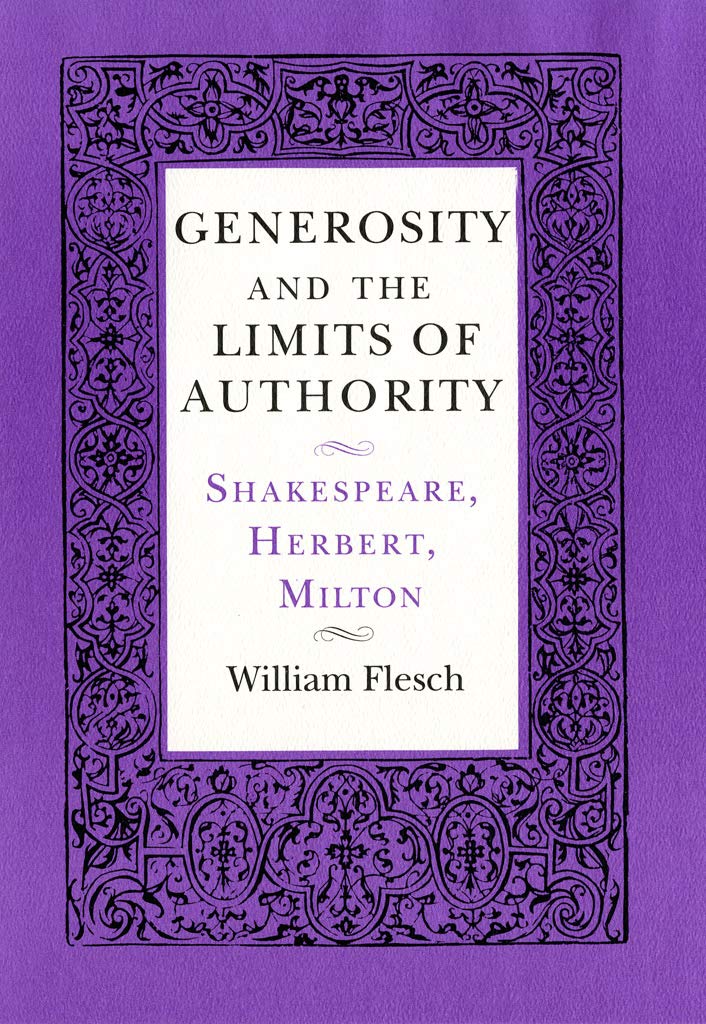
Generosity is an ambiguous quality, William Flesch observes; while receiving gifts is pleasant, giftgiving both displays the wealth and strength of the giver and places the receiver under an obligation. In provocative new readings of Shakespeare, Herbert, and Milton, Flesch illuminates the personal authority that is bound inextricably with acts of generosity.Drawing on the work of such theorists as Mauss, Blanchot, Bourdieu, Wittgenstein, Bloom, Cavell, and Greenblatt, Flesch maintains that the literary power of Shakespeare, Herbert, and Milton is at its most intense when they are exploring the limits of generosity. He considers how in Herbert's Temple divine assurance of the possibility of redemption is put into question and how the poet approaches such a gift with the ambivalence of a beneficiary. In his readings of Shakespeare's Richard II, Henry IV, King Lear, Antony and Cleopatra, and the sonnets, Flesch examines the perspective of the benefactorincluding Shakespeare himselfwho confronts the decline of his capacity to give. Turning to Milton's Paradise Lost, Flesch identifies two opposing ways of understanding generositySatan's, on the one hand, and Adam and Eve's, on the other and elaborates the different conceptions of poetry to which these understandings give rise.Scholars of Shakespeare and of Renaissance culture, Miltonists, literary theorists, and others interested in the relationship between philosophy and literature will want to read this insightful and challenging book.
⚠️ WARNING (California Proposition 65):
This product may contain chemicals known to the State of California to cause cancer,
birth defects, or other reproductive harm.
For MAP (Minimum Advertised Price) violations and Intellectual Property (IP) or Trademark concerns, please contact:
support@ergodebooks.com
⚠️ California Proposition 65 Warning: Some products sold on this website may expose you to chemicals known to the State of California to cause cancer, birth defects, or other reproductive harm. For more information, visit www.P65Warnings.ca.gov.