If you have any questions, you are always welcome to contact us. We'll get back to you as soon as possible, withing 24 hours on weekdays.
Customer service
All questions about your order, return and delivery must be sent to our customer service team by e-mail at yourstore@yourdomain.com
Sale & Press
If you are interested in selling our products, need more information about our brand or wish to make a collaboration, please contact us at press@yourdomain.com
Help
If you have any questions, you are always welcome to contact us. We'll get back to you as soon as possible, withing 24 hours on weekdays.
Customer service
All questions about your order, return and delivery must be sent to our customer service team by e-mail at yourstore@yourdomain.com
Sale & Press
If you are interested in selling our products, need more information about our brand or wish to make a collaboration, please contact us at press@yourdomain.com
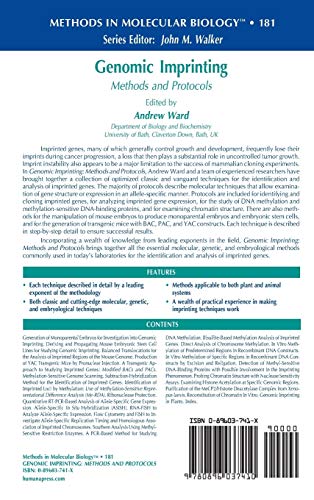
Genomic imprinting is the process by which gene activity is regulated according to parent of origin. Usually, this means that either the maternally inherited or the paternally inherited allele of a gene is expressed while the opposite allele is repressed. The phenomenon is largely restricted to mammals and flowering plants and was first recognized at the level of whole genomes. Nuclear transplantation experiments carried out in mice in the late 1970s established the nonequivalence of the maternal and paternal genomes in mammals, and a similar conclusion was drawn from studies of interploidy crosses of flowering plants that extend back to at least the 1930s. Further mouse genetic studies, involving animals carrying balanced translocations (reviewed in Chapter 3), indicated that imprinted genes were likely to be widely scattered and would form a minority within the mammalian genome. The first imprinted genes were identified in the early 1990s; over forty are now known in mammals and the list continues steadily to expand.
⚠️ WARNING (California Proposition 65):
This product may contain chemicals known to the State of California to cause cancer,
birth defects, or other reproductive harm.
For MAP (Minimum Advertised Price) violations and Intellectual Property (IP) or Trademark concerns, please contact:
support@ergodebooks.com
⚠️ California Proposition 65 Warning: Some products sold on this website may expose you to chemicals known to the State of California to cause cancer, birth defects, or other reproductive harm. For more information, visit www.P65Warnings.ca.gov.