
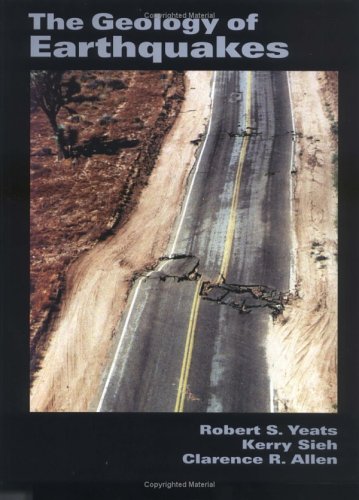
Title
Geology of Earthquakes,Used
Sold by Ergodebooks, an authorized reseller.
Returns accepted within 30 days | support@ergodebooks.com
Shipping Information
- Free Standard Shipping — United States only
- Processing Time: 3–5 business days
- Estimated Delivery: 6–10 business days after dispatch
- Double-boxed, fully insured & discreetly packaged
- Tracking number sent via email once dispatched
Returns & Refund
Returns accepted within 30 days of delivery.
Damaged or Defective Item
Free return shipping + replacement or full refund
Wrong Item Received
Free return shipping + replacement or full refund
Change of Mind
Return shipping at customer's expense · 25% restocking fee applies
Payment Option

The first modern treatment of purposes, methods, and principles of the geological investigation of earthquakes draws upon examples from many seismically active regions of the globe, including China, Japan, the Mediterranean countries, the U.S., and New Zealand. The Geology of Earthquakes will be useful to engineers, geophysicists, and planners, in addition to geologists, and will be an aid to the geotechnical community as well as to graduate and advanced undergraduate students. The first several chapters of the book include introductions to plate tectonics, structural geology, seismic waves, geodesy, Quaternary geochronological methods, and tectonic geomorphology. These serve as a common interdisciplinary background for the second half of the text, which divides the discussion of earthquakes according to tectonic environment: strikeslip, divergent, and convergent. Earthquake environments from the globe are amply illustrated with photographs, maps, and cross sections. Case histories of recent, wellstudied earthquakes demonstrate the interdisciplinary nature of earthquake science. Personal vignettes of early pioneers such as Charles Darwin, G.K. Gilbert, Bunjiro Koto, and Alexander McKay illustrate early historical milestones in earthquake geology. The final chapters of the book are devoted to secondary effects such as liquefaction, seismically induced landslides and tsunamis, and to the use of earthquake geology in earthquake hazard assessment. A glossary of terms, an extensive bibliography, and a comprehensive reference table of more than 300 historical earthquakes accompanied by surface faulting appear at the end of the text.
⚠️ WARNING (California Proposition 65):
This product may contain chemicals known to the State of California to cause cancer, birth defects, or other reproductive harm.
For more information, please visit www.P65Warnings.ca.gov.